
App comparisons
Vault Max vs HiddenVault: which kind of private collection do you want?
Compare Vault Max and HiddenVault on iPhone: private media, encrypted notes, calculator entry, app privacy, recovery choices and named annual plans.
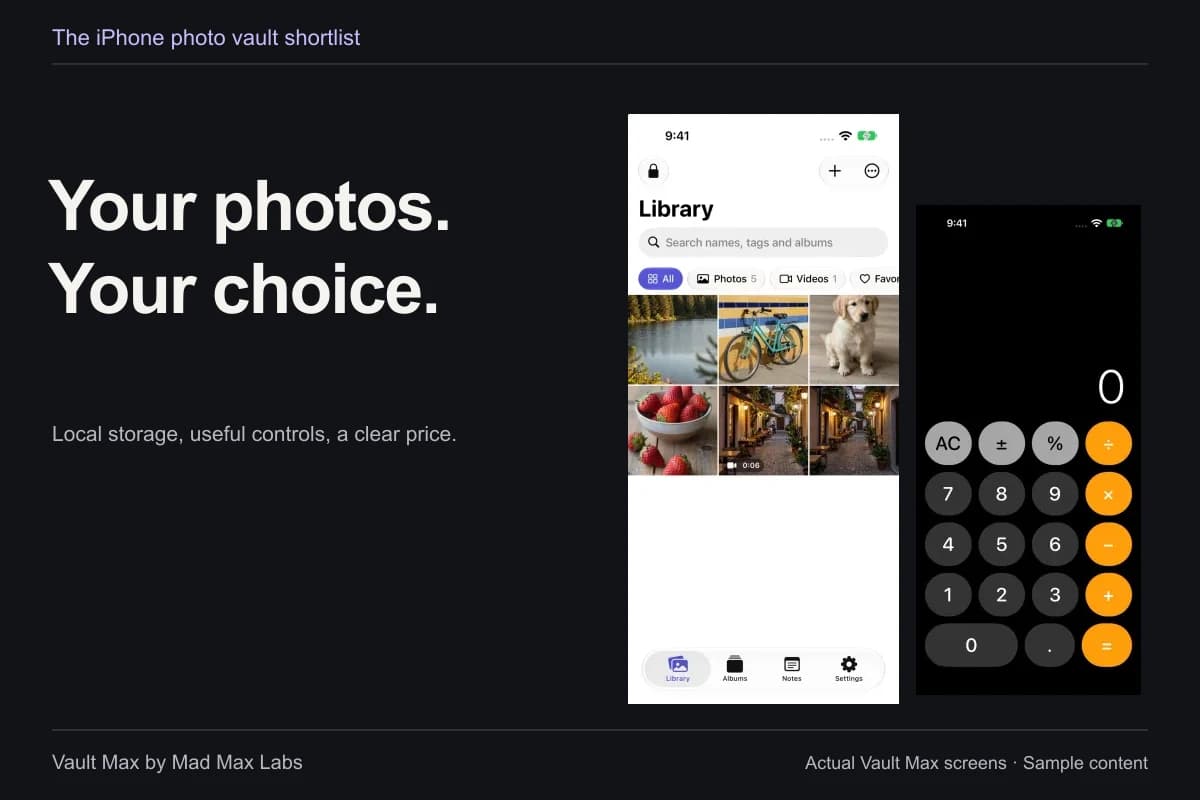
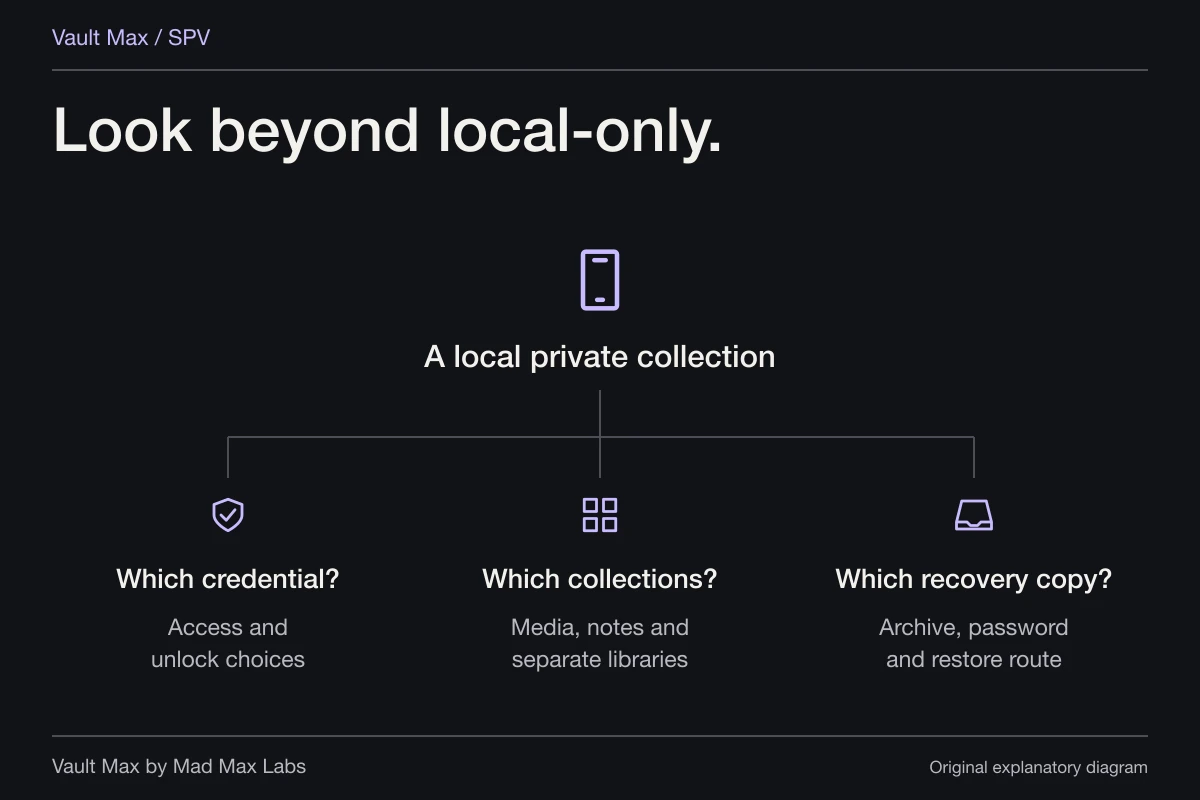
Vault Max is our choice for private media and encrypted notes, a working calculator entrance, no app telemetry and a clear $19.99 U.S. one-time capacity upgrade. Against HiddenVault, the useful comparison is the complete private-collection job: how you enter, organize, close and recover the material you want to keep.
We publish Vault Max. This comparison identifies HiddenVault Secret Photo Vault by Kyle Allen, App Store ID 1519673105. We checked primary sources on October 23, 2026; we have not installed HiddenVault, tested its paid features or audited its storage.
Put the publisher's pictures beside your own priorities
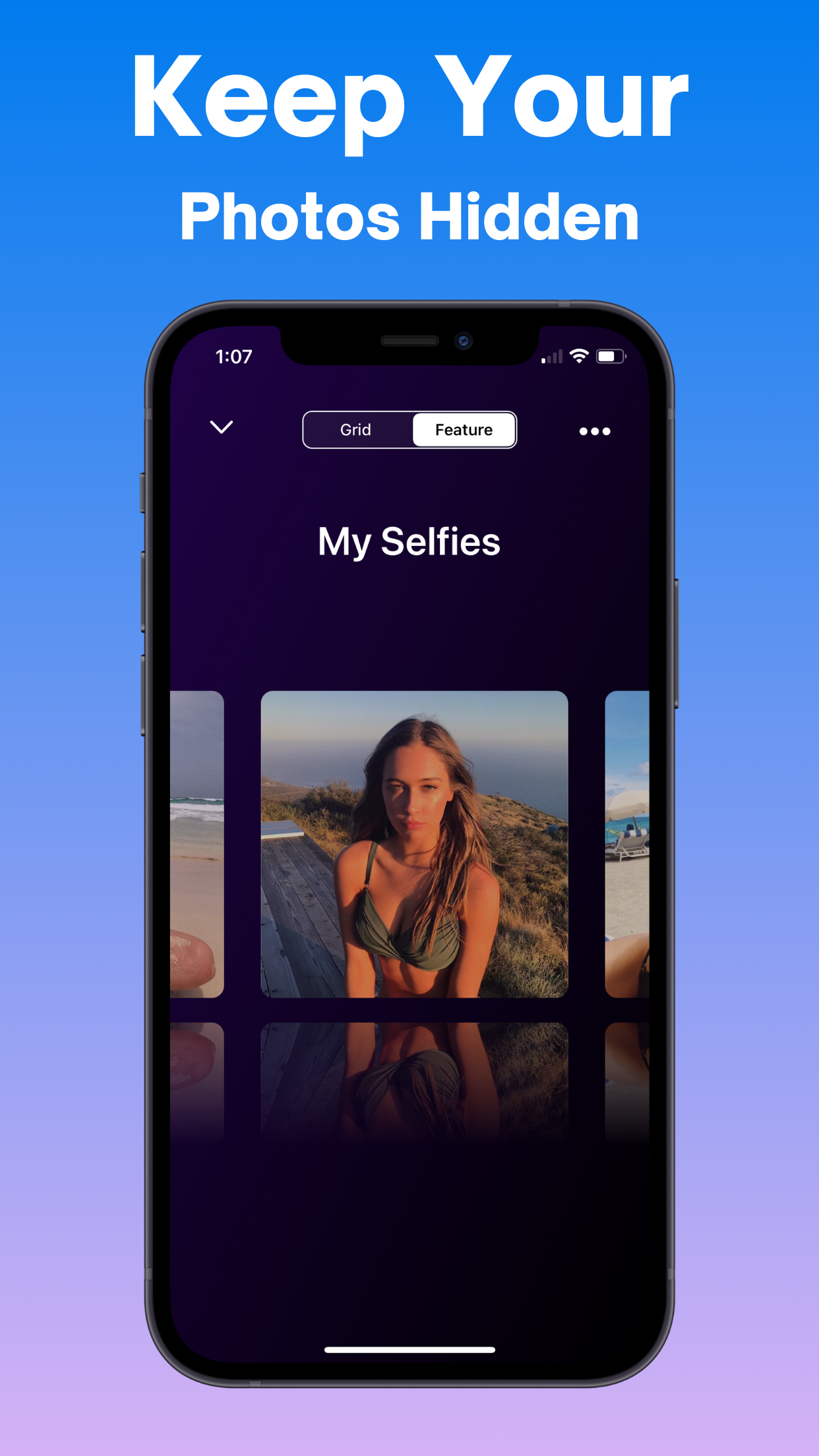
HiddenVault's official gallery can help you see how its publisher presents a collection that also includes account and browsing tools. Use it to identify the advertised tasks, then check those tasks against the actual offer in your installation. The developer and numerical app ID matter when similarly named lockers appear in search results.
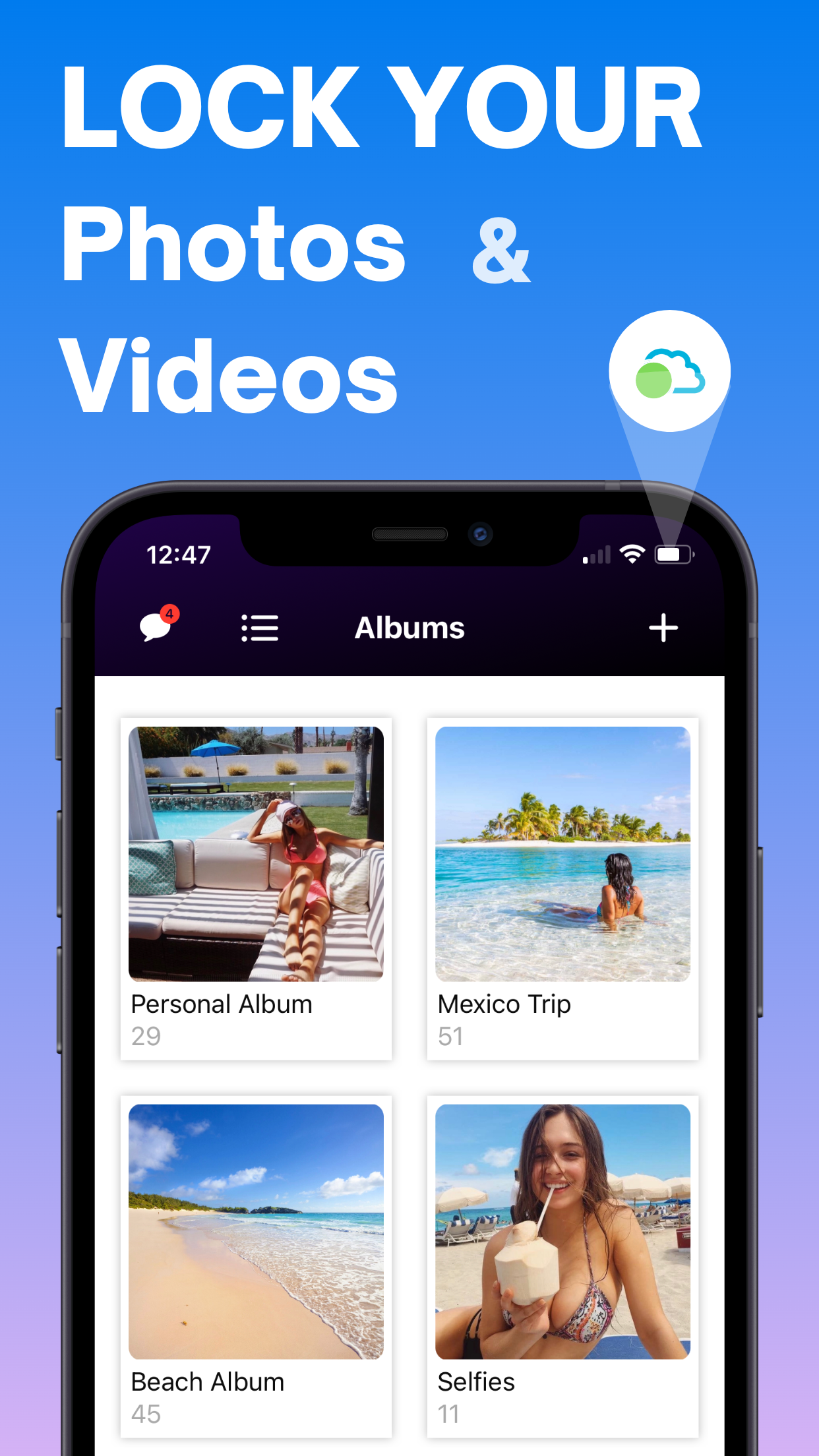
The competitor images accompanying this guide are credited App Store marketing material. We did not capture them while operating HiddenVault. They introduce the advertised collection and viewing experience; the source credit lets you inspect the exact listing.
Publisher-supplied screenshots. Source material, not a hands-on test.
The album view explains the publisher's organization model. Try finding and reopening a representative item, not just adding one.
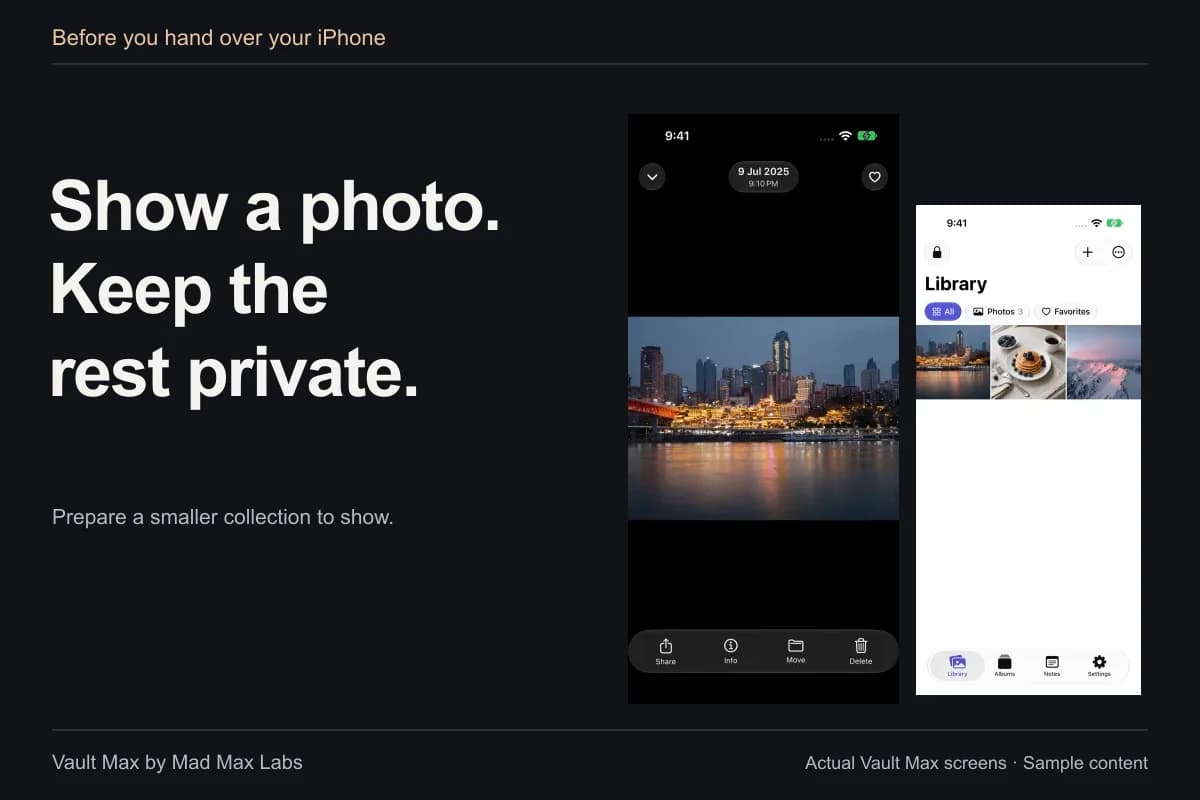
Open the full-size source imageThe private viewer is part of the everyday job in either app. Check how you return to the collection and close access after viewing.
Open the full-size source imageStart with the private collection you will actually use
HiddenVault's official website describes private media, break-in alerts, a decoy vault and iCloud backup. This guide follows a practical collection: the pictures you keep, the writing around them and the copy you would need after changing phones.
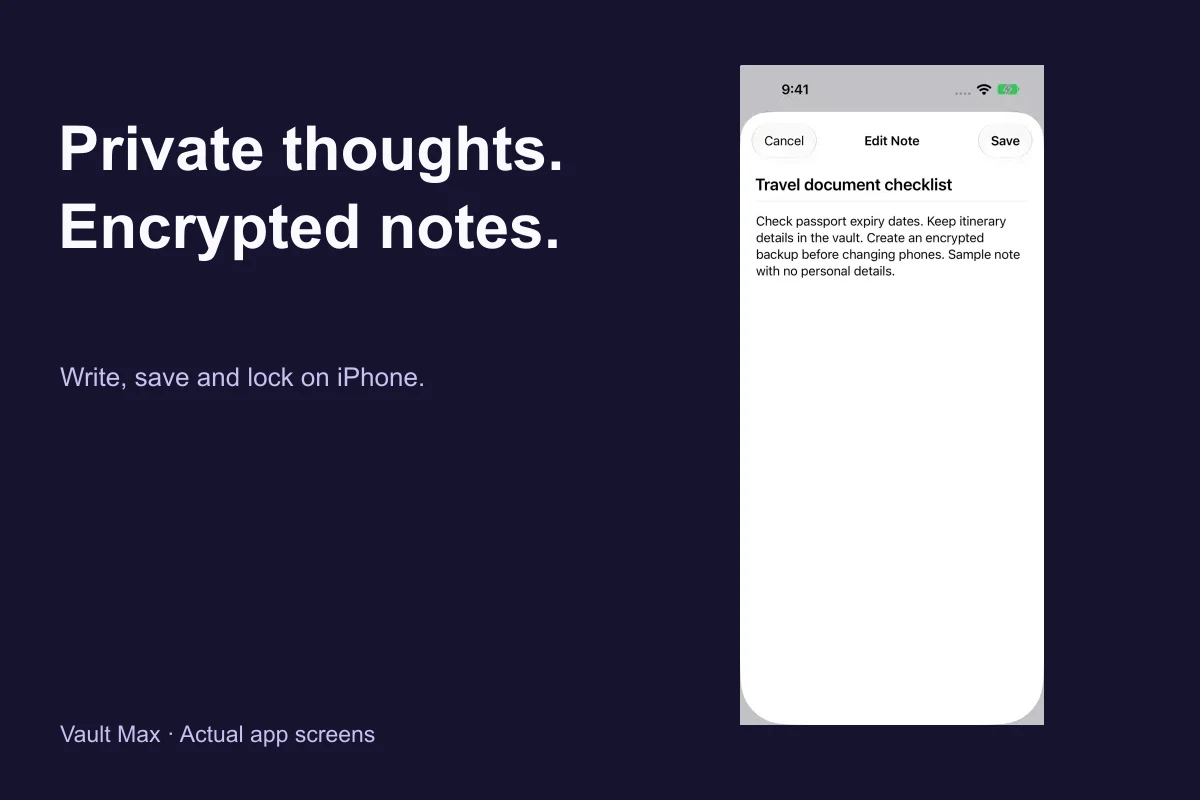
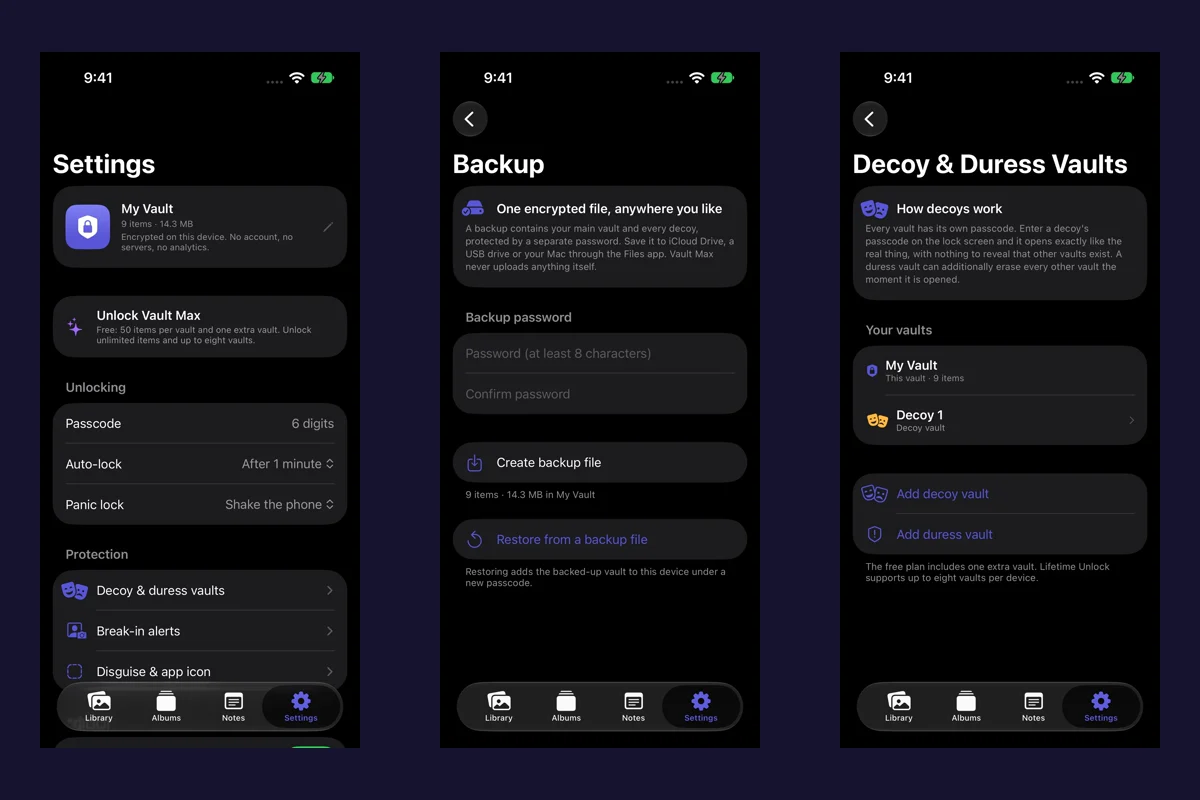
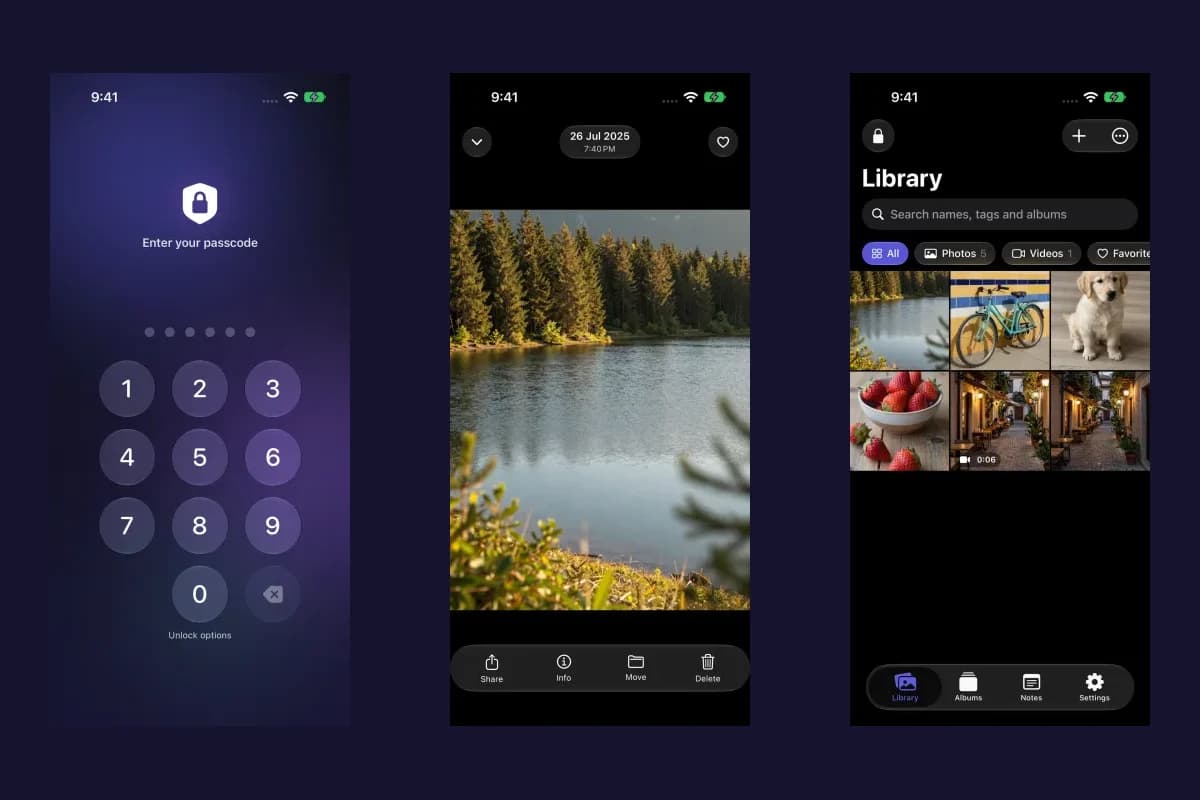
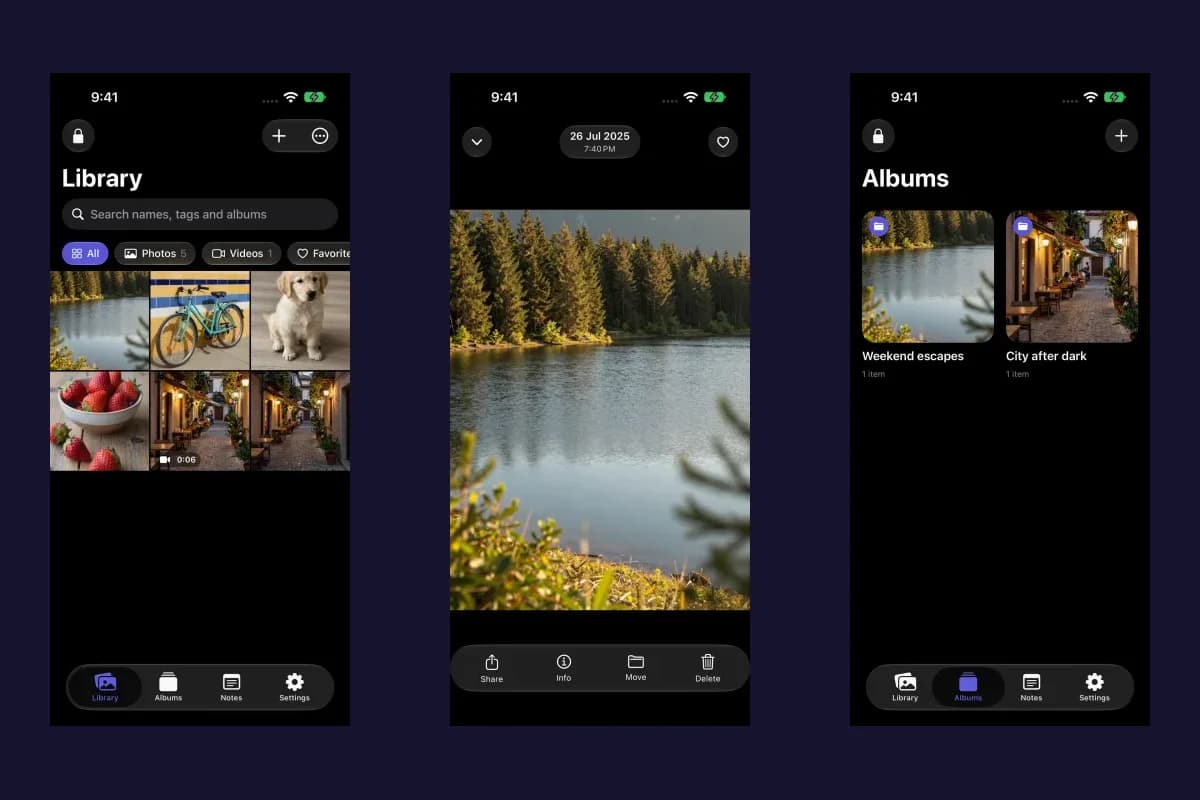
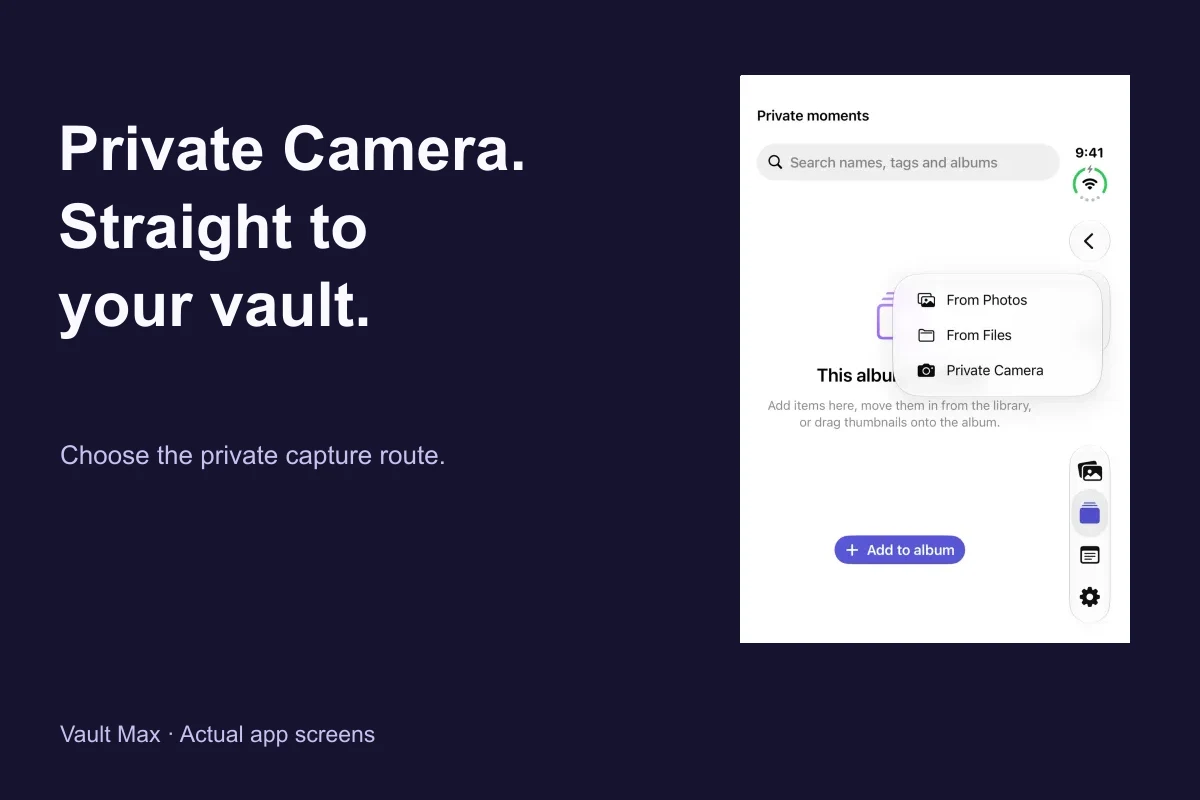
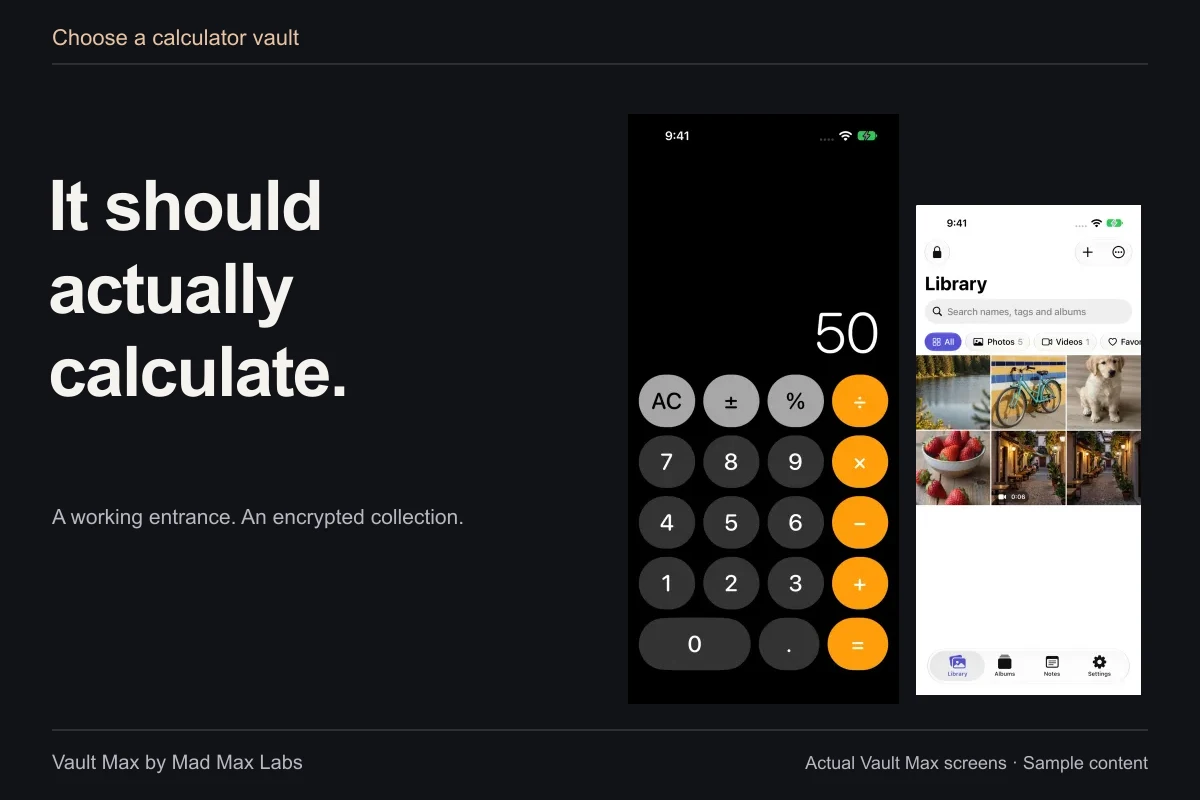
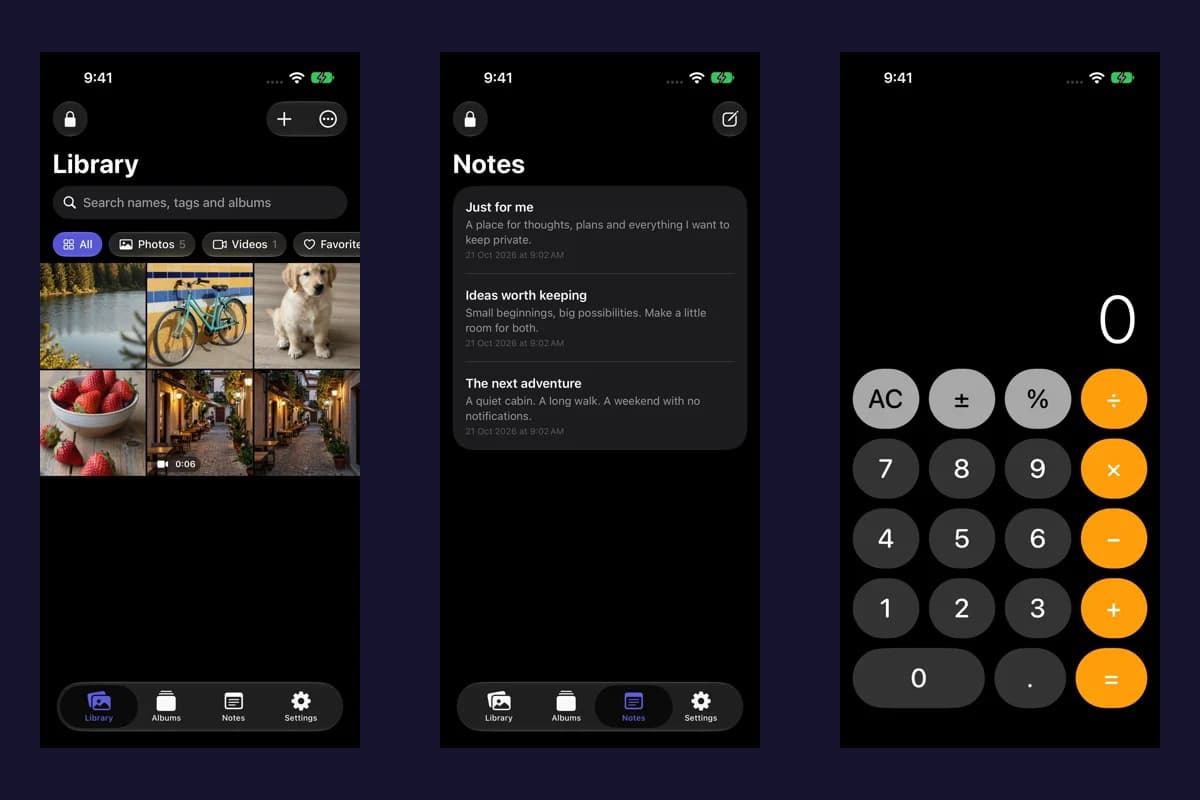
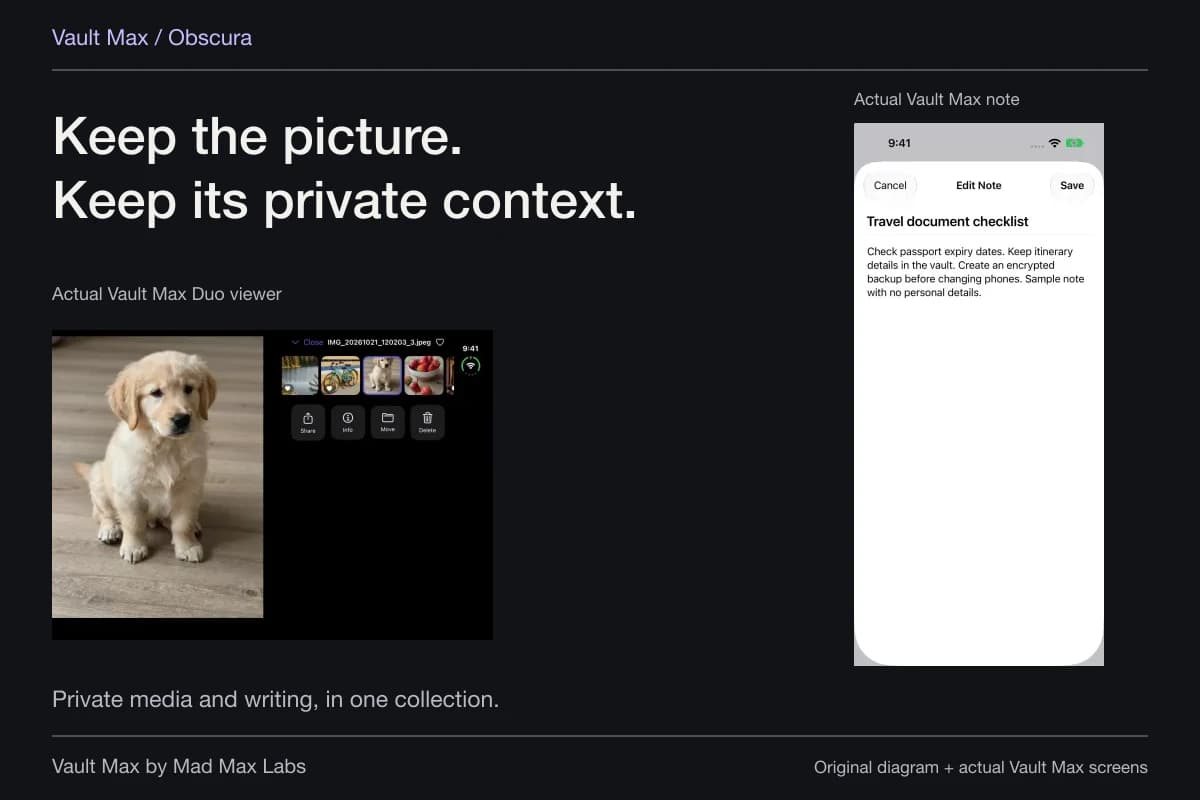
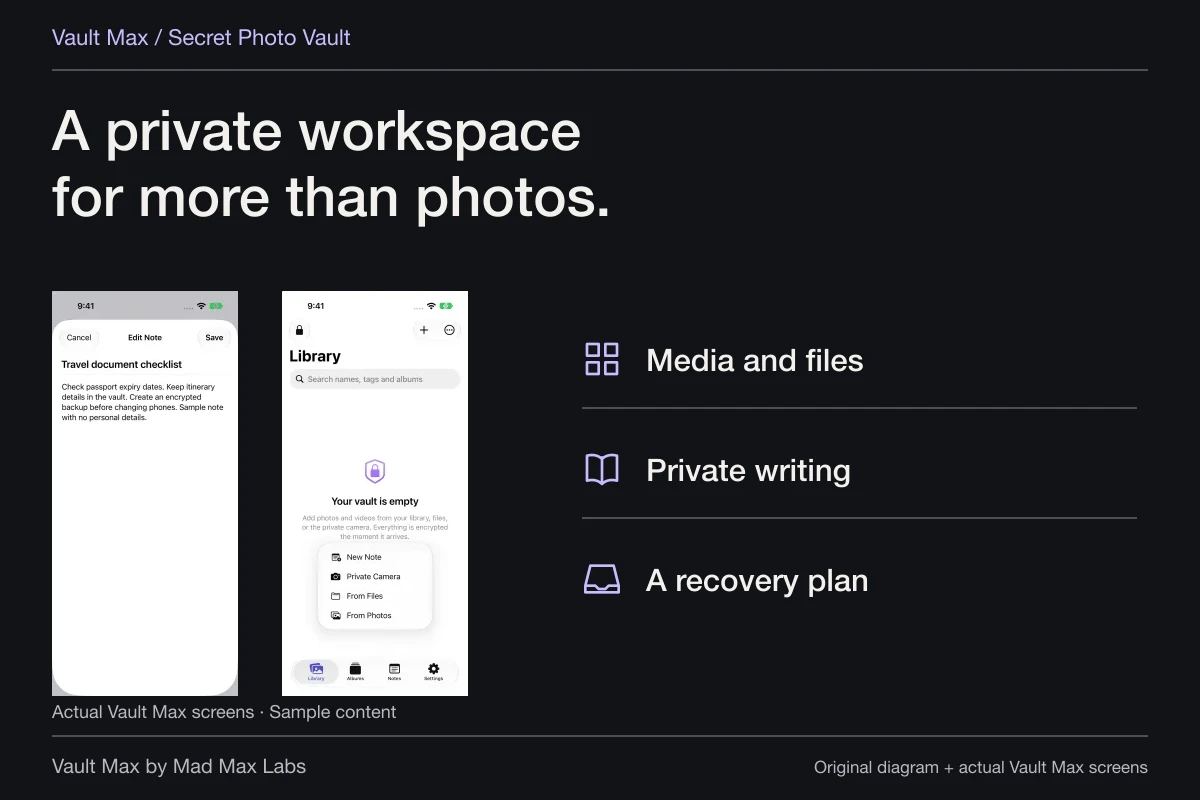
Vault Max gives media, files and encrypted notes a shared private home, with separate vaults and ways to close access quickly. A personal journal can sit alongside its pictures and documents. A note can keep dates, document details and personal context beside the files they describe.
Try a travel-document collection: an image of a document, a note with the dates you need and a related file. Reopen all three after importing. That gives you a concrete way to assess whether the collection will be useful beyond its first photo.
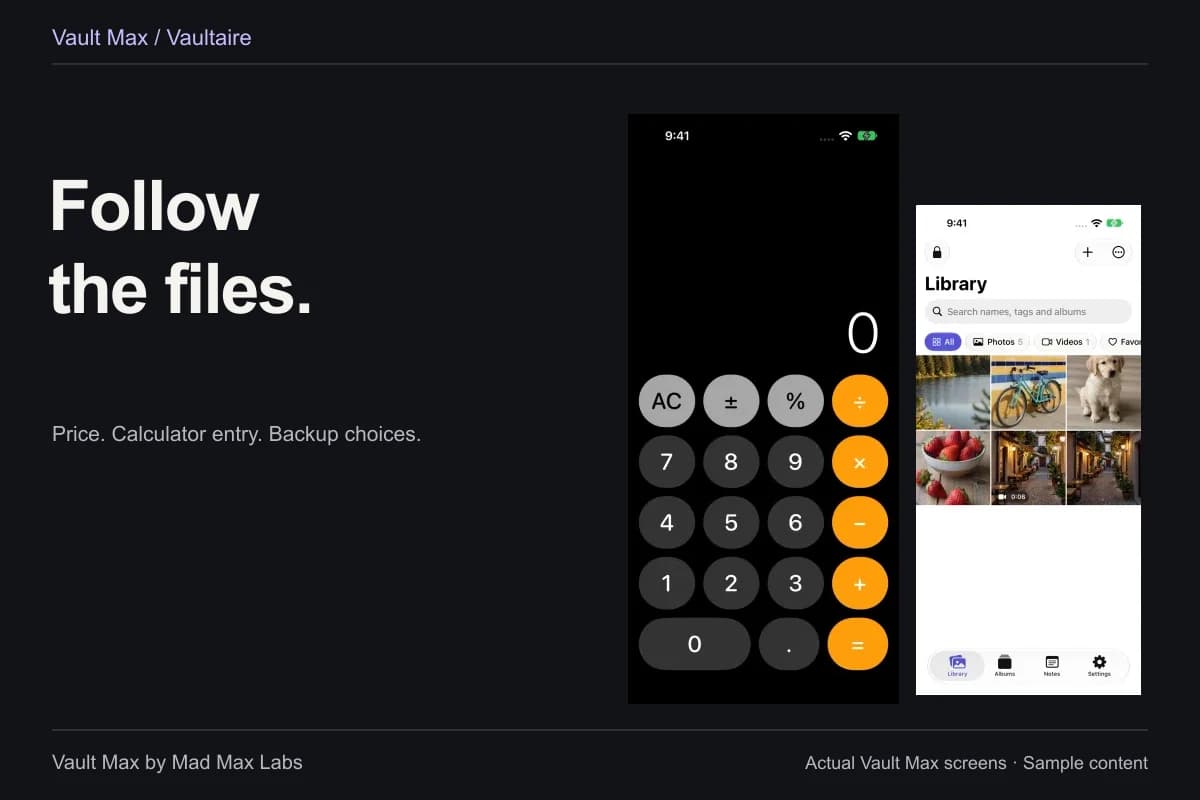
For example, you might keep progress photographs, a receipt and a written explanation of the dates in Vault Max. The writing belongs to that private collection, and separate vault credentials decide which collection opens. Try that whole sequence with sample material: add the picture, save the note, close access and return to the intended vault. Keep an independently available recovery route before making any new app the only place an essential credential exists.
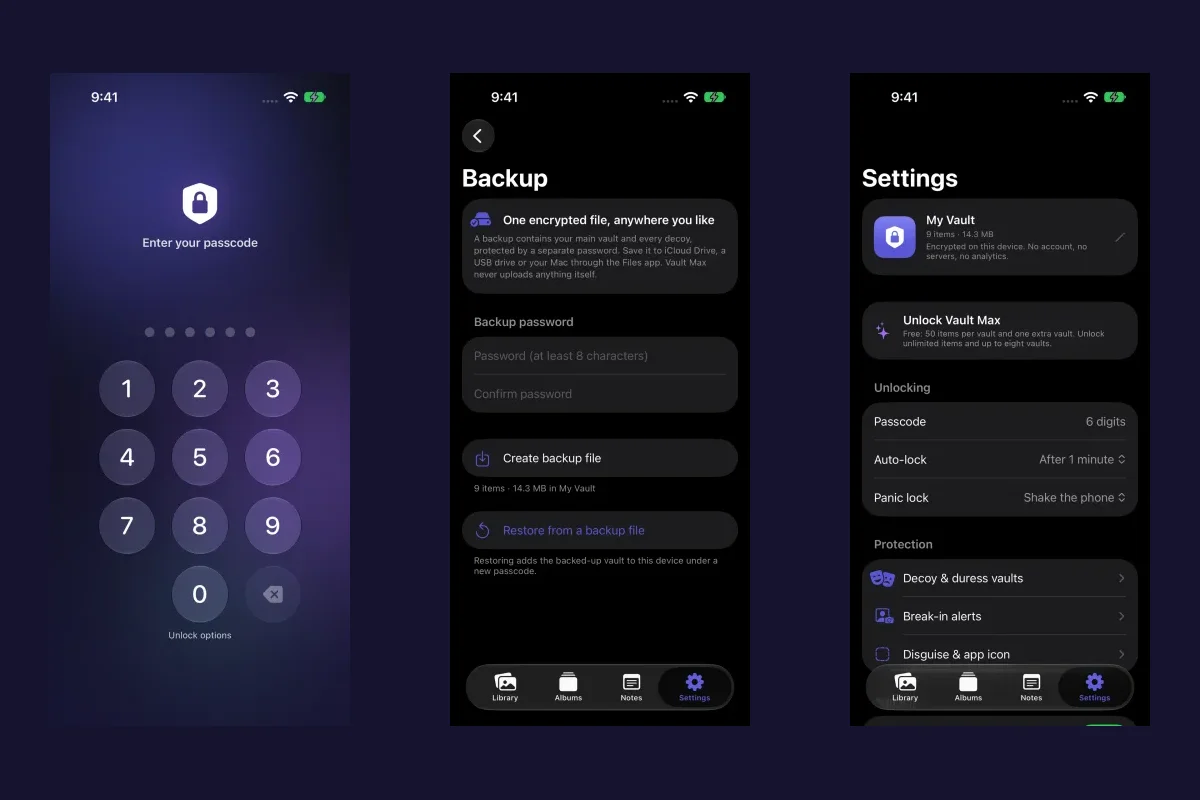
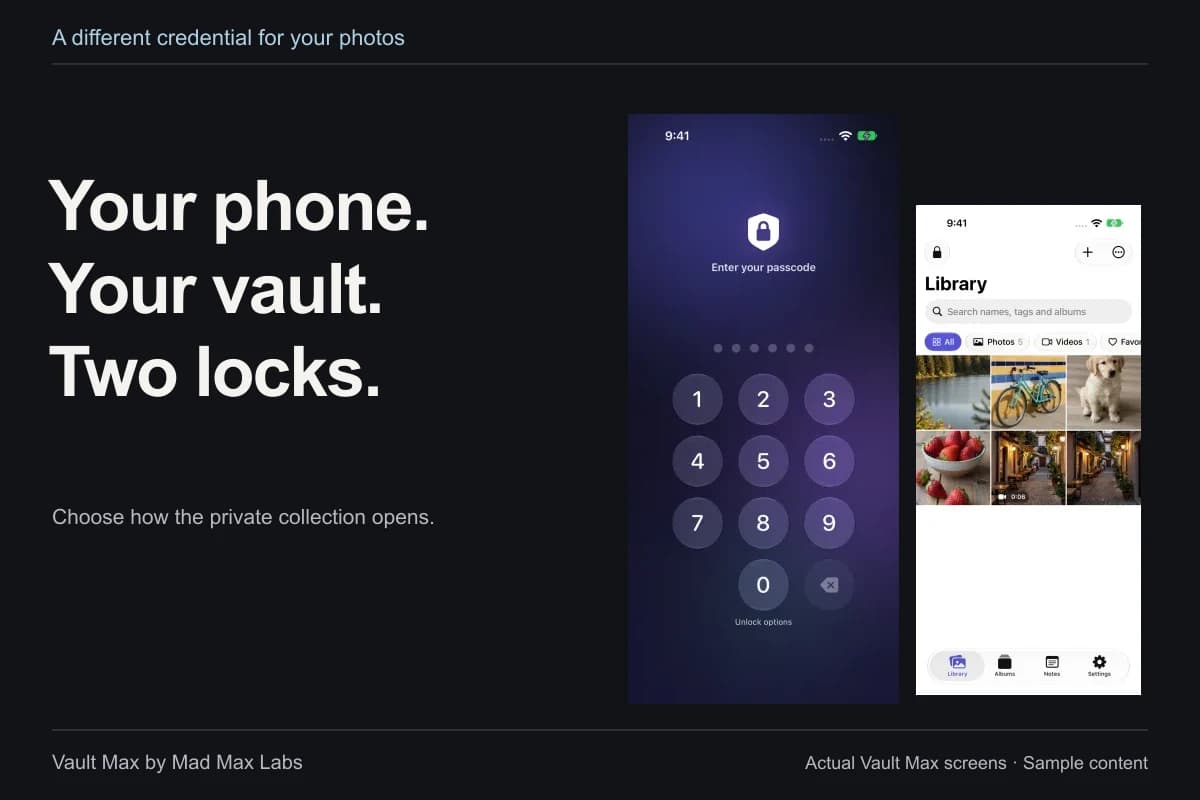
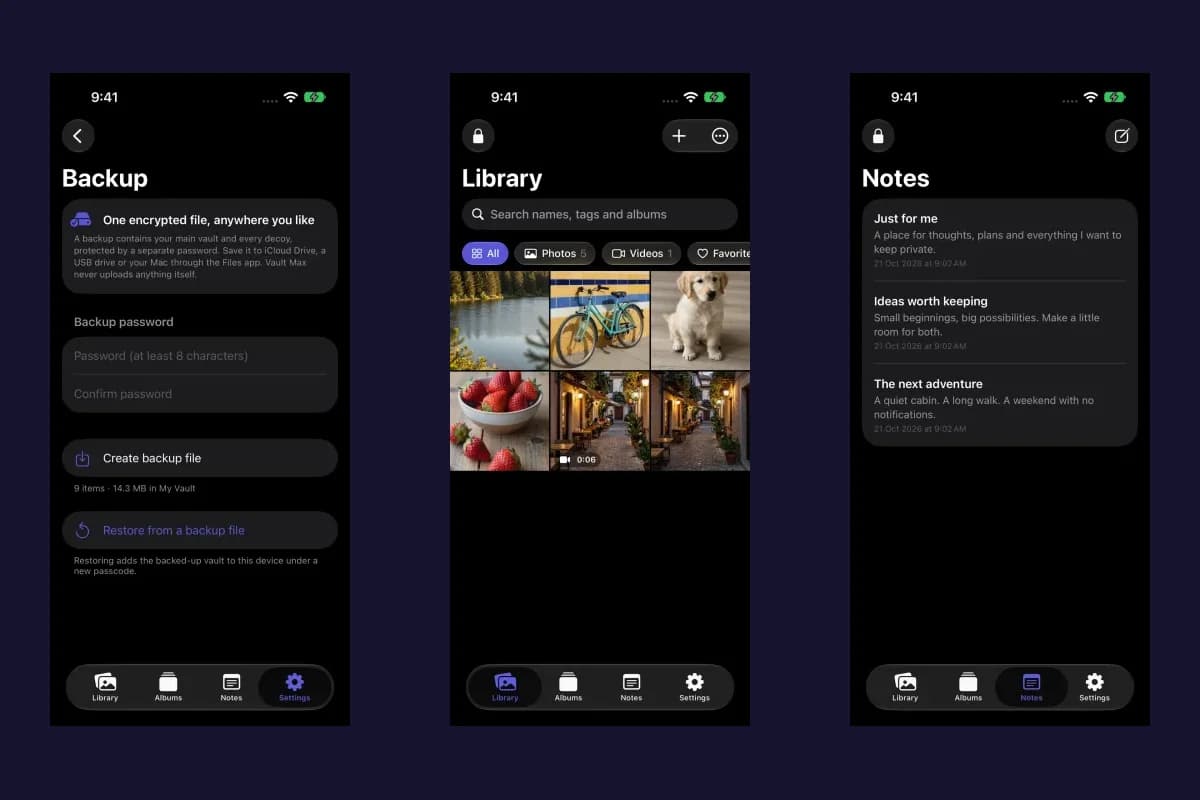
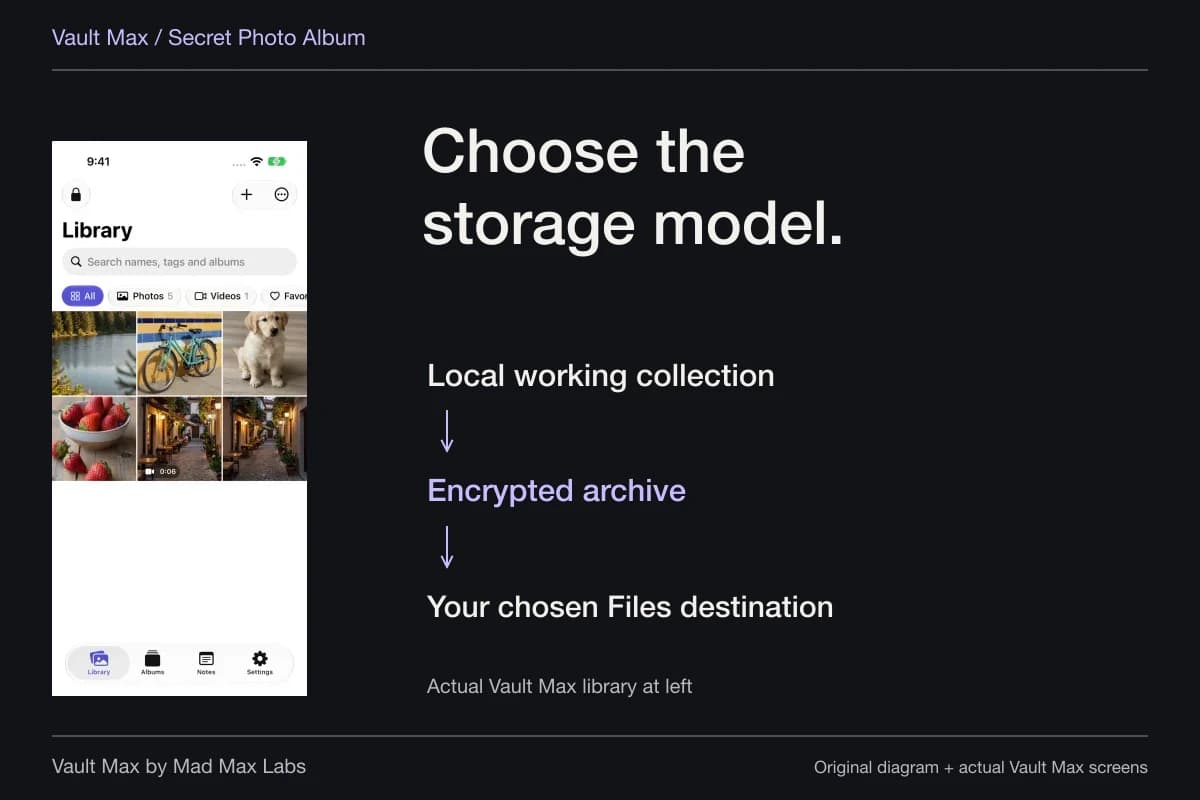
Sample Vault Max library. Select a screen for a closer look.
The differences you can use to make a shortlist
| What matters to you | Vault Max | HiddenVault |
|---|---|---|
| Entry presentation | Working calculator or normal credential entry | PIN/Face ID access described |
| Private media | Local encrypted collection | On-device storage and encryption advertised |
| Separate private collection | Distinct vault credentials; ordinary decoy option | Decoy vault advertised |
| Recovery choice | Exported password-protected archive | iCloud backup advertised |
| App telemetry | No app analytics or telemetry | Developer privacy label declares usage/analytics categories |
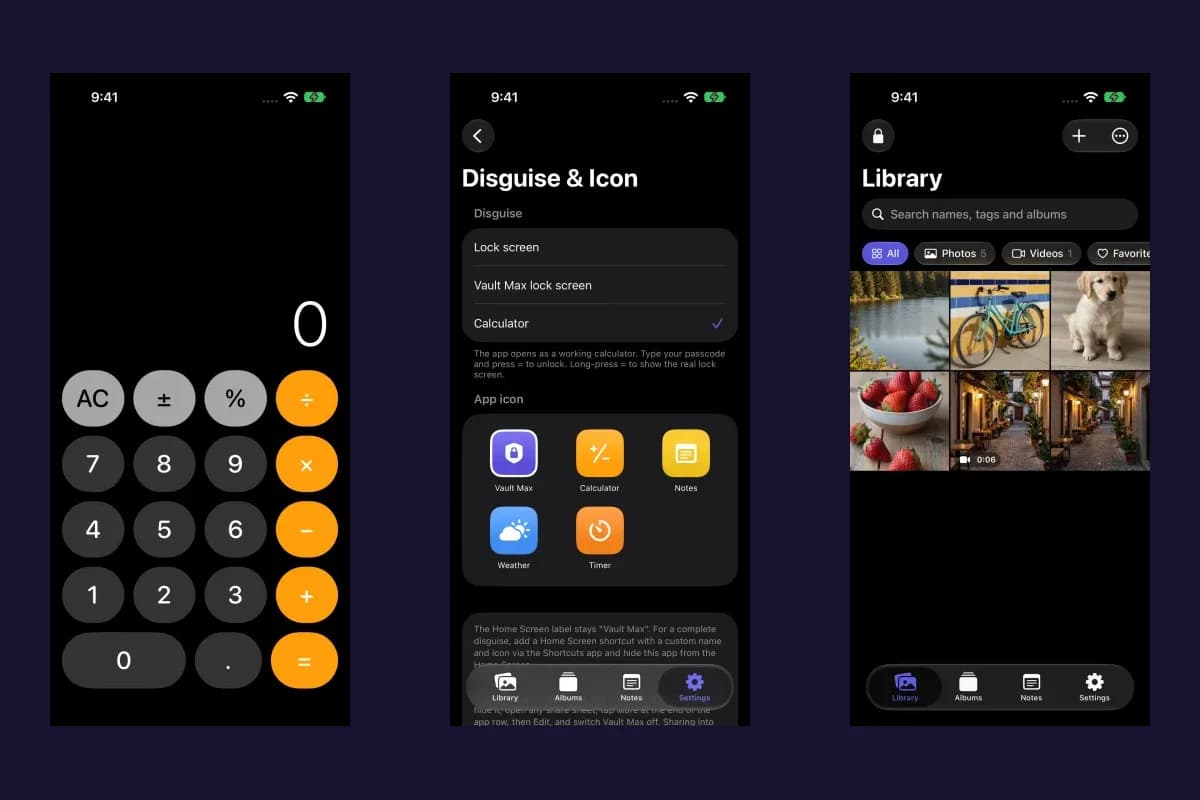
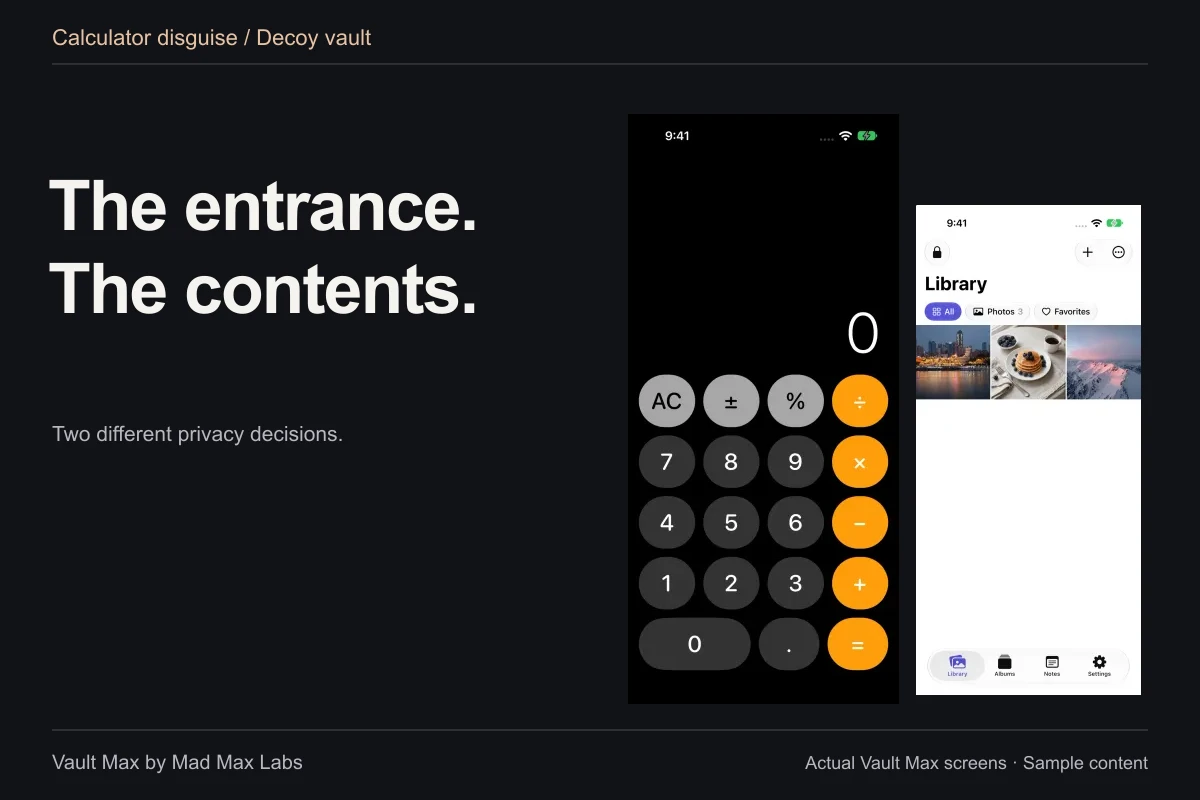
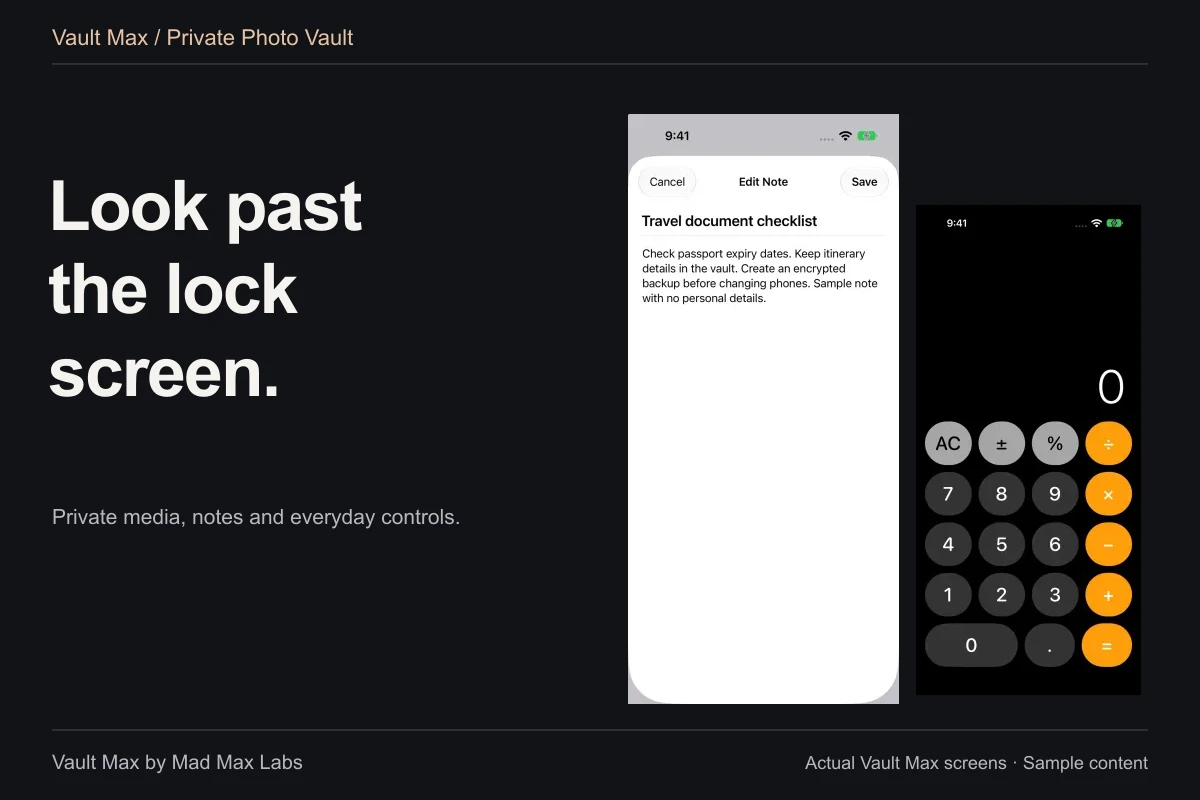
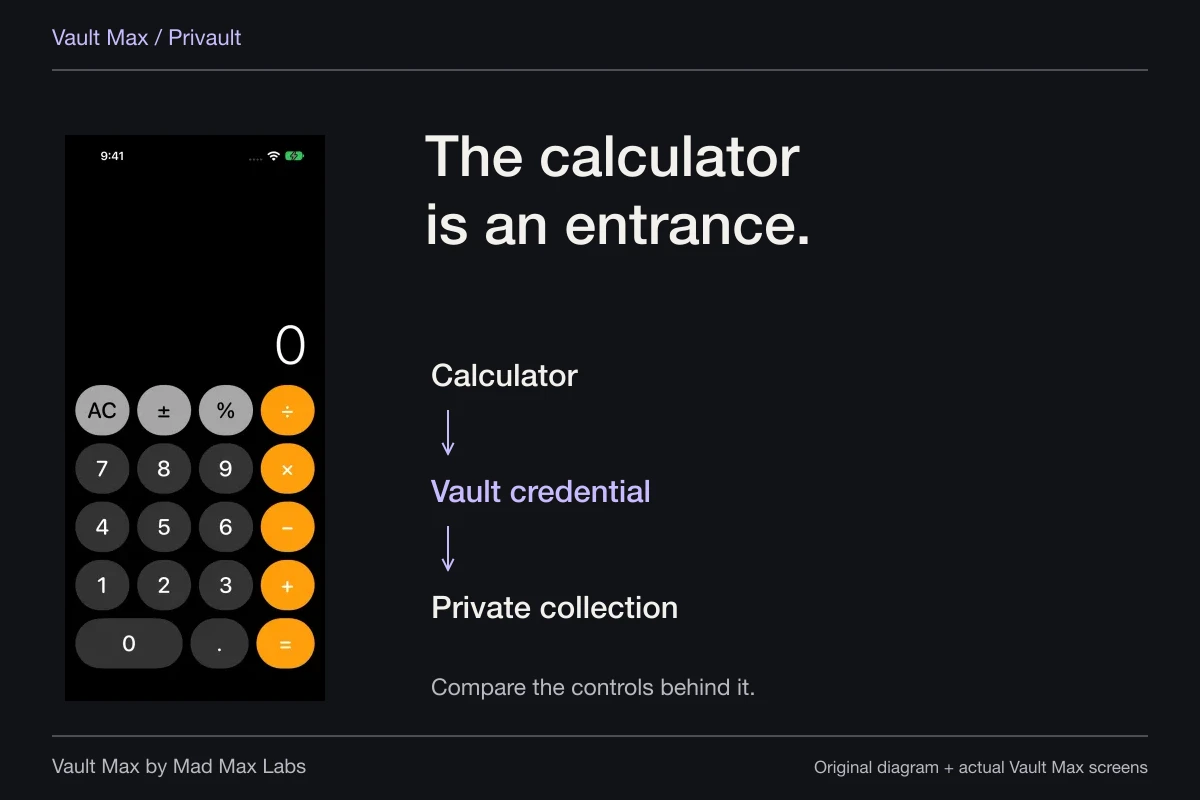
For your own trial, choose the two rows you expect to use most often. Try ordinary arithmetic and the sample unlock in our calculator walkthrough, then inspect the separate-collection and recovery routes. A promising first screen should lead to material you can still find, close and retrieve later.
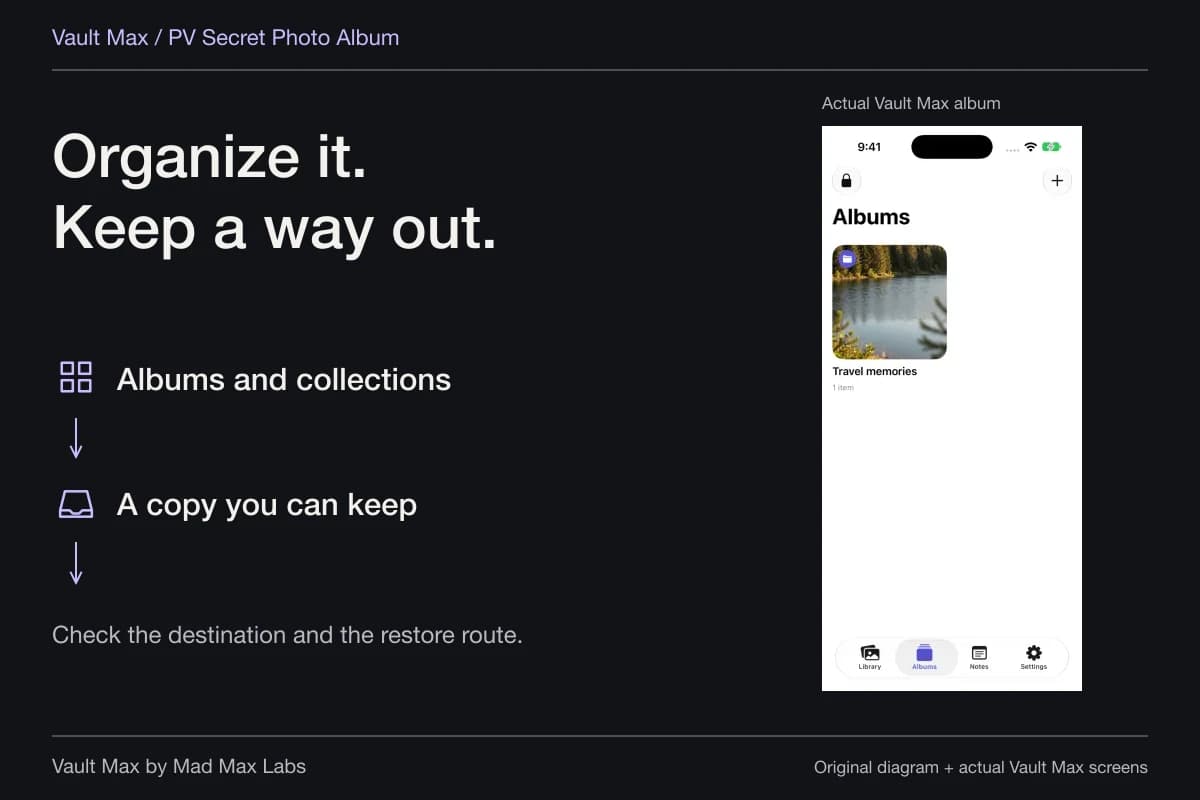
For a growing media collection, include finding things in that trial. Add pictures with different dates, put them in an album and return after a day. Can you recognize the item you wanted without opening every thumbnail? Check the relevant sorting and organization controls yourself. This comparison does not assume that two products listing albums will organize a large library in the same way.
Know where an ordinary exported copy can appear
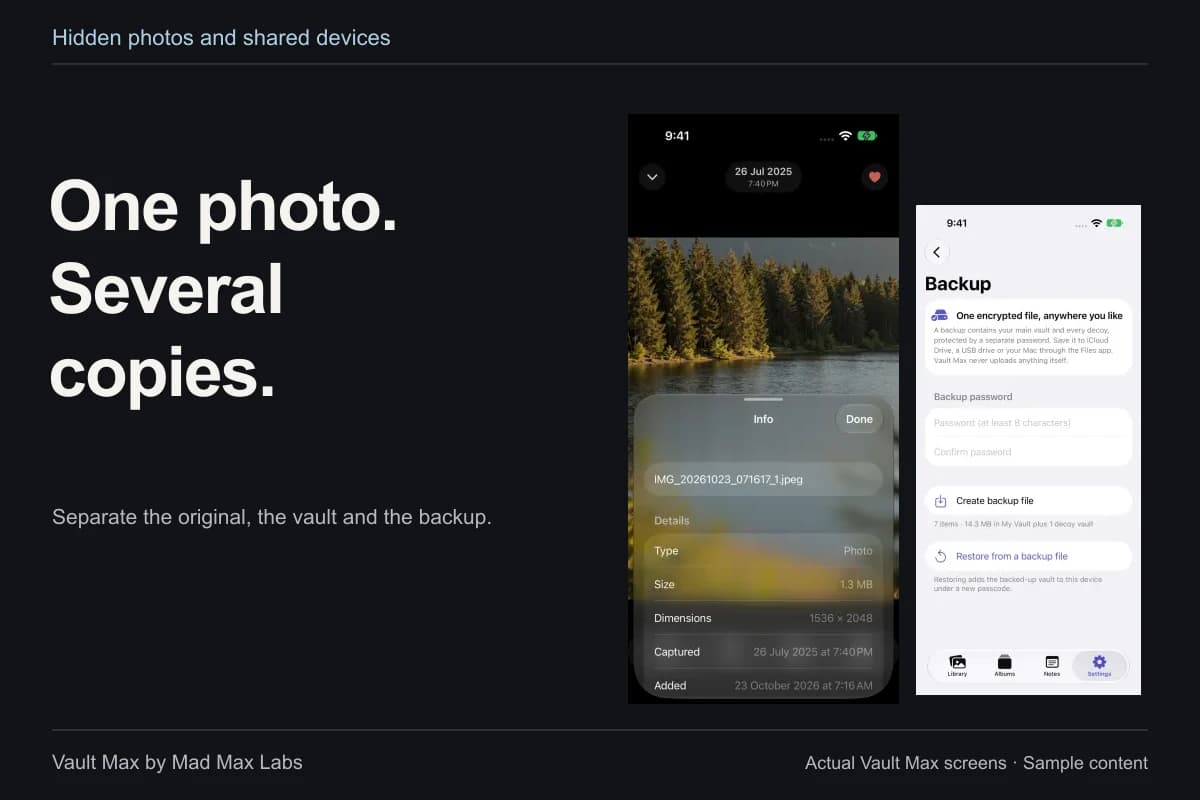
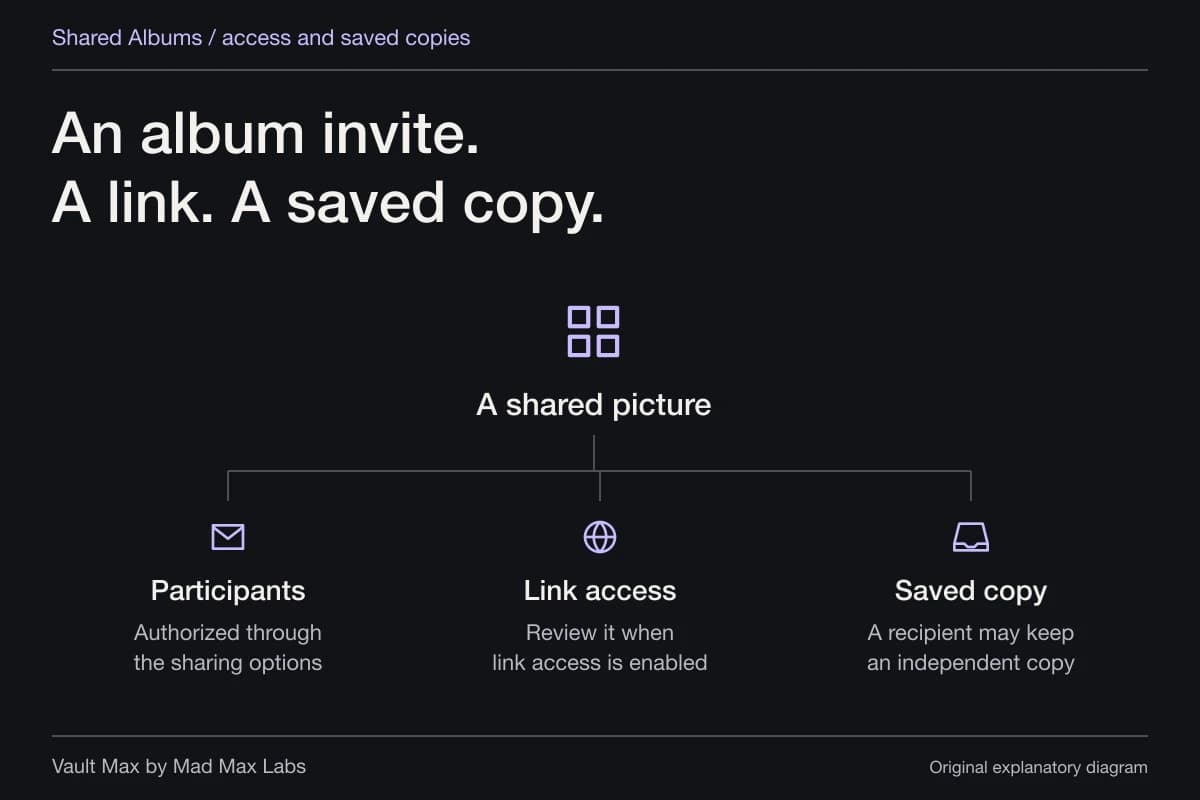
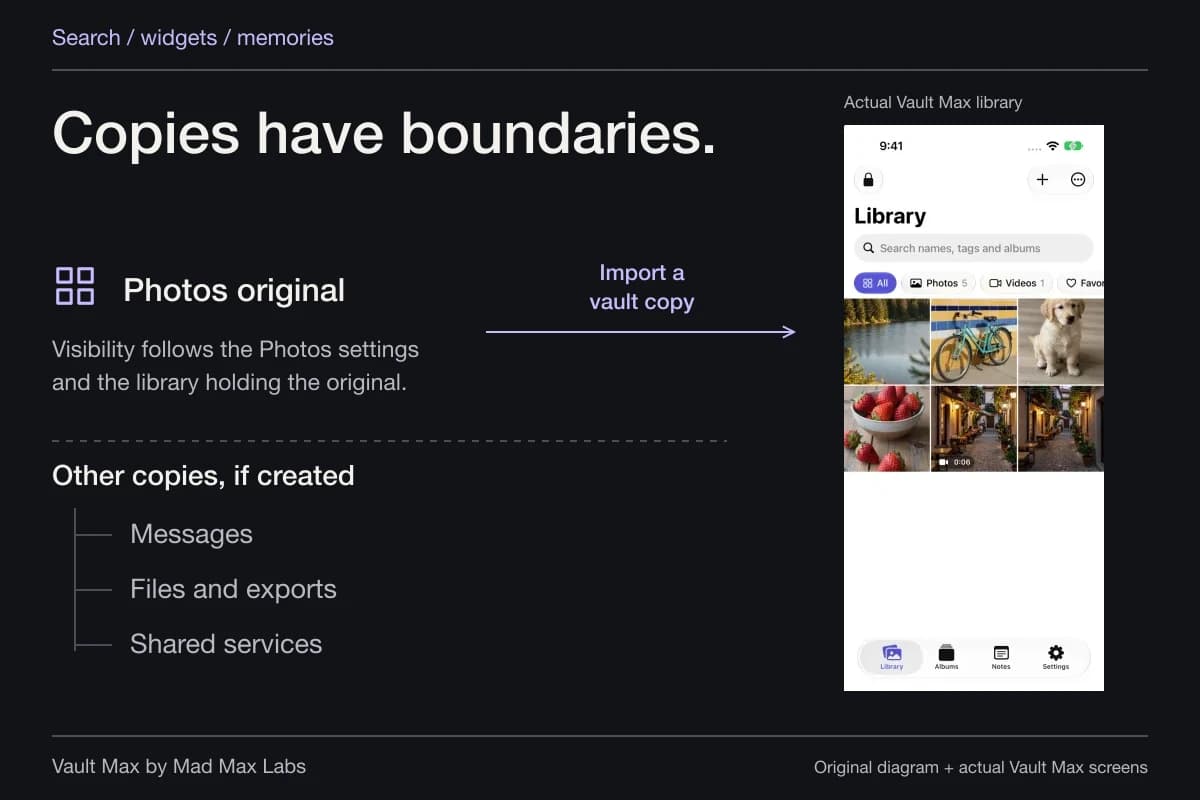
Vault Max's lock controls access to its private collection. A picture shared out, a document saved elsewhere or text copied into another application has crossed a different boundary. Closing the vault does not reach into those destinations and close their independent copies. Decide whether the job calls for an ordinary usable export or a password-protected recovery archive before sharing.
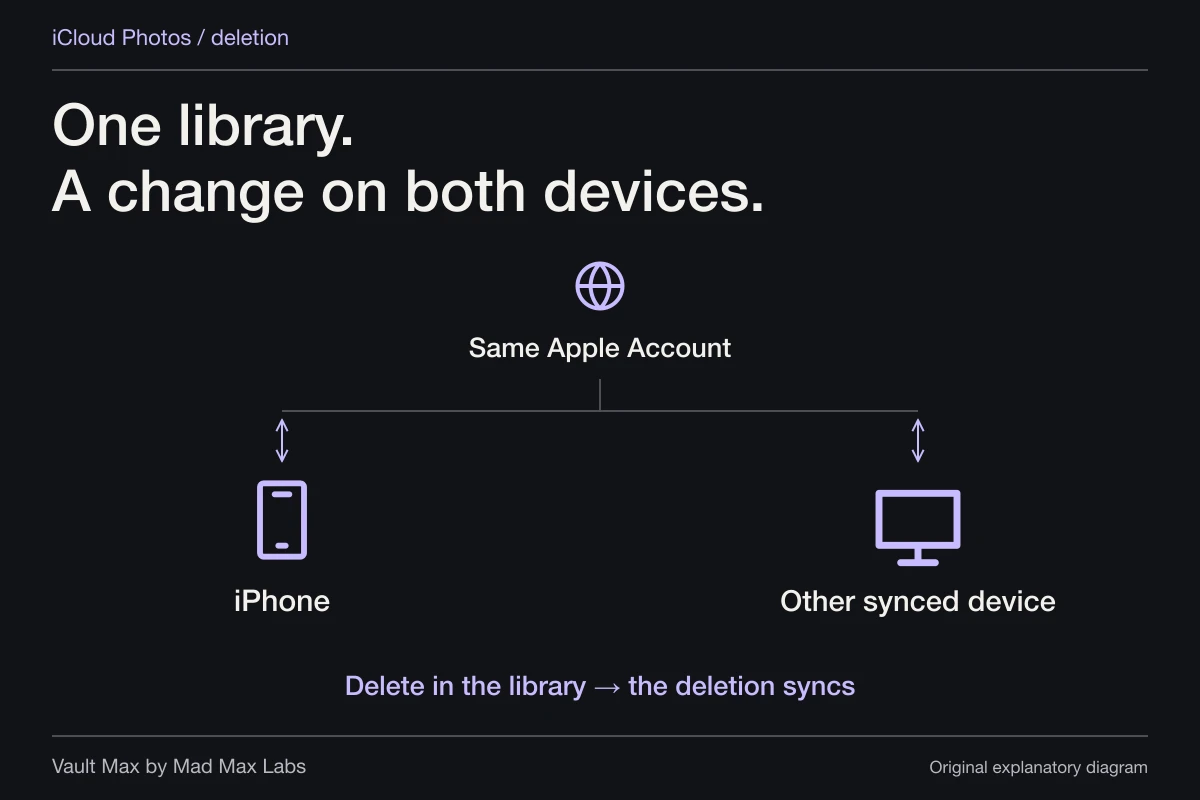
Use a sample file to learn that distinction while the collection is small. Inspect the destination and confirm what opens the result. If you return it to Photos, consider the library's own sync arrangement. If you create a backup archive, retain its separate password. That complete routine gives the collection's privacy claims useful context without assigning security properties to an export you have never inspected.
Local media does not mean every privacy policy is identical
HiddenVault describes on-device storage in its listing, and its website advertises encryption. The inspected primary pages do not explain the file cipher or key architecture in enough detail for us to compare them against Vault Max's implementation. That is a limit of this documentation comparison, not evidence that HiddenVault leaves files unencrypted.
Its App Store privacy declaration also lists usage data for tracking and categories for advertising, analytics and diagnostics. Apple notes that these declarations are supplied by developers and are not independently verified. The declaration does not establish that private photographs are uploaded or sold.
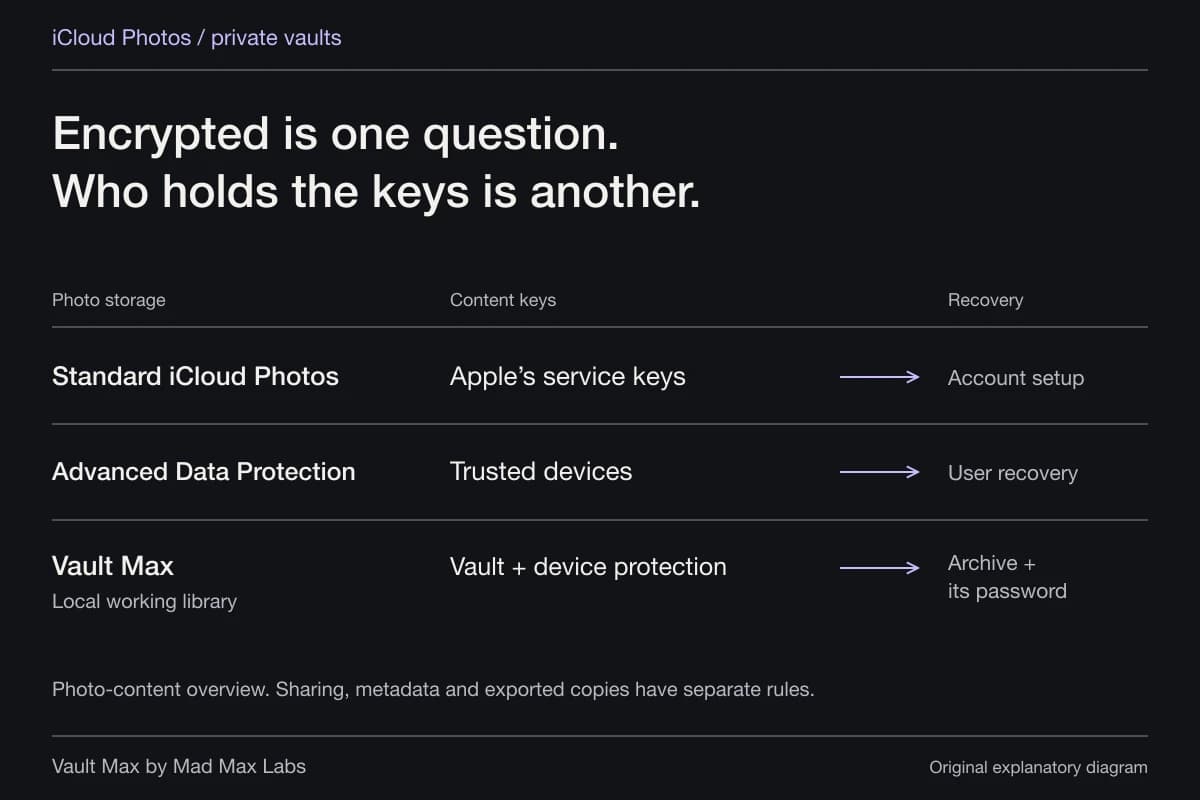
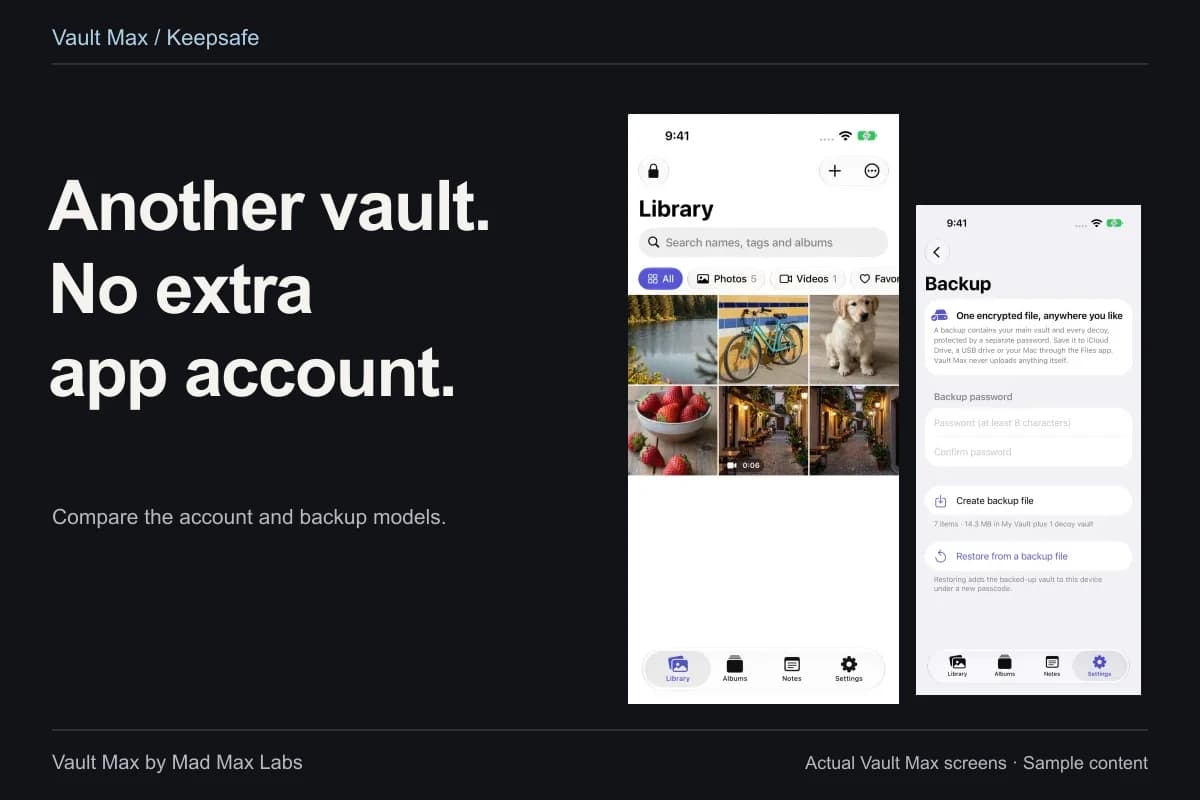
Vault Max has no app analytics or telemetry. There is no Vault Max account and no developer-hosted library. Apple's purchase services remain separate. That narrower setup is a useful advantage for someone who wants fewer services around their private collection, without turning uncertainty about another product into a breach story.
Ask what the decoy changes
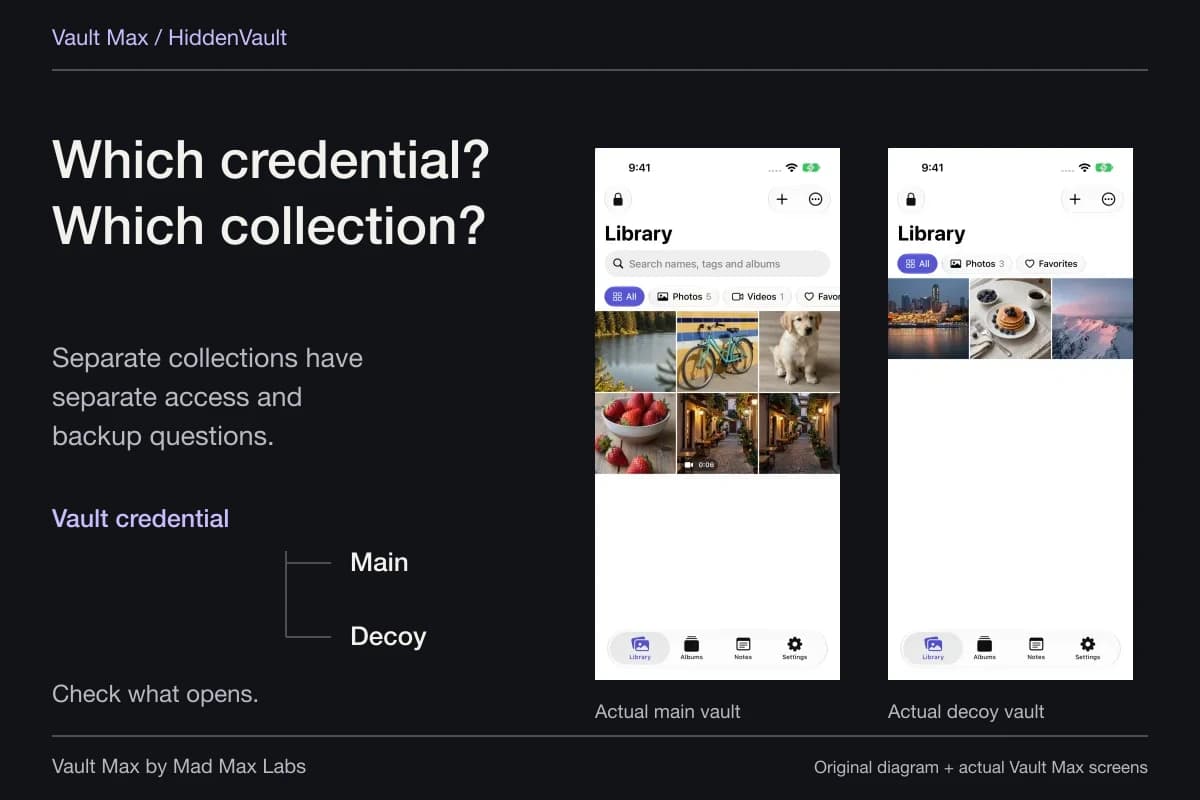
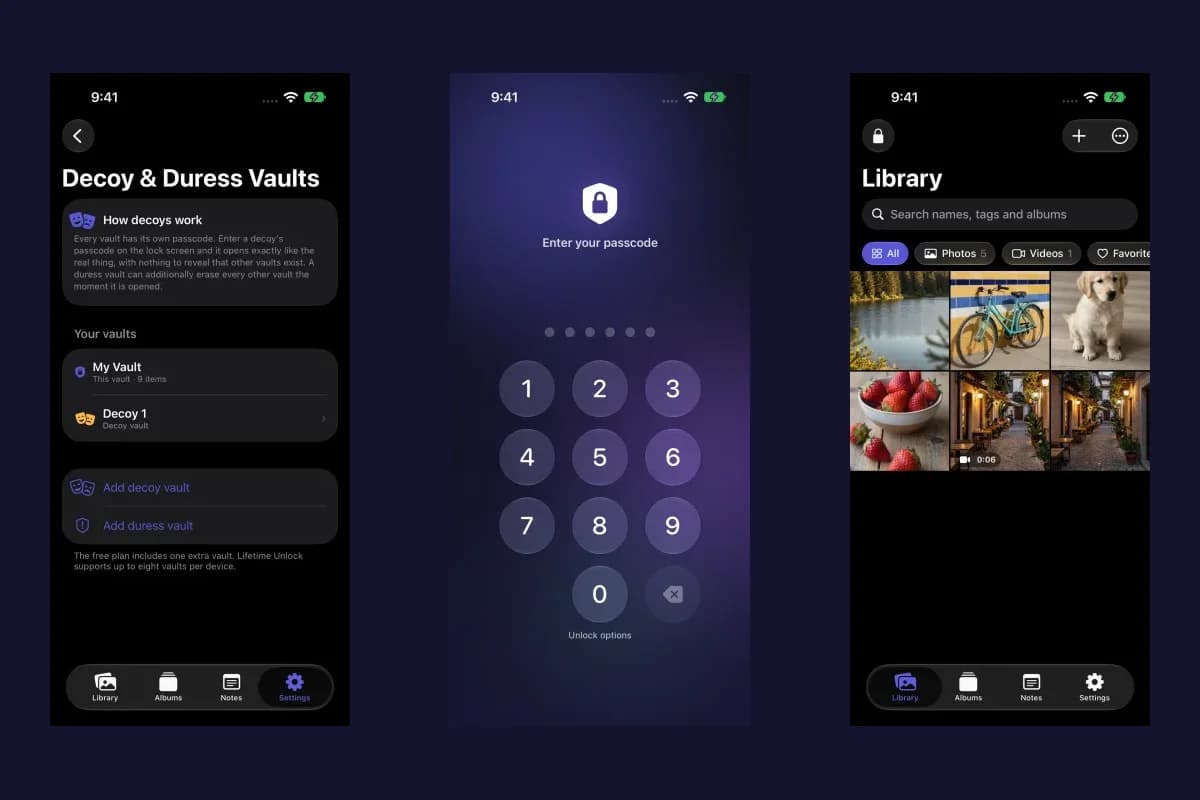
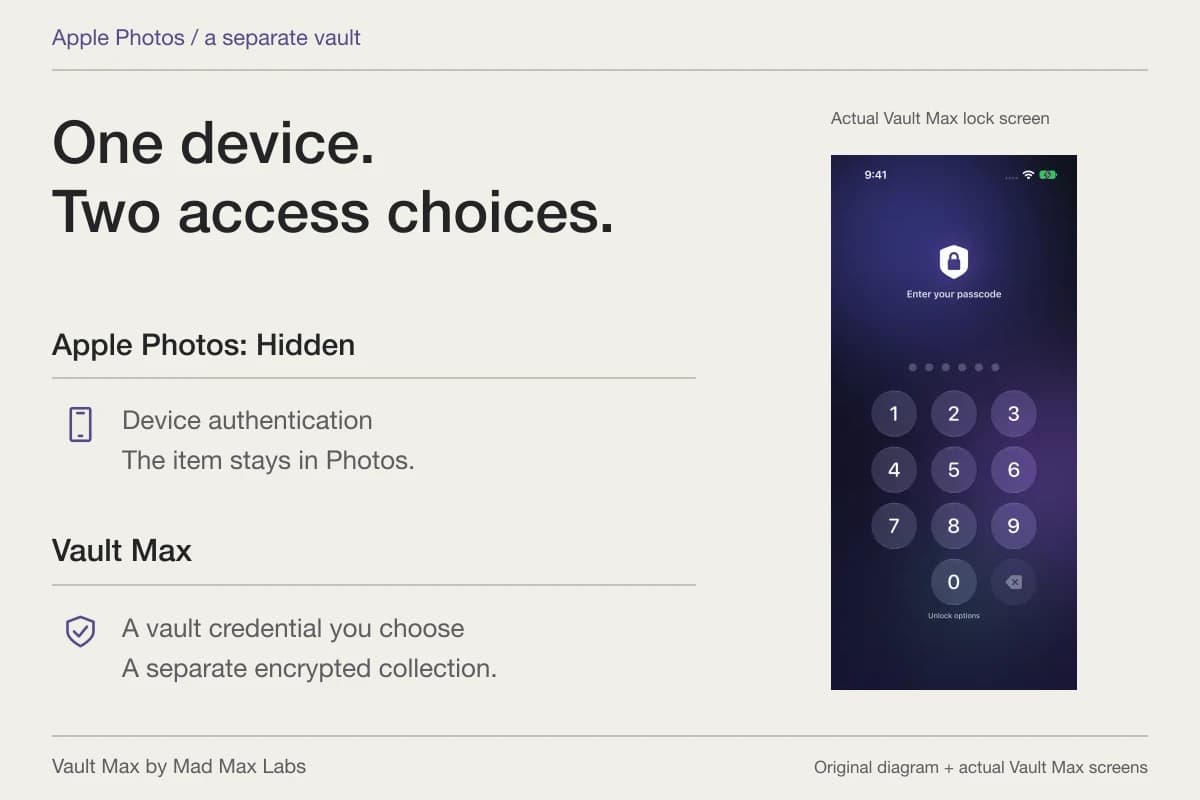
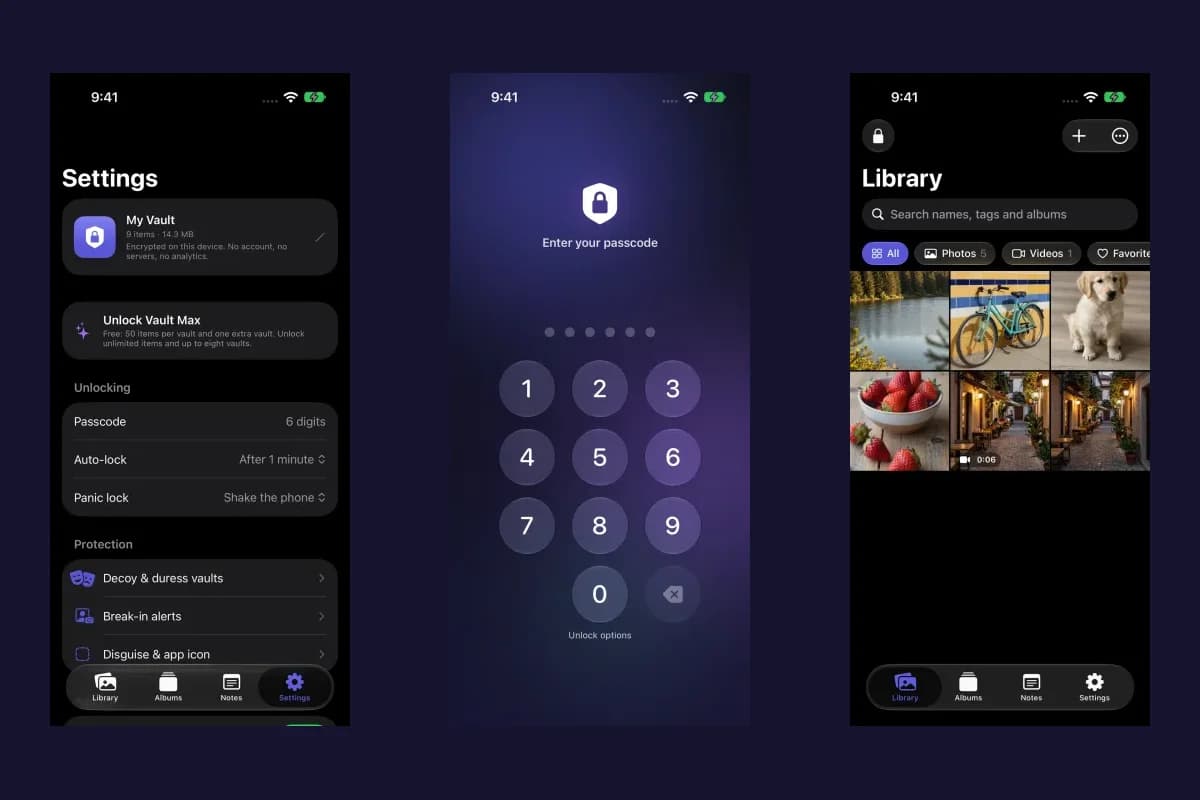
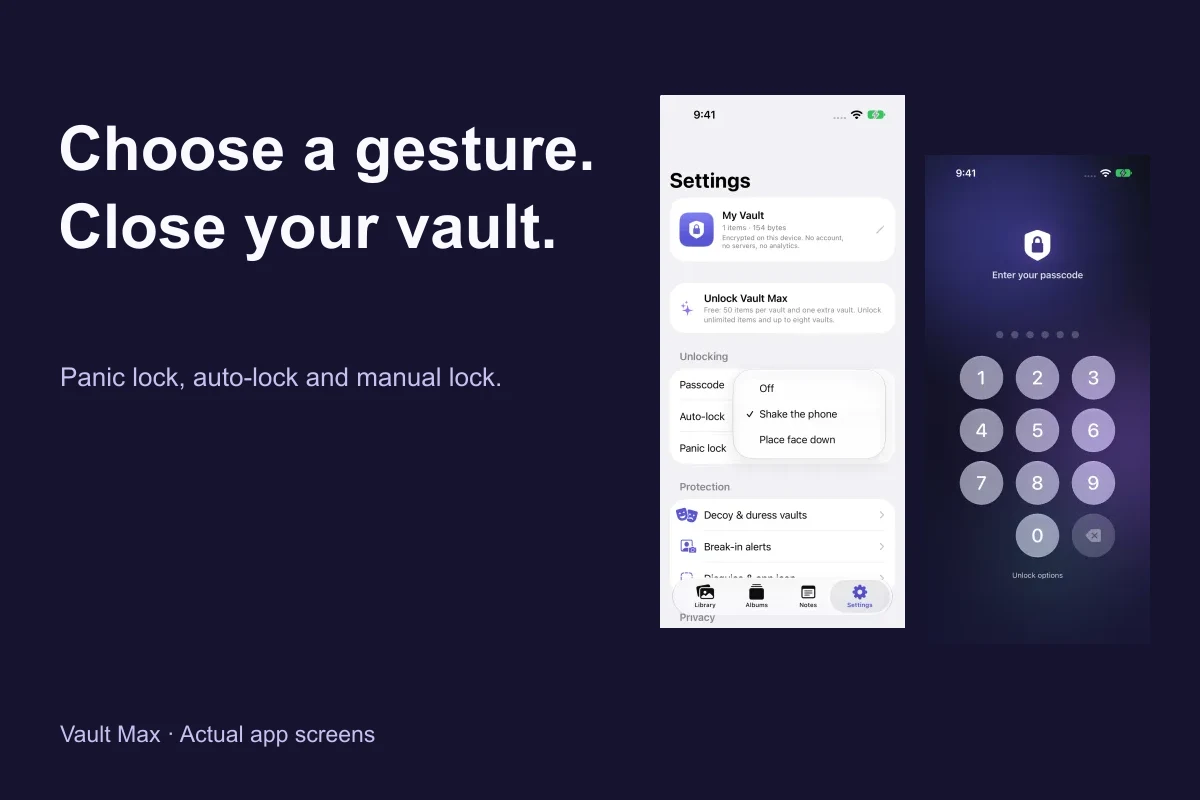
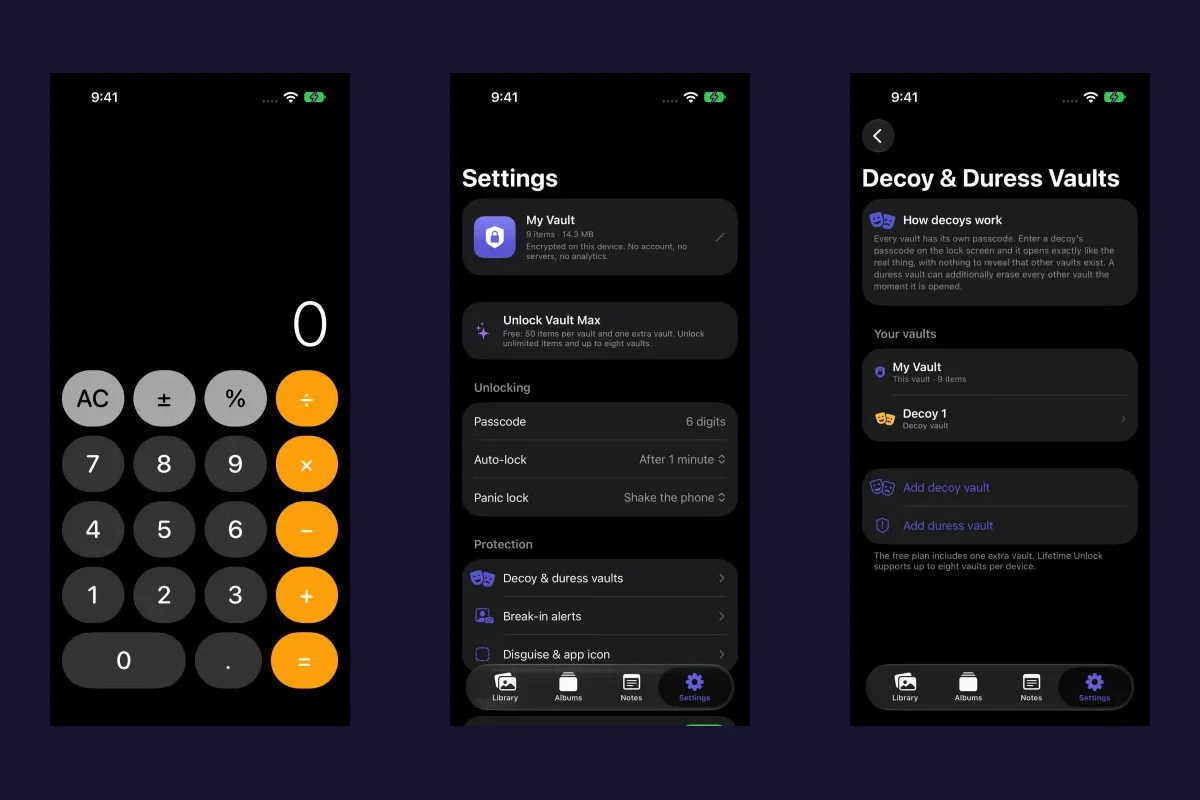
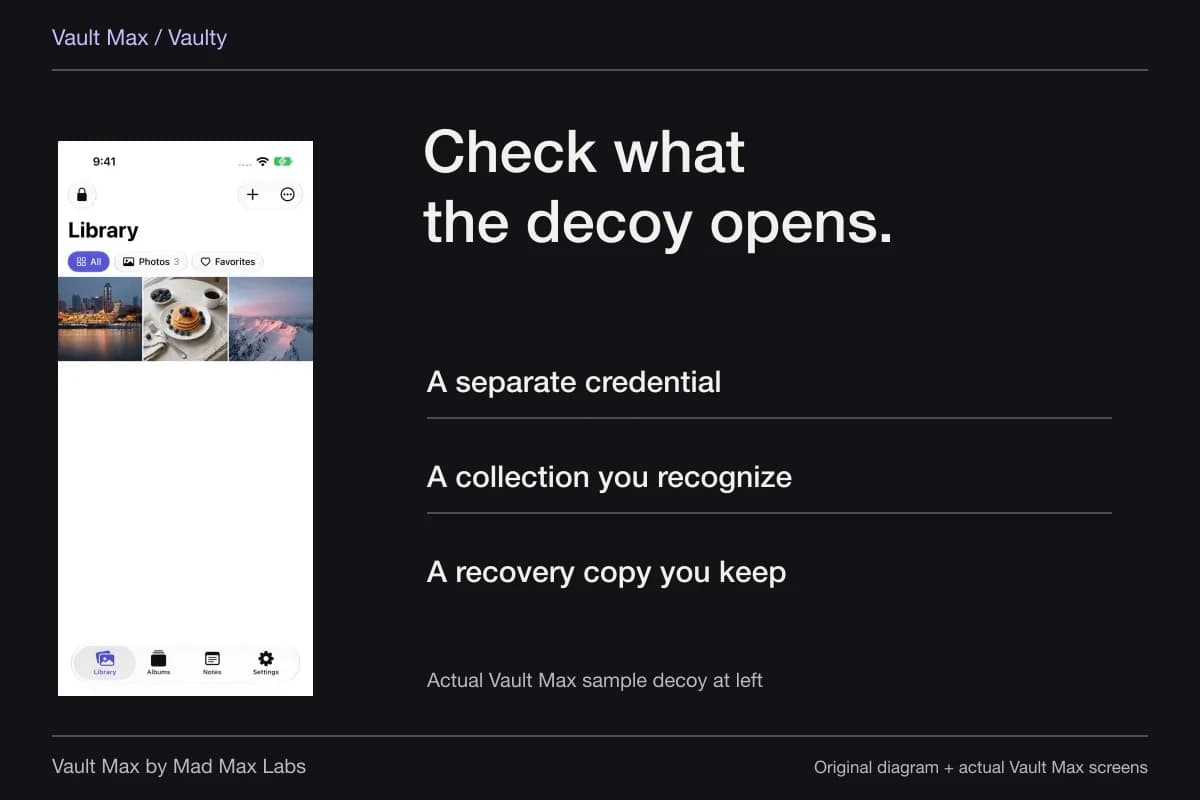
A decoy is useful when it opens a separate, ordinary collection rather than exposing your main library. Vault Max lets different credentials open different vaults. Put harmless sample media in the alternate collection and practice returning to the intended one.
Sample Vault Max library. Select a screen for a closer look.
HiddenVault advertises a decoy too. Before choosing on that basis, check the current plan requirements, how content enters the alternate view and how it returns after a new-device move. Our decoy guide explains Vault Max's ordinary decoy and keeps destructive duress behavior separate. An ordinary decoy does not erase the main collection.
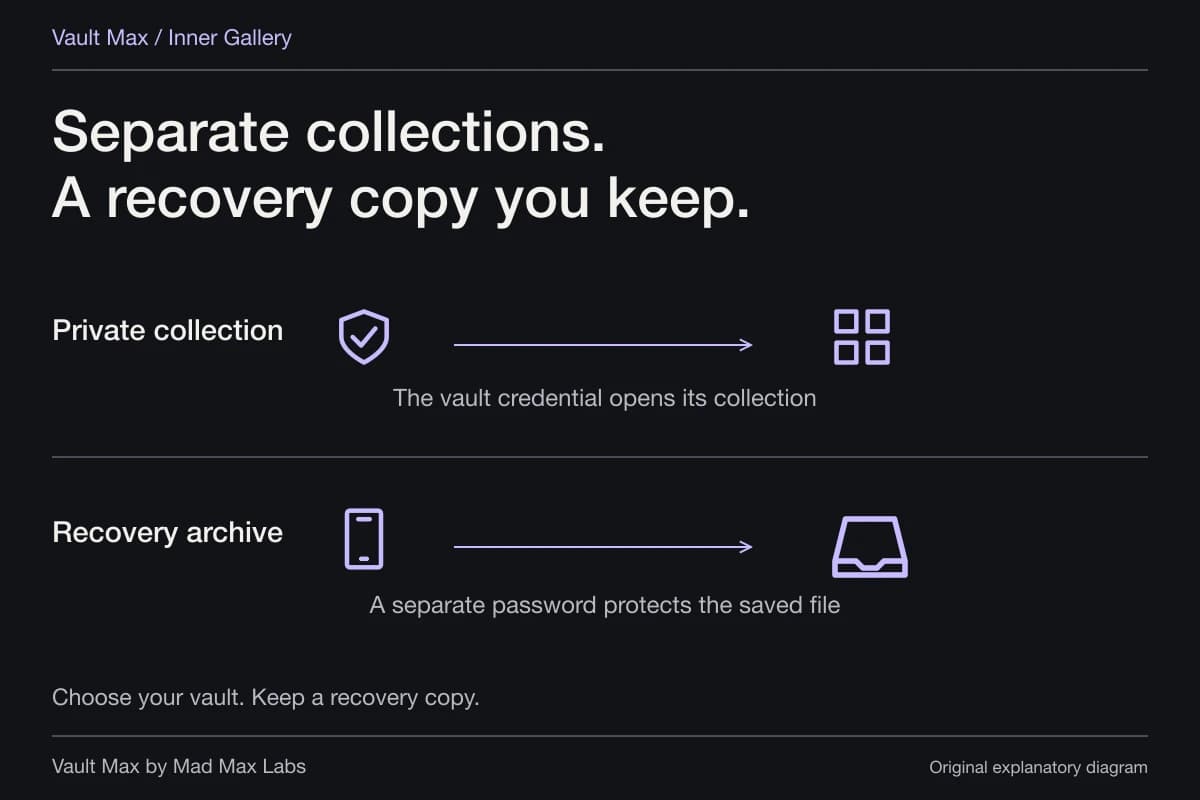
Include that alternate collection in the recovery question. A successful return to the main library does not establish that its decoy was included in the same backup. Use a harmless item you can recognize in each collection and record which credential should reach it. In Vault Max, the scope of an archive is the selected vault and its included descendants; it should not be assumed to cover every unrelated vault on the phone.
The public annual prices do not all agree
HiddenVault's named U.S. IAP entries show HiddenVault Premium: Annual at $44.99, Monthly at $7.99, and Weekly at $2.99. They also include an Annual Discount at $19.99 and 6-Months at $24.99. Its website and the listing description instead quote $34.99 annually. Trial descriptions differ as well. The actual offer and eligibility need checking inside the app.
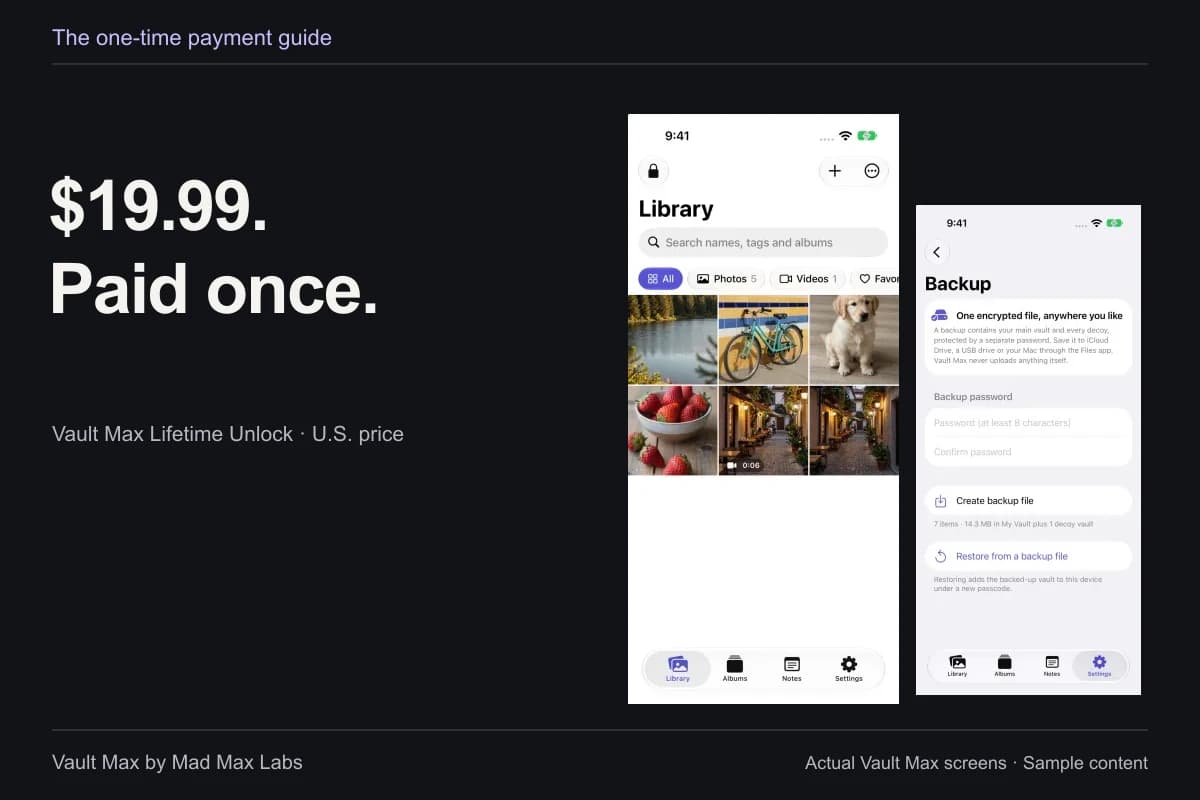
Vault Max's current plans are $1.49 weekly, $3.99 monthly, $14.99 annually or $19.99 for Lifetime Unlock in the U.S. Its annual price is lower than each of those publicly shown HiddenVault annual entries, including the discount. We do not assume every reader can buy the same offer or that the packages contain identical services.
The one-time option is a reason we prefer Vault Max for a long-lived local collection. It increases capacity to unlimited counted items and up to eight total vaults per device. It does not buy cloud hosting or a promised future update schedule, and it does not create more physical storage on the phone.
| Choice | Vault Max | HiddenVault public offers |
|---|---|---|
| Weekly | $1.49 | $2.99 |
| Monthly | $3.99 | $7.99 |
| Six months | No six-month plan | $24.99 |
| Annual | $14.99 | Annual $44.99; Annual Discount $19.99; website/description quote $34.99 |
| One-time capacity | $19.99 Lifetime Unlock | No matched lifetime offer established by these checked sources |
Vault Max's paid intervals all increase the same capacity limits; they do not unlock a better encryption tier. You can evaluate its security controls, calculator and notes free before deciding the collection needs more room. Existing content also stays available to open, export, delete and back up after subscription expiry. Check HiddenVault's exact current capacity and expiry conditions rather than assigning ours to its differently packaged services.
Finish the comparison with the recovery job
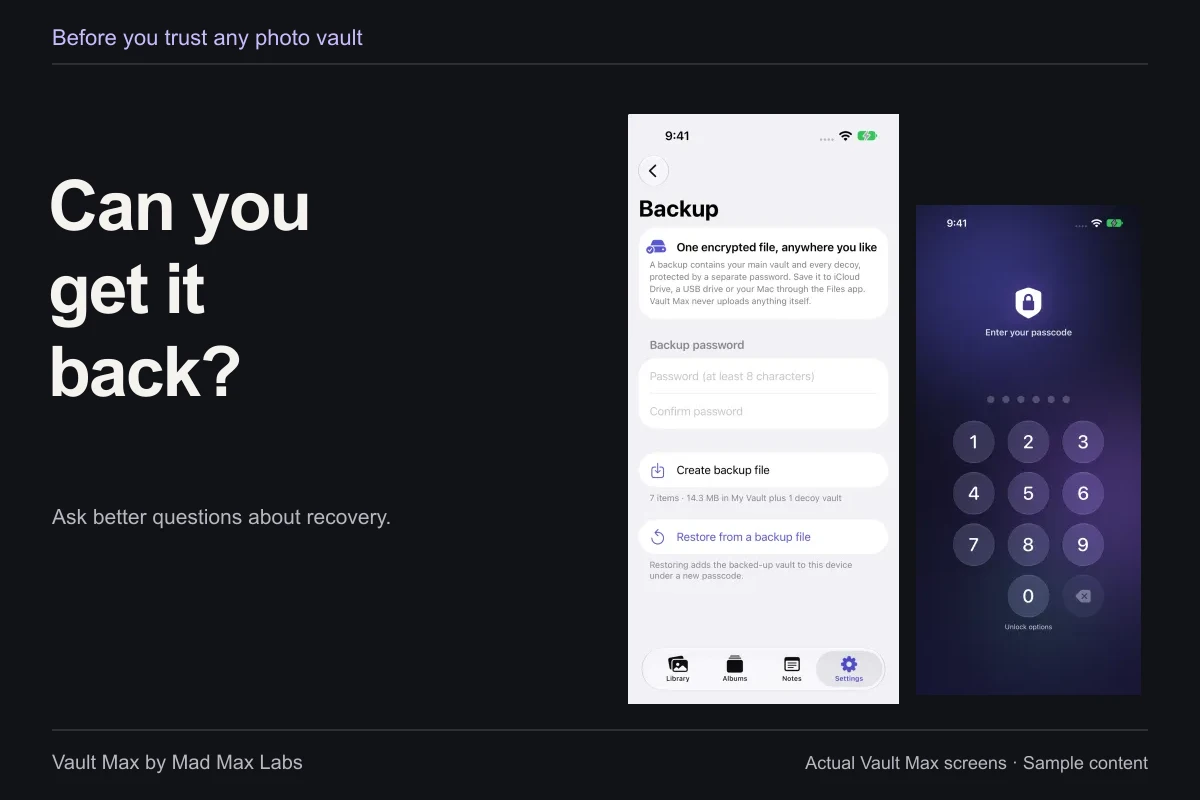
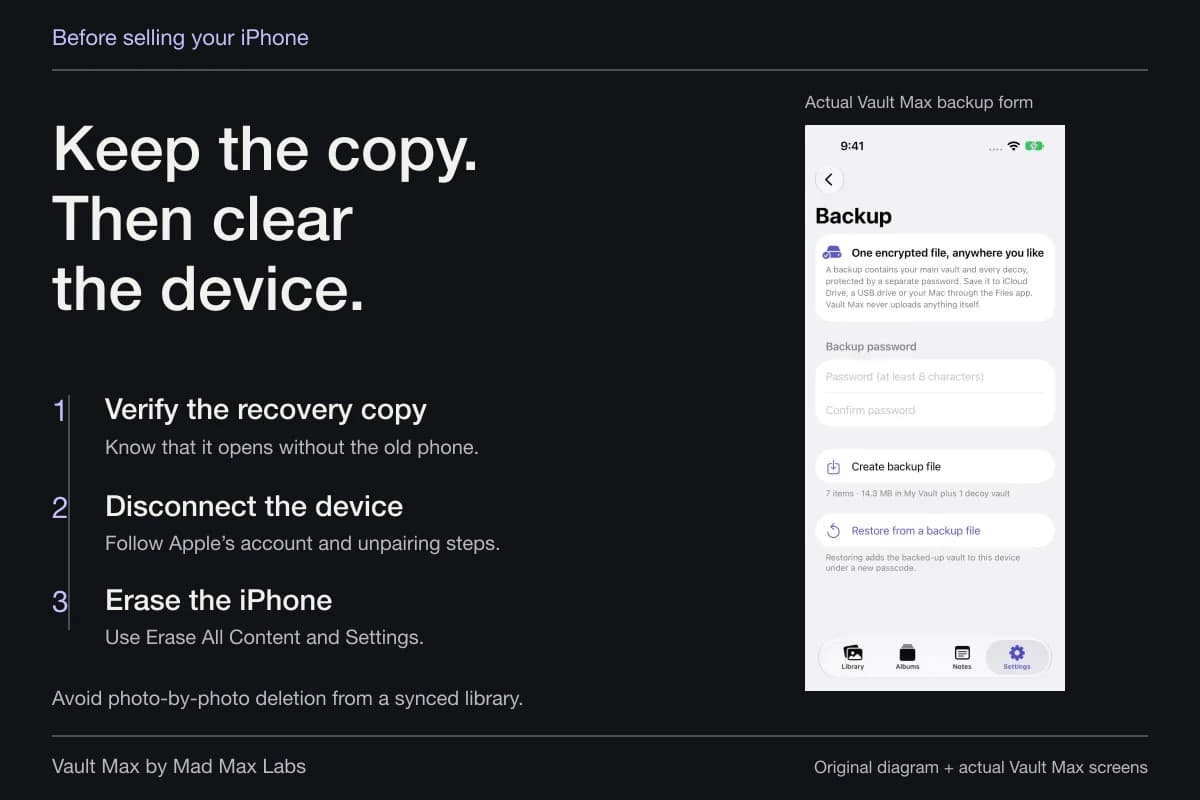
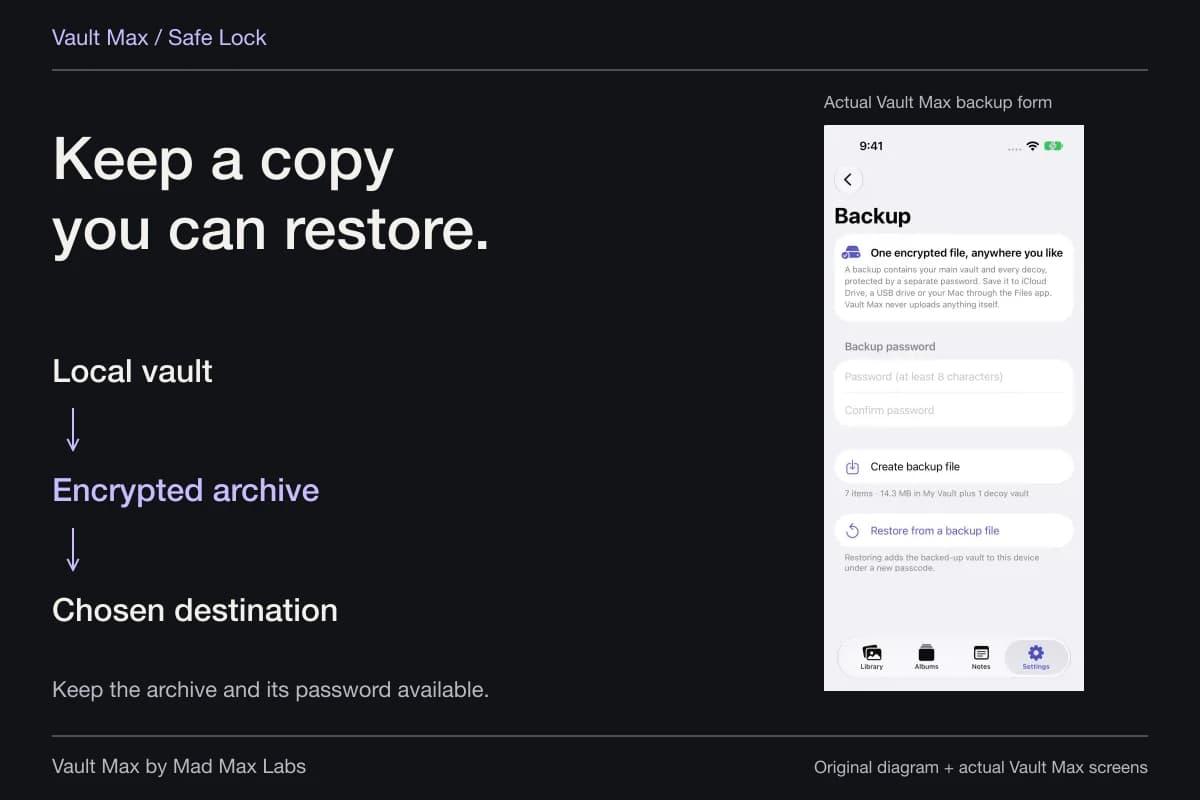
A library can be private and still be lost. Ask where the usable second copy lives, what password opens it and how you verify that it contains the collection you expect. A feature called “backup” is only helpful once you understand those details.
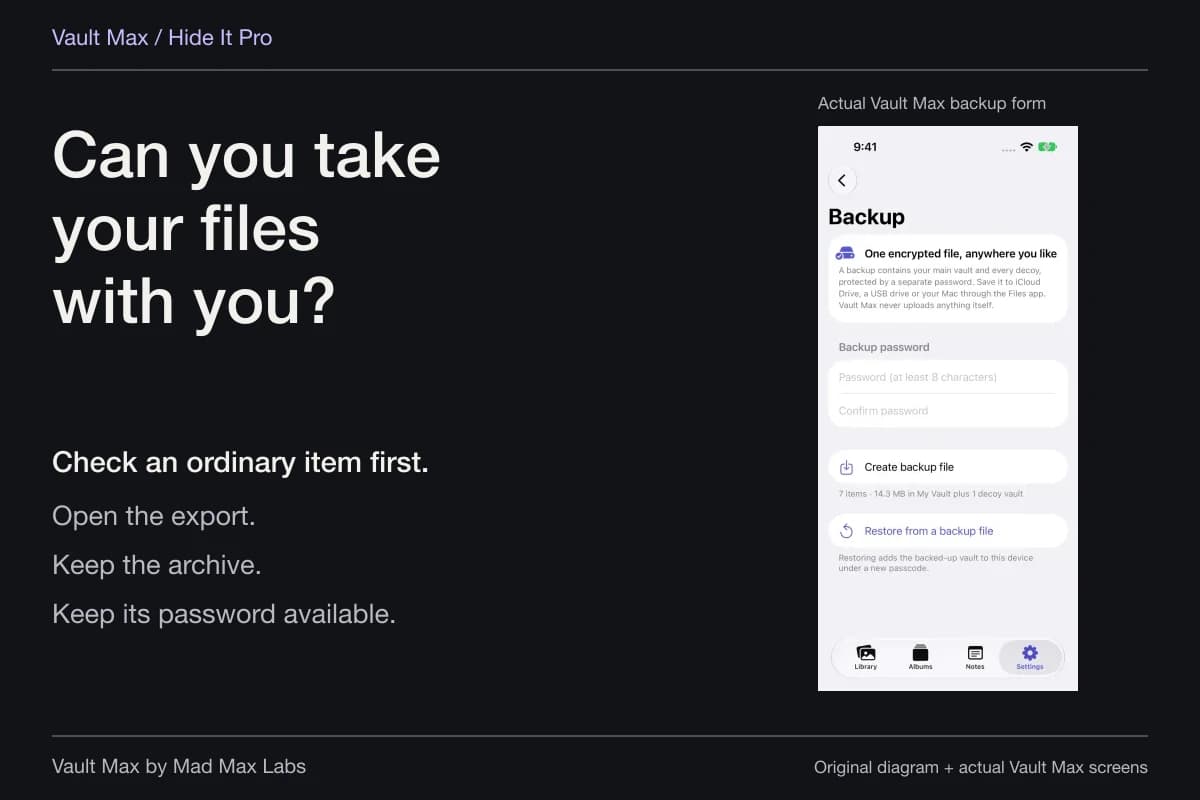
Vault Max exports a separately password-protected archive through Files. A cloud destination uses that provider; a file kept only on the same phone may disappear with it. Keep the backup password reachable independently, and refresh the archive after important additions. Use the recovery checklist before removing originals.
We recommend Vault Max for a focused private workspace, encrypted writing, calculator entry, separate credentials, no app telemetry and a modest one-time price. Start with a small sample collection and carry it through to a usable recovery copy. That gives you evidence for the routine you will keep, before moving important material on the strength of a headline.
Common questions
Which HiddenVault app is compared here?
HiddenVault Secret Photo Vault by Kyle Allen, App Store ID 1519673105. Other similarly named photo hiders are separate products.
Is HiddenVault unencrypted?
Its official website advertises encryption. The primary sources inspected do not specify its file cipher and key design, so we do not treat undocumented details as proof that encryption is absent.
What is HiddenVault's annual price?
The checked U.S. listing shows named Annual products at $44.99 and an Annual Discount at $19.99, while its description and website quote $34.99. We cannot determine eligibility from those pages; check the actual purchase sheet.
Continue reading
More guides
Practical tips for your private library. Swipe or scroll to choose your next guide.
50 guides to explore