
App comparisons
Vault Max vs Vaulty: a local collection or a cloud-backed gallery?
Compare Vault Max with Mappvate's Vaulty: local and cloud-backed libraries, account privacy, empty decoys, recovery credentials and named U.S. price plans.
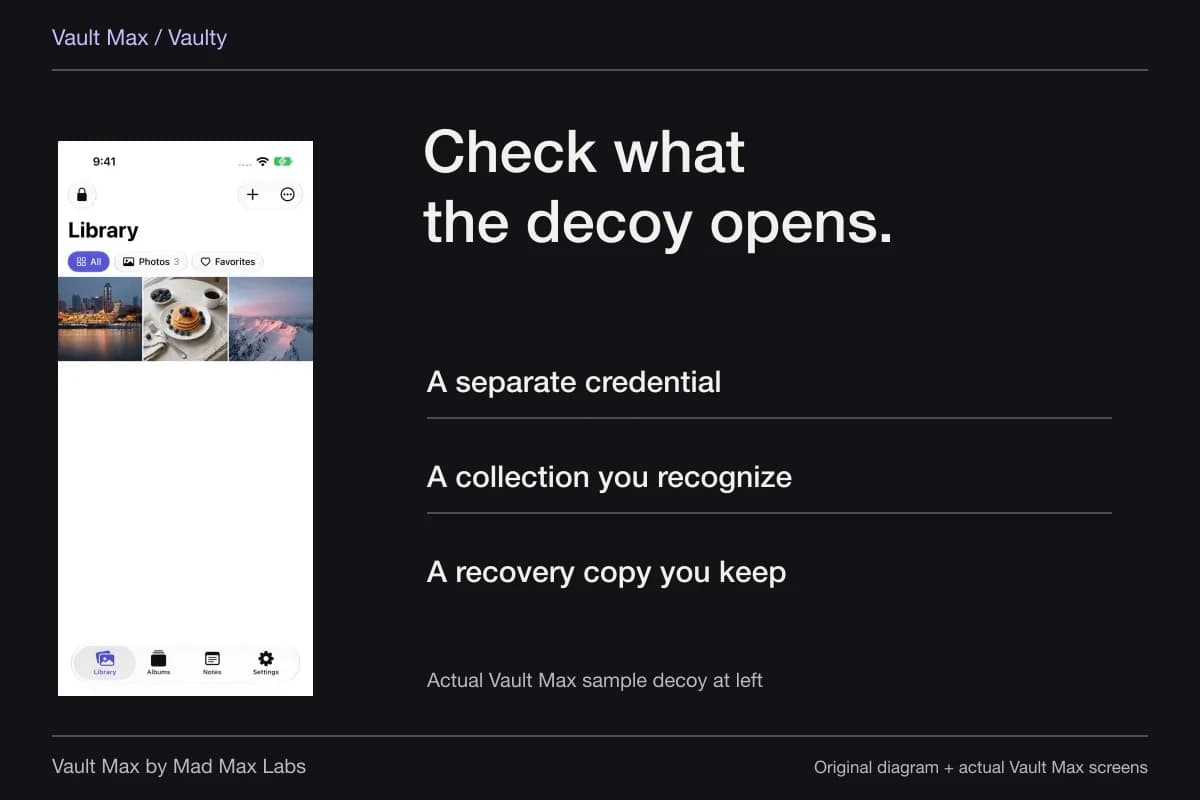
Vault Max is our recommendation for a local private collection without an app account or telemetry, with encrypted writing, a working calculator and a $19.99 U.S. Lifetime Unlock. Against Mappvate's Vaulty, its combination of populated alternate collections, an explicit recovery archive and clearly named capacity plans gives you concrete buying questions to work through.
We publish Vault Max. The other app here is Vaulty: Hidden Photos Vault, by MAPPVATE YAZILIM LIMITED SIRKETI, App Store ID 1616386868. We checked first-party sources on October 23, 2026. We have not installed Vaulty, observed its network traffic or tested recovery of its cloud collection.
Check the developer before following recovery advice
There are different products with Vaulty in their names. Mappvate's listing is not the newer Lock Photos - Vaulty by Ranjit Singh. The older Android brand name also should not be treated as proof of features in this particular iPhone app.
That distinction matters more than the icon when you are troubleshooting. A reset instruction, subscription offer or privacy policy for the wrong product may have no bearing on the installation holding your files. Match the developer and numerical App Store ID before following a guide or entering account details.
Mappvate's product page identifies this Vaulty and advertises cloud backup, sync, PIN/Face ID access and disguise options. We use those official descriptions for its advertised workflow, without importing conclusions from another vault publisher's comparison table.
What the publisher's gallery can help you compare
Use the official App Store gallery to inspect the way the product presents its collection and access choices. A publisher-supplied screenshot is useful marketing evidence about the experience being offered; it is not a capture of an account we created or a test of what happens without connectivity.
As you look, connect each advertised screen to a task: finding an item, opening a collection, changing its appearance or accessing recovery. Keep screenshots and written instructions together. The image cannot tell you who controls a cloud decryption key or whether the last upload finished.
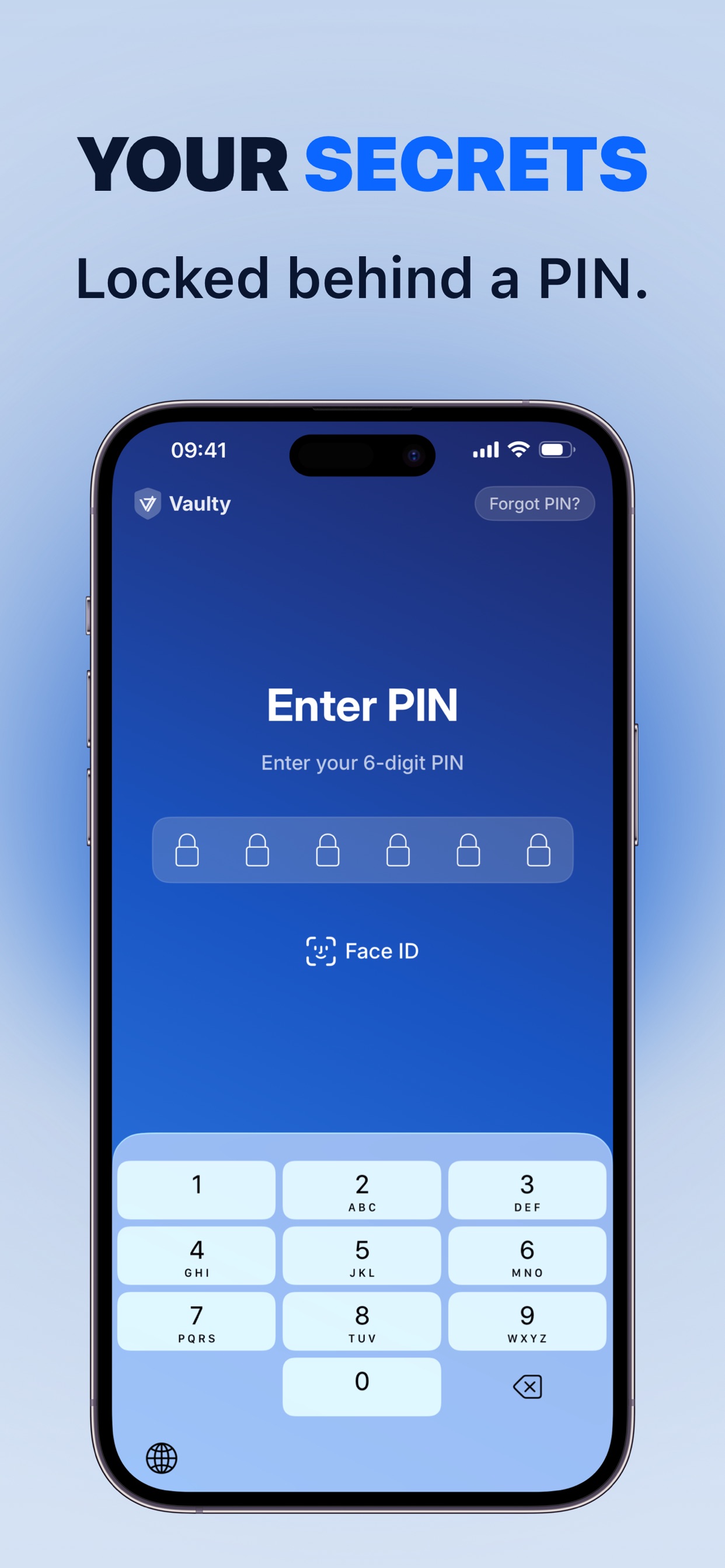
Publisher-supplied screenshots. Source material, not a hands-on test.
The exact Mappvate listing depicts credential entry. Similar names in the store should not be mixed into this app's feature or price comparison.
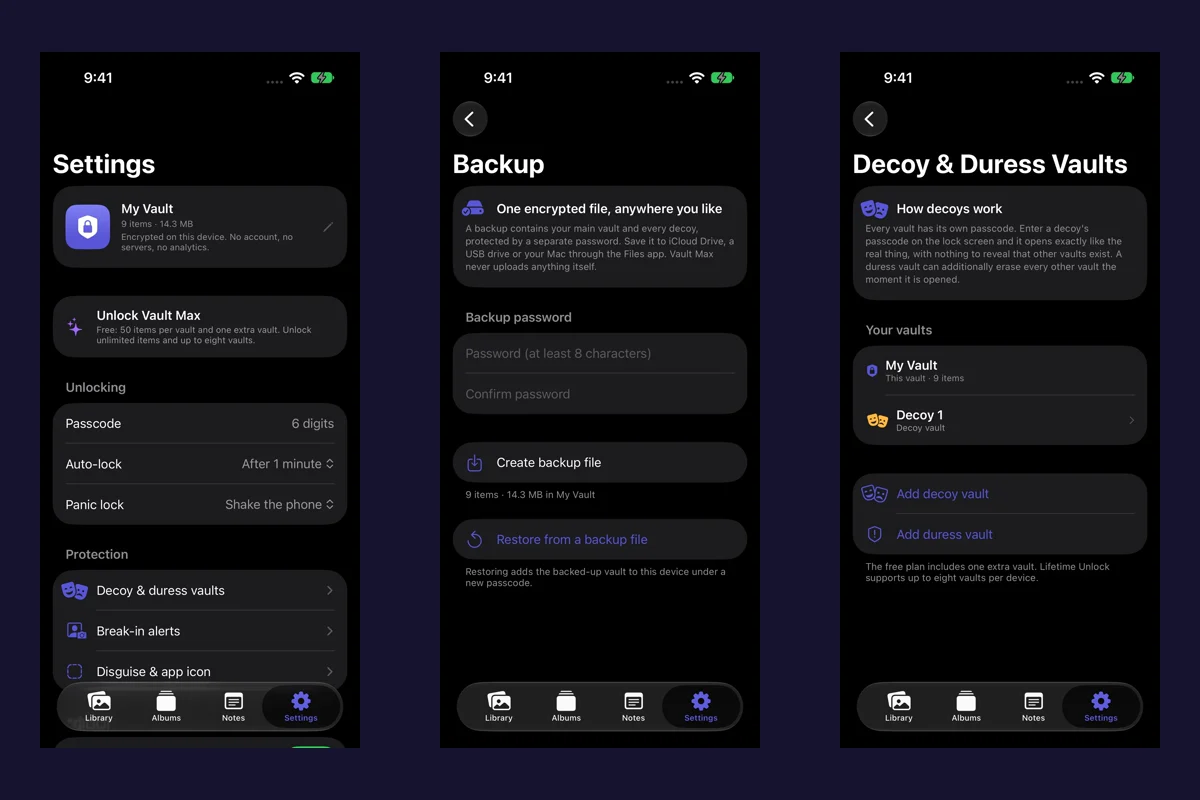
Open the full-size source imageThe alternate gallery is an advertised Vaulty feature too. Ask what each credential opens and what a recovery copy contains.
Open the full-size source imageDecide where you expect the second copy to live
Vaulty describes a cloud-backed private gallery. That may be attractive when you want access from several iOS devices or do not want a recurring manual-export habit. Its publisher's claim that a collection can survive changing devices is a feature to examine with its current setup and account instructions.
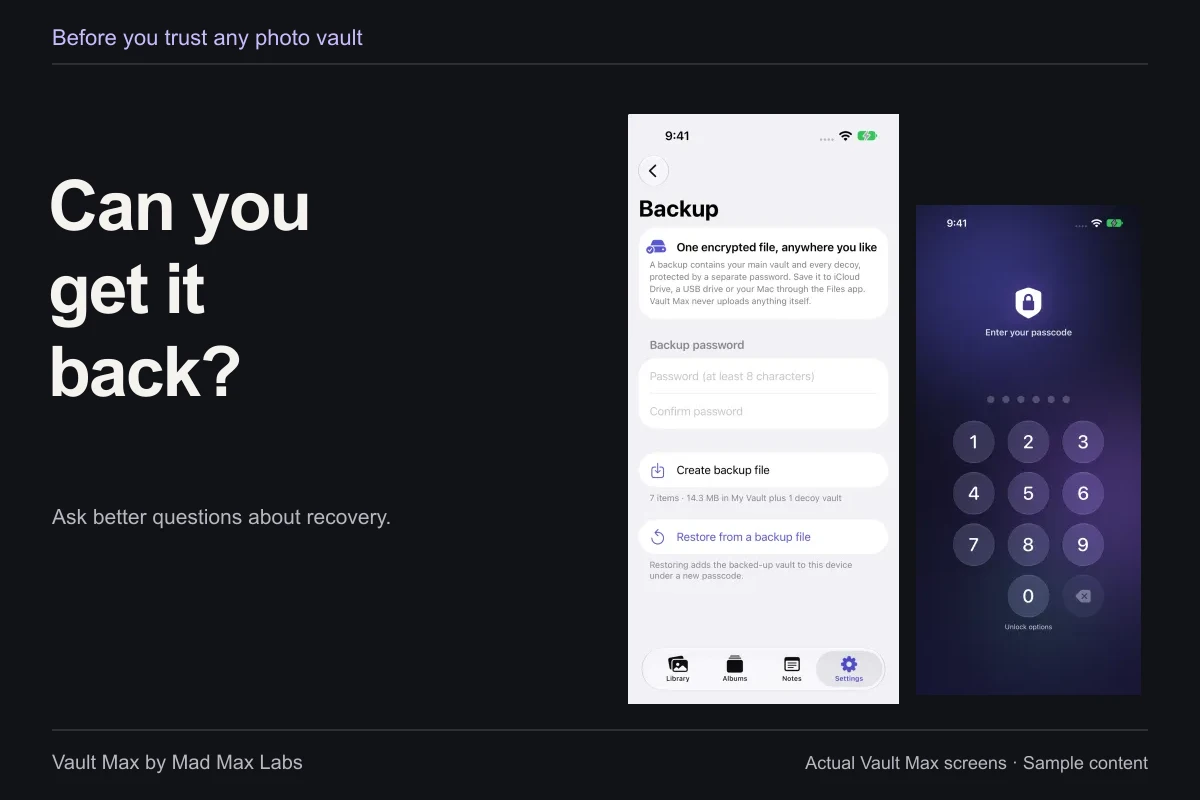
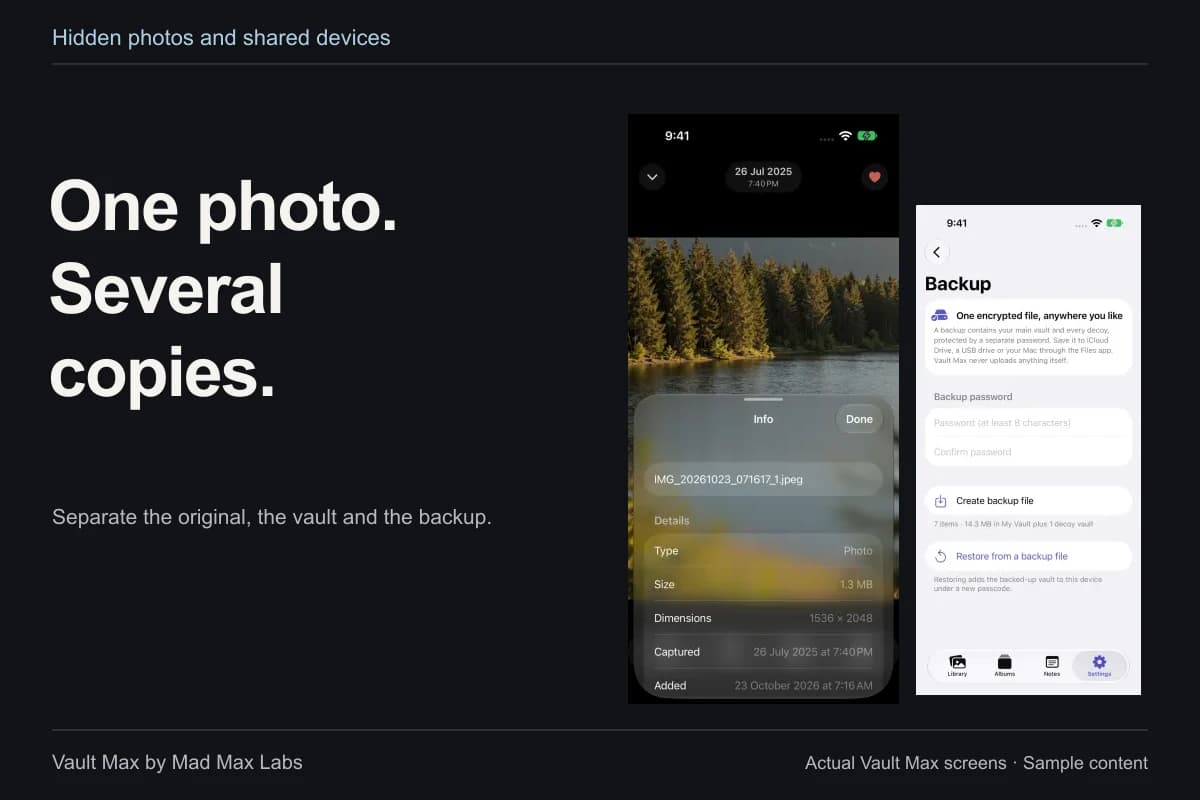
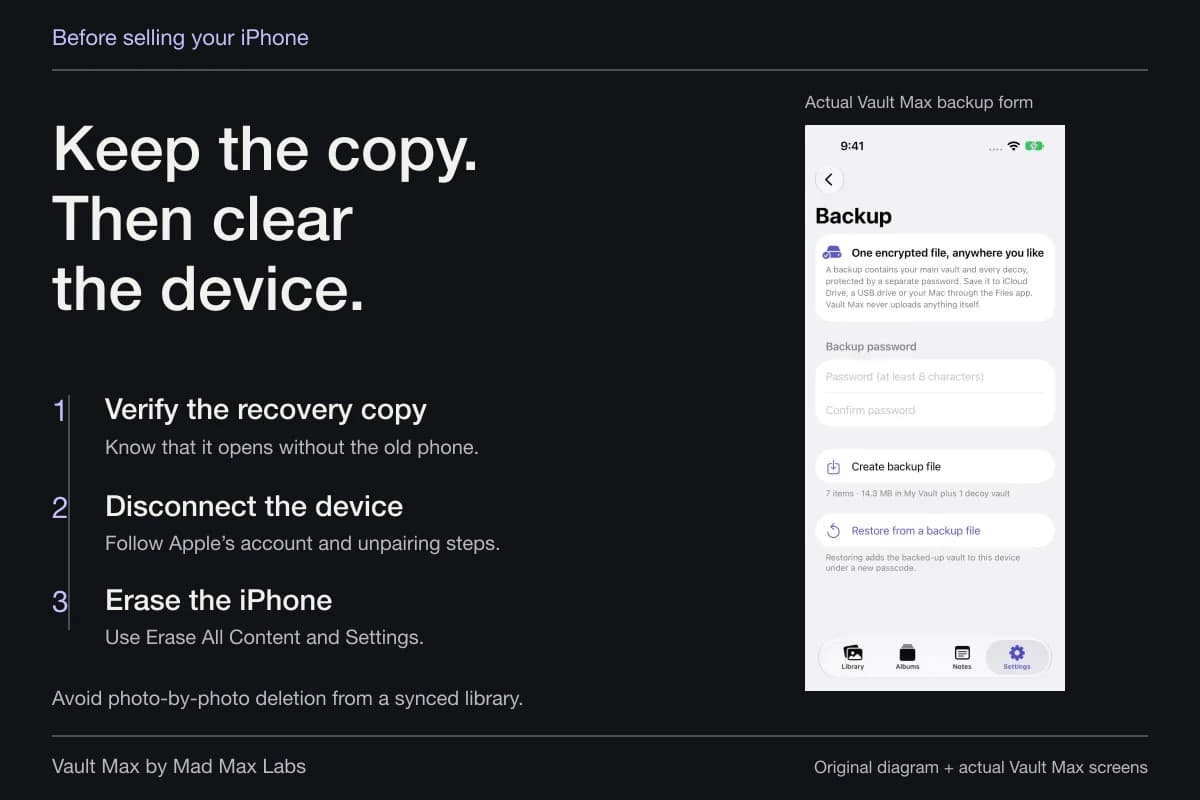
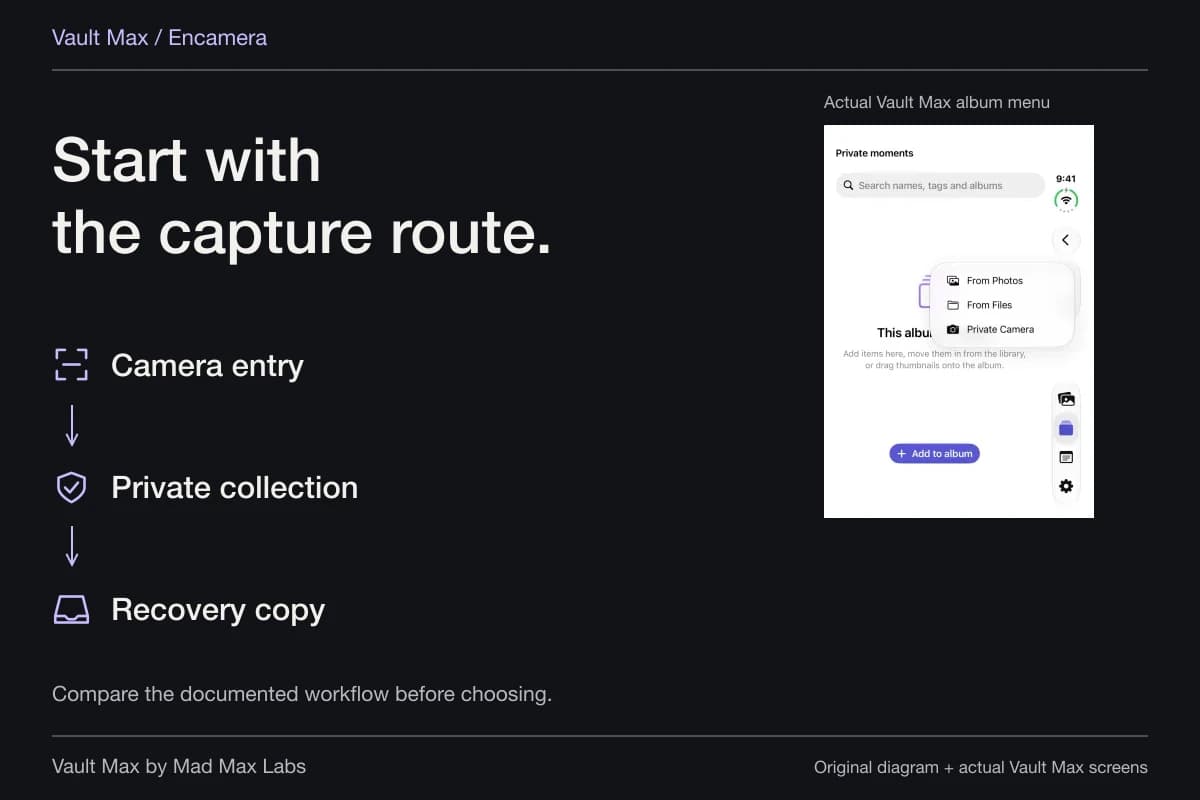
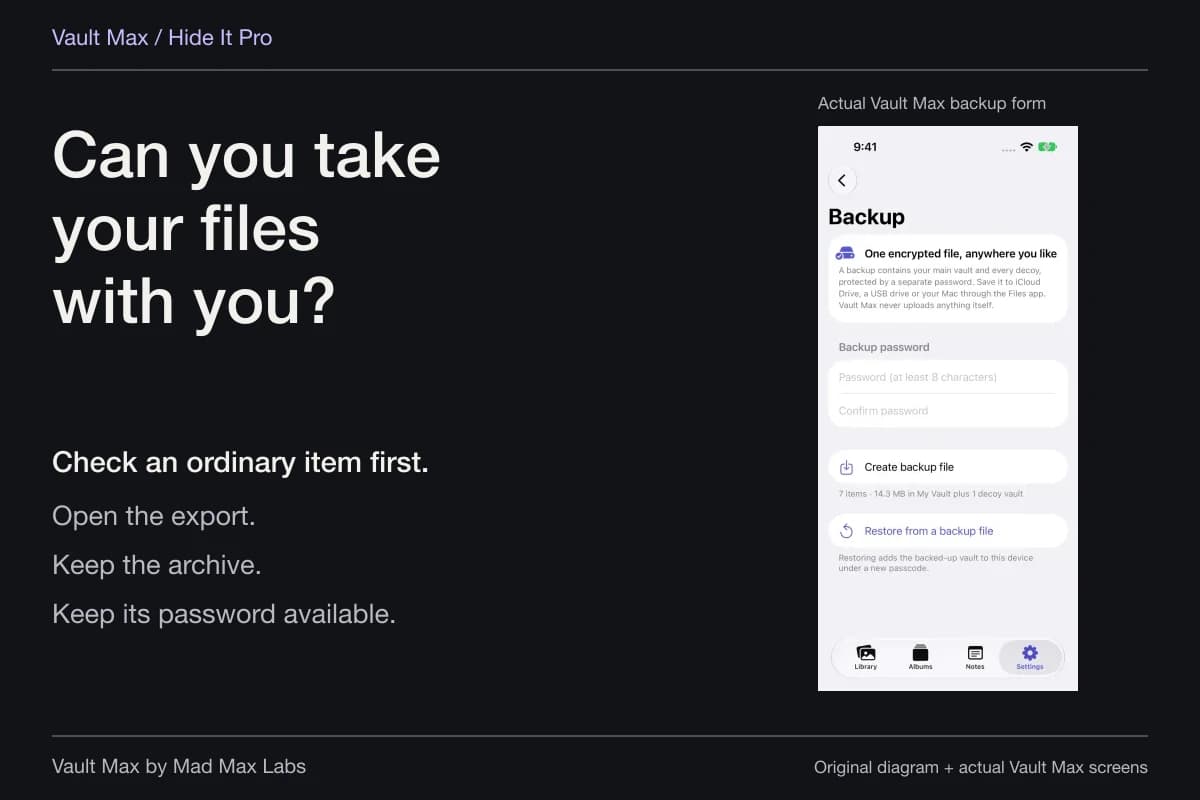
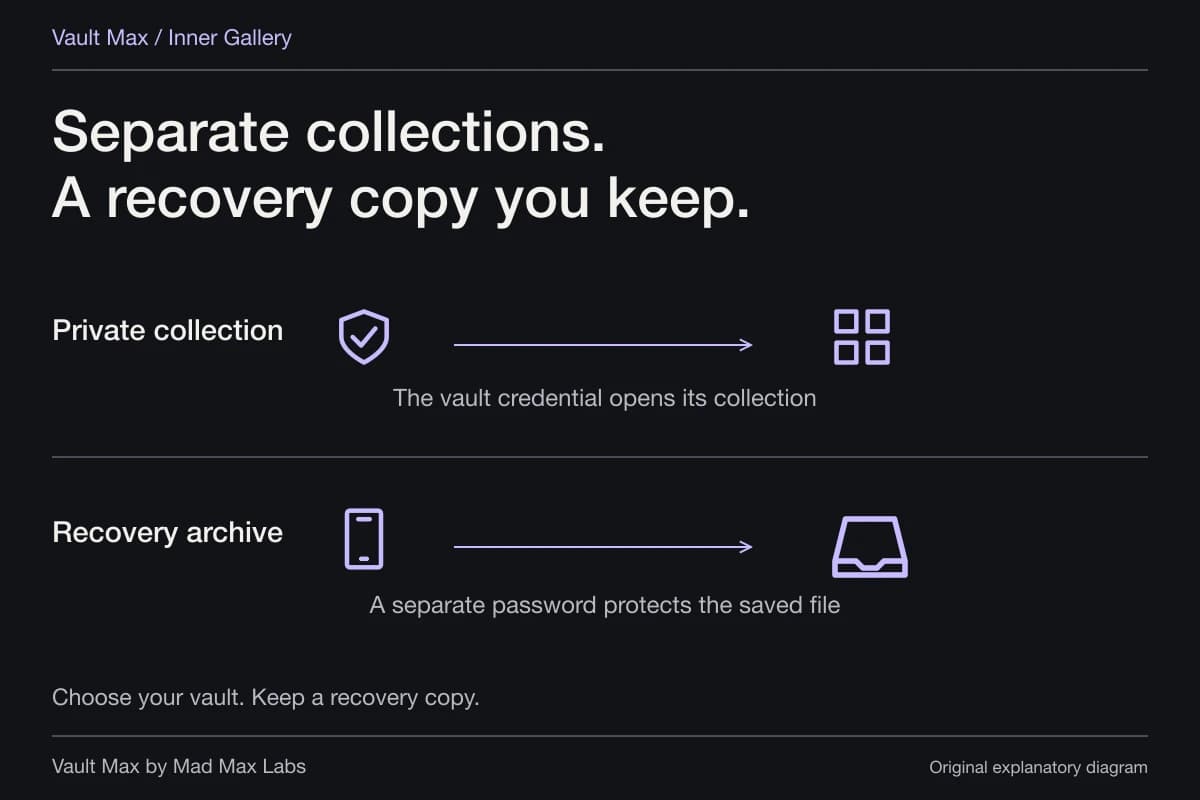
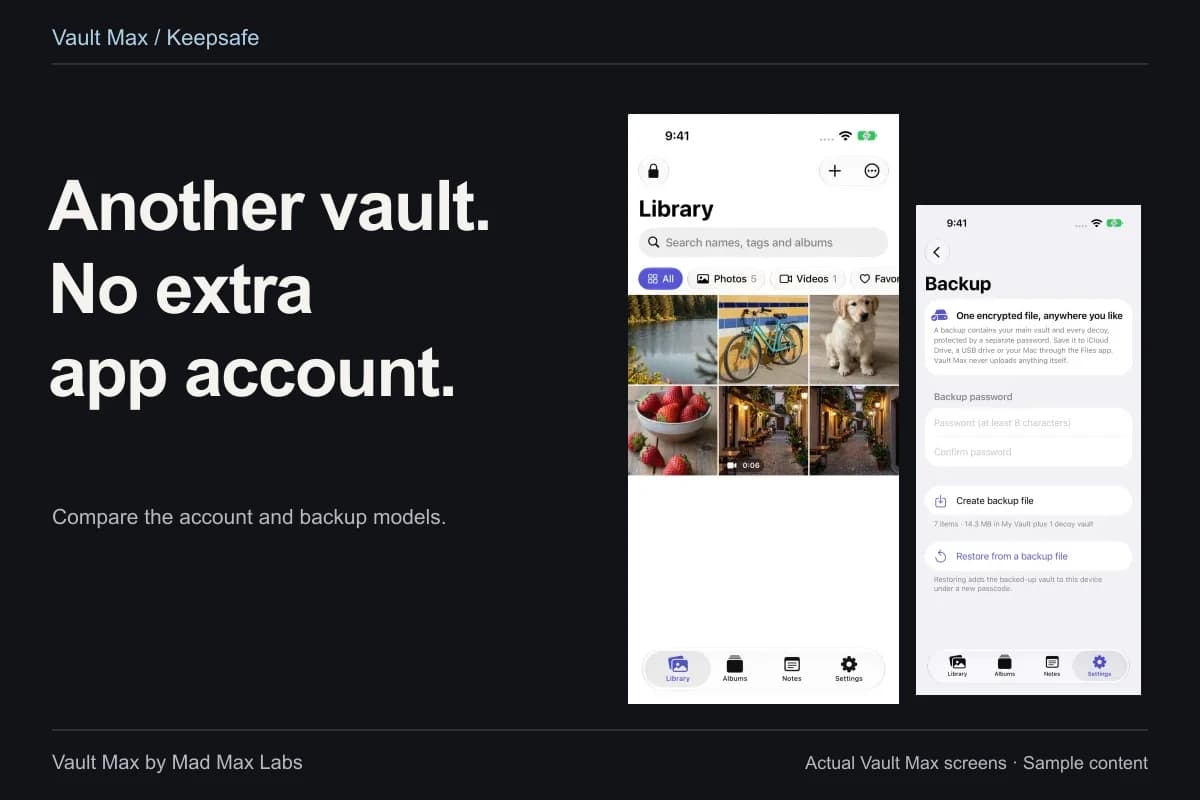
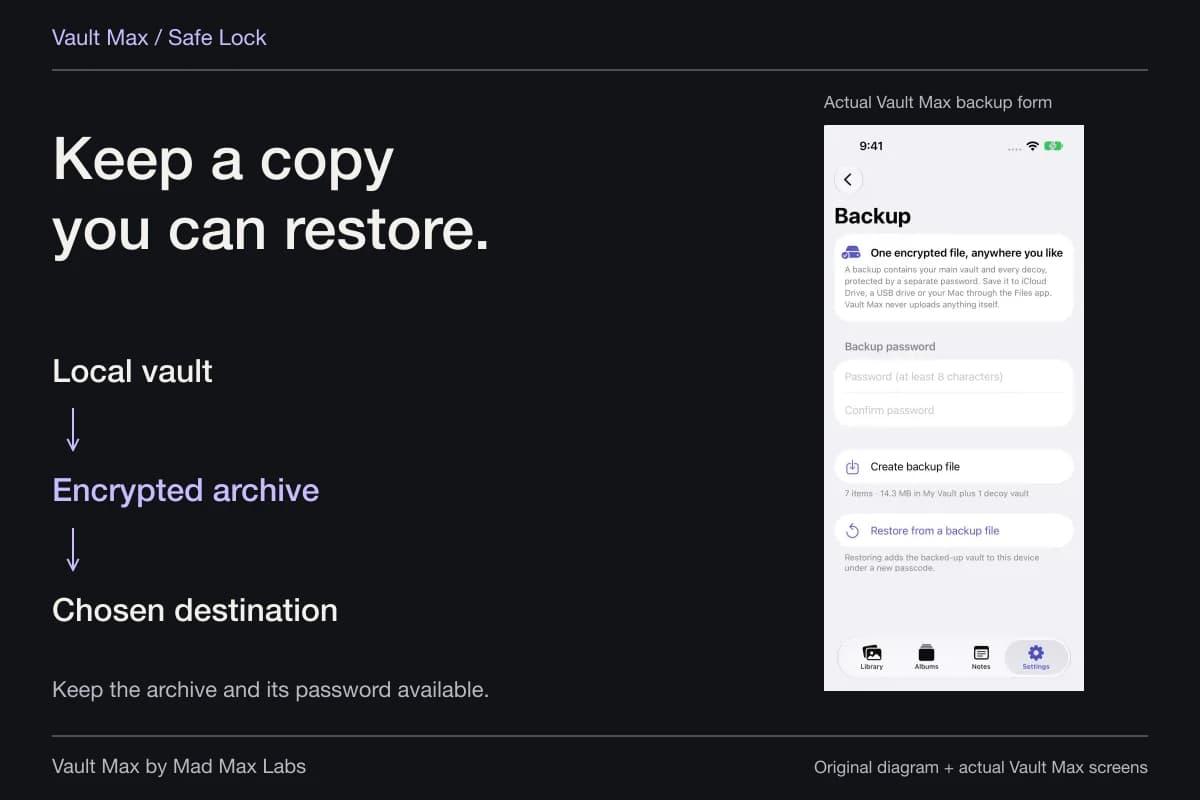
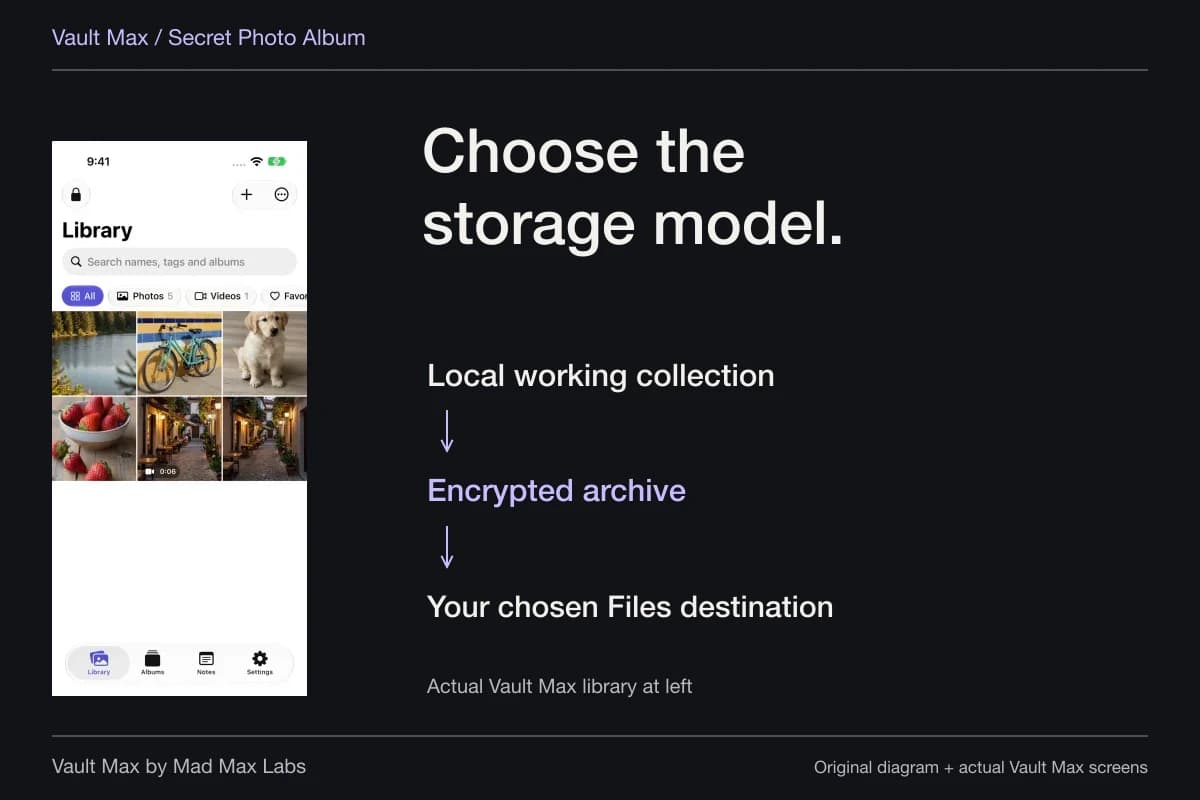
Vault Max's working collection is on the device. There is no Vault Max-hosted library waiting for you after a reinstall. A password-protected archive gives you an explicit recovery object, and you choose its destination through Files. You must create and preserve it.
Picture adding a set of important photographs to a private project. With Vault Max, you decide when to refresh its archive and where that encrypted copy belongs. Give the saved file a recognizable date and preserve the password separately. With a cloud-backed product, establish the upload state and service credentials instead. Neither copy arrangement becomes complete simply because the product name includes “vault.”
Separate an empty decoy from an ordinary collection
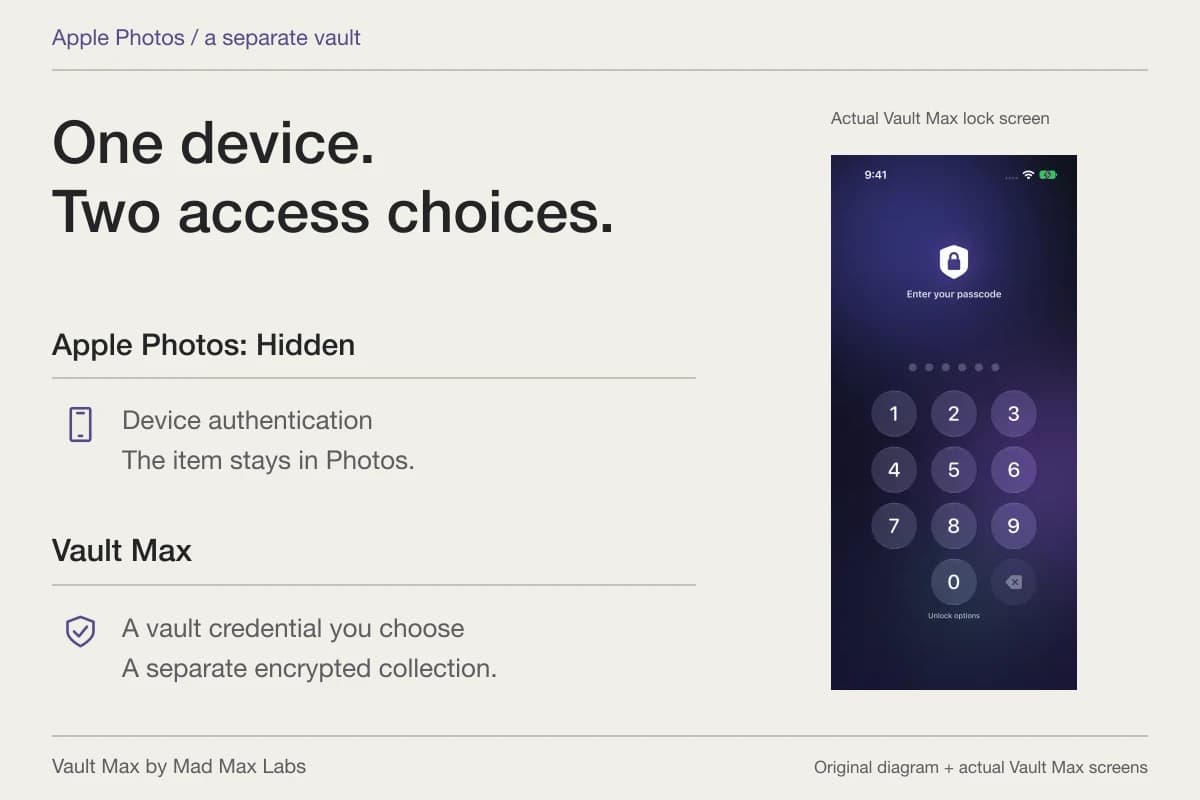
Vaulty's listing describes a Decoy PIN that opens an empty gallery. Its disguise options can make the app look like Notes or Passwords. Those are specific presentation choices and should not be silently treated as equivalent to every other decoy system.
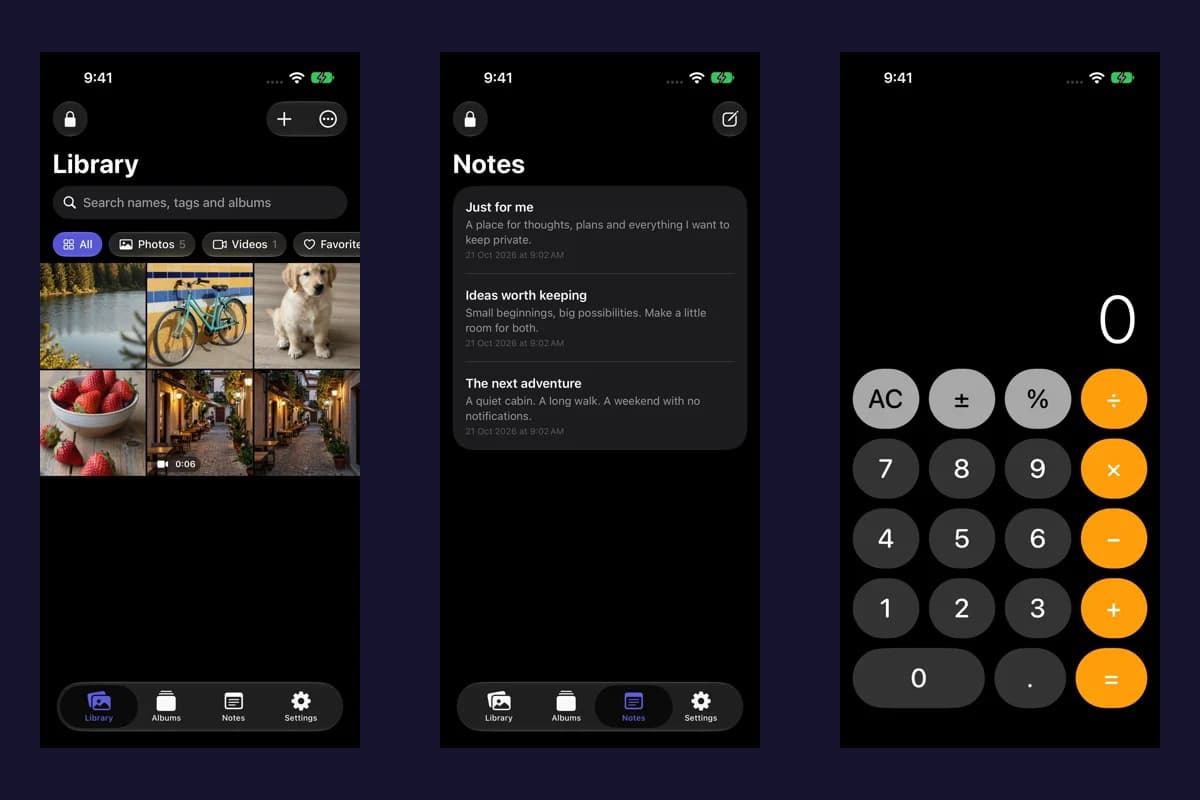
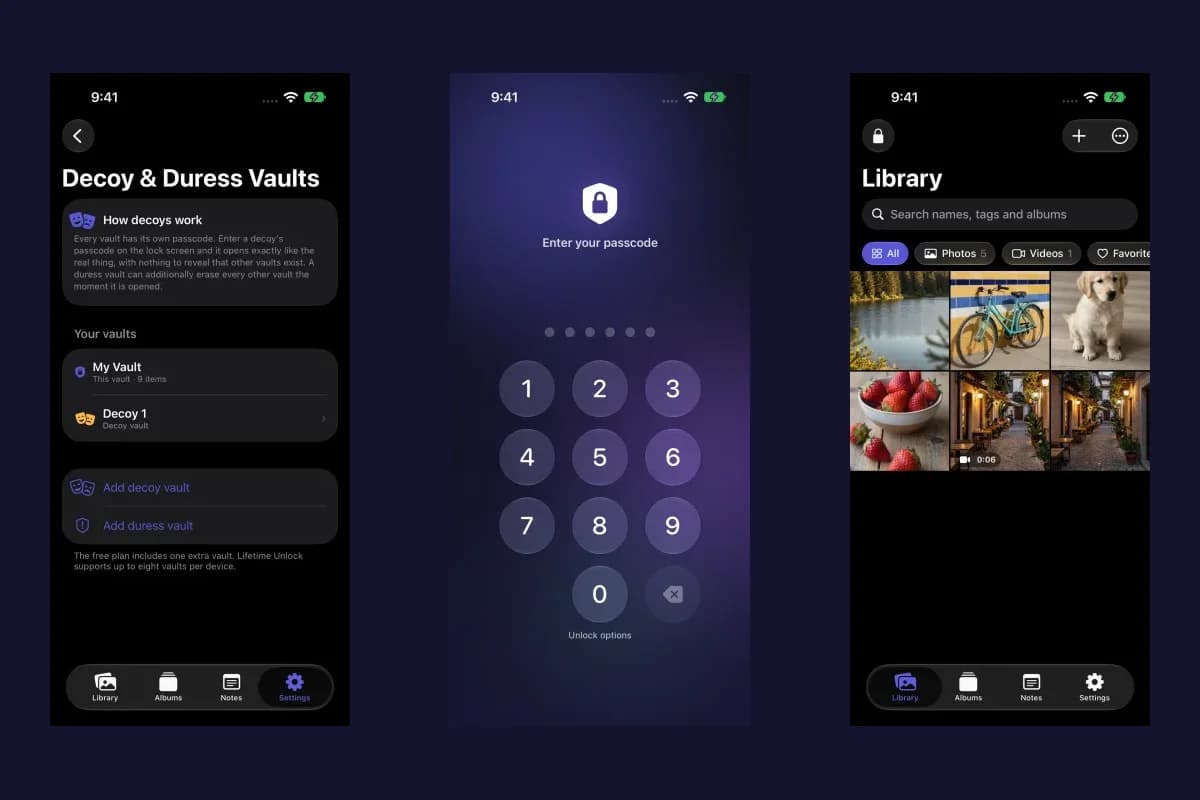
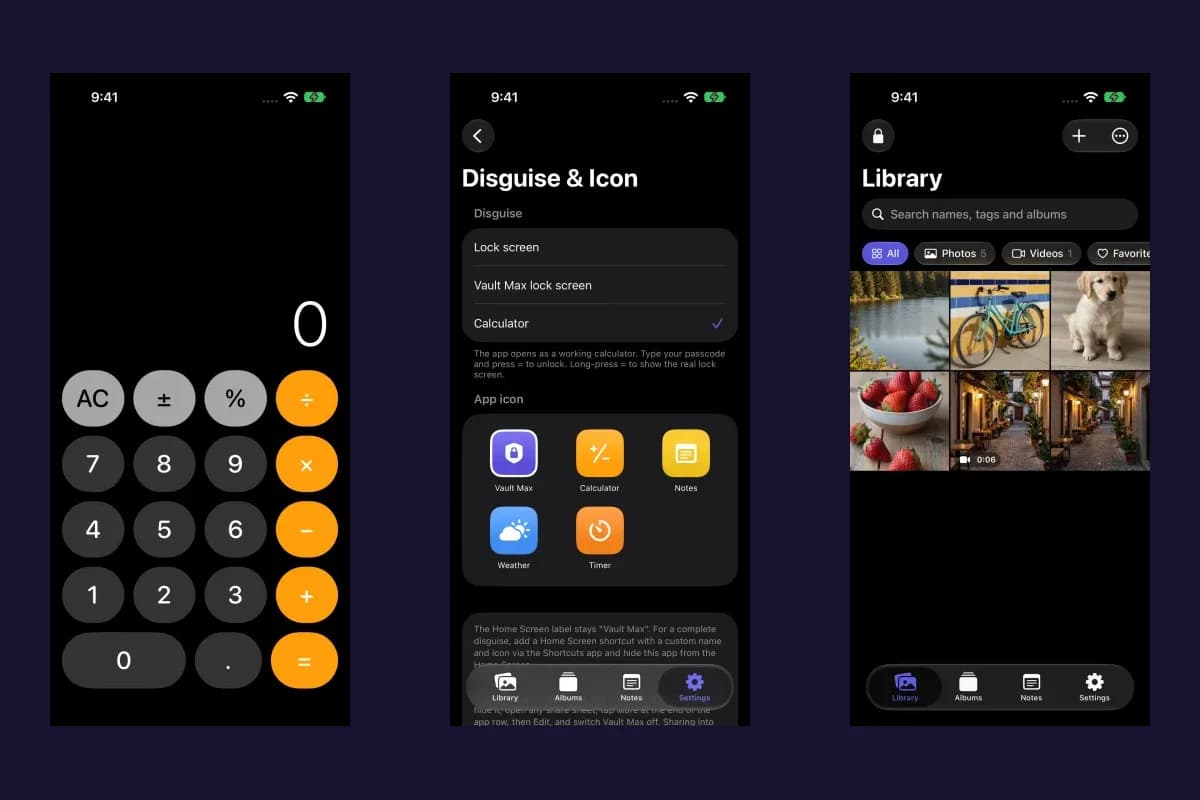
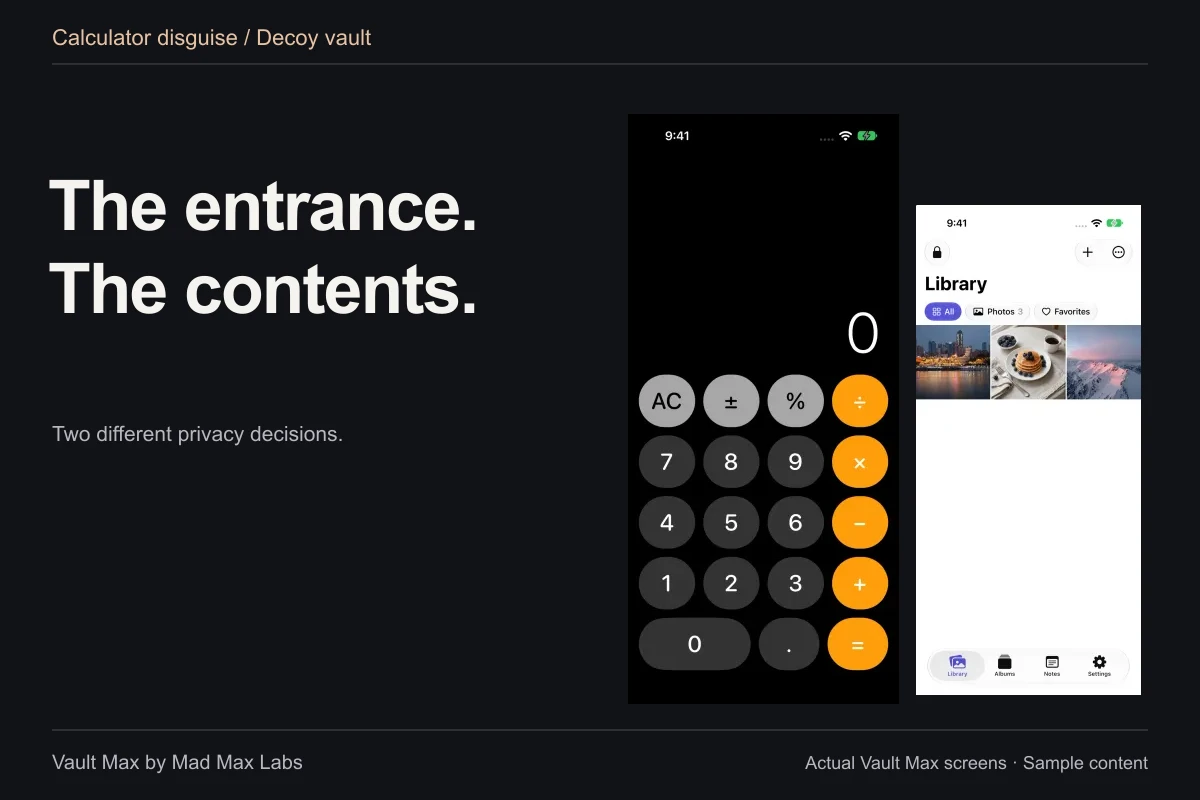
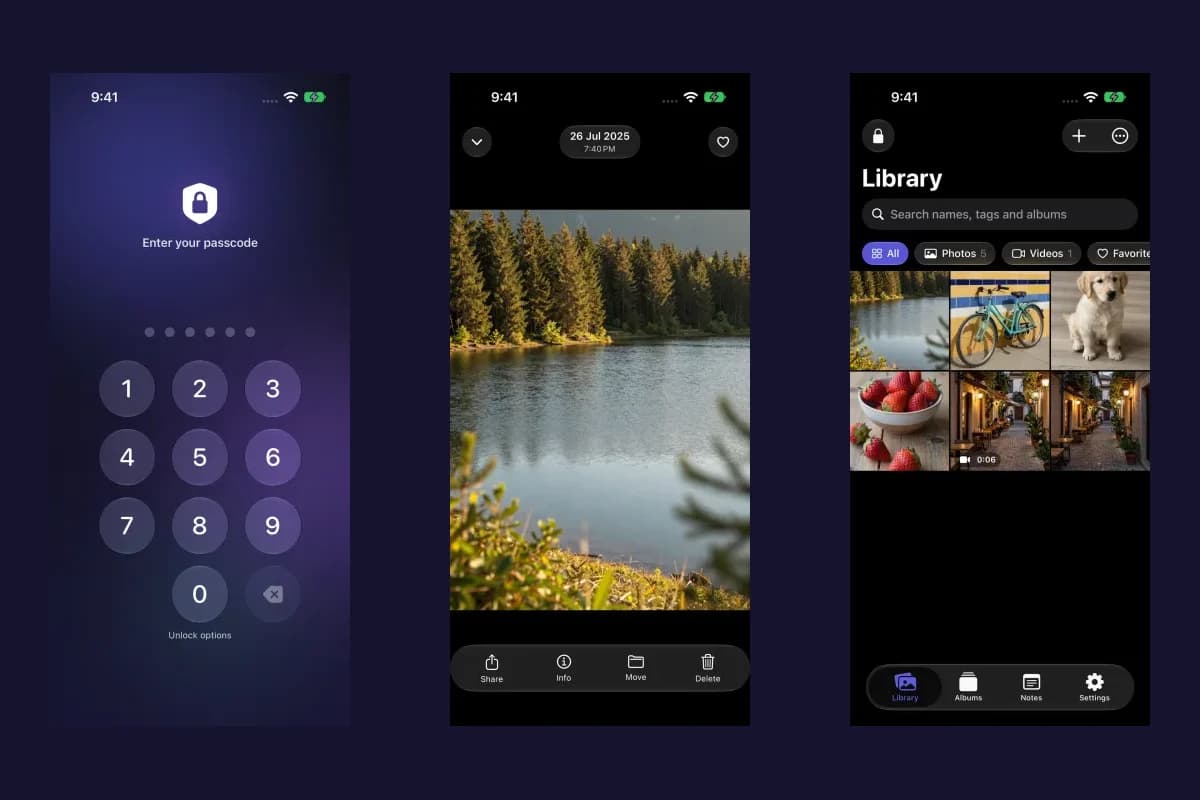
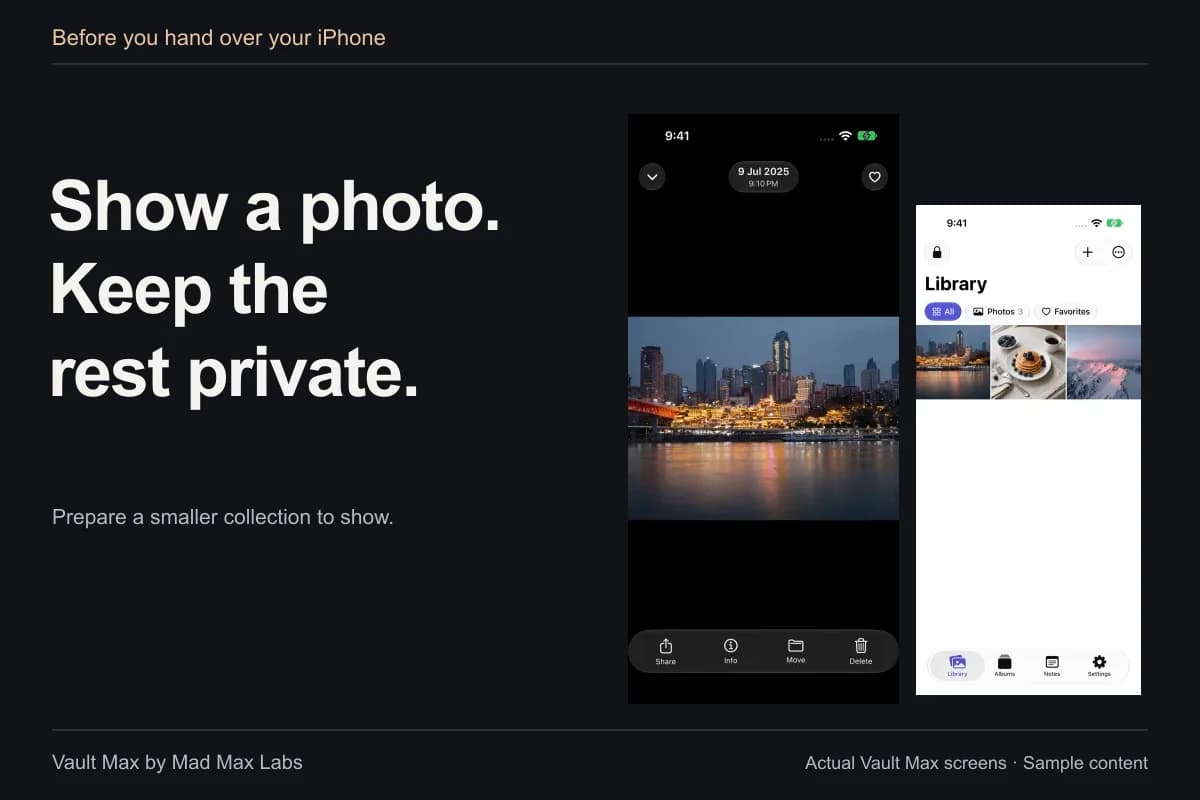
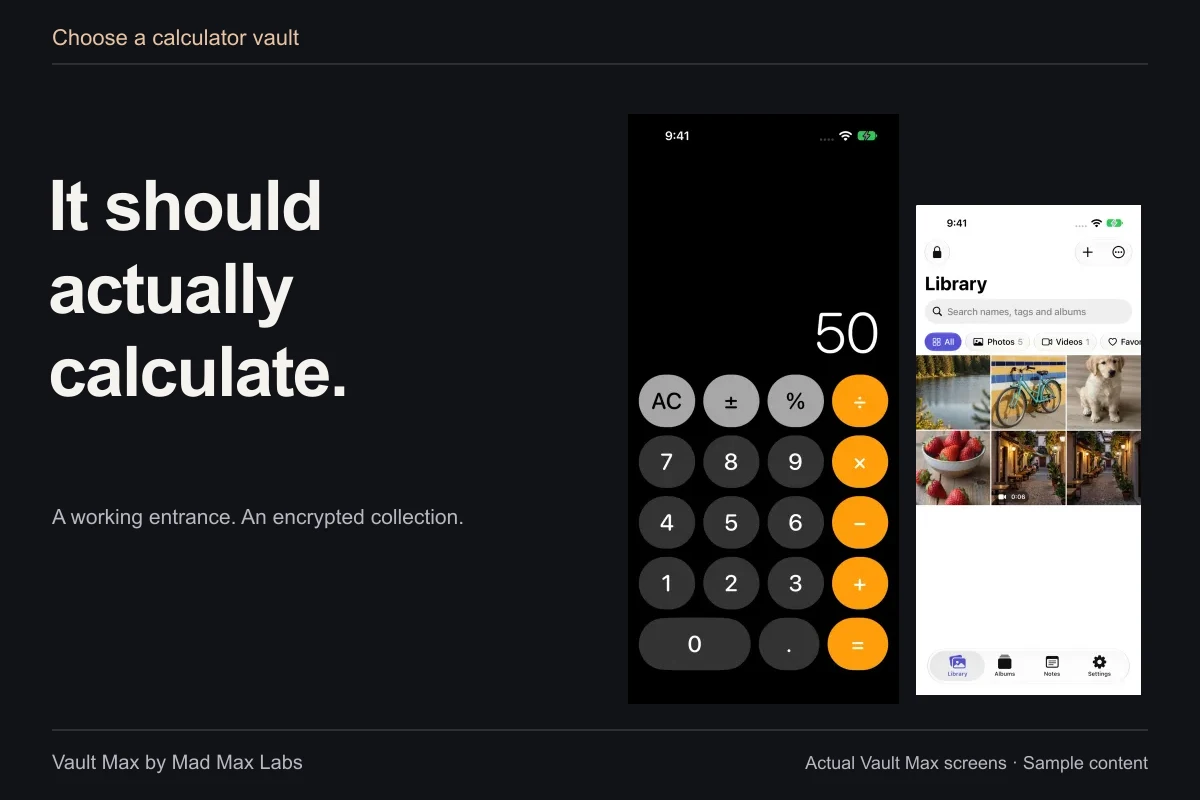
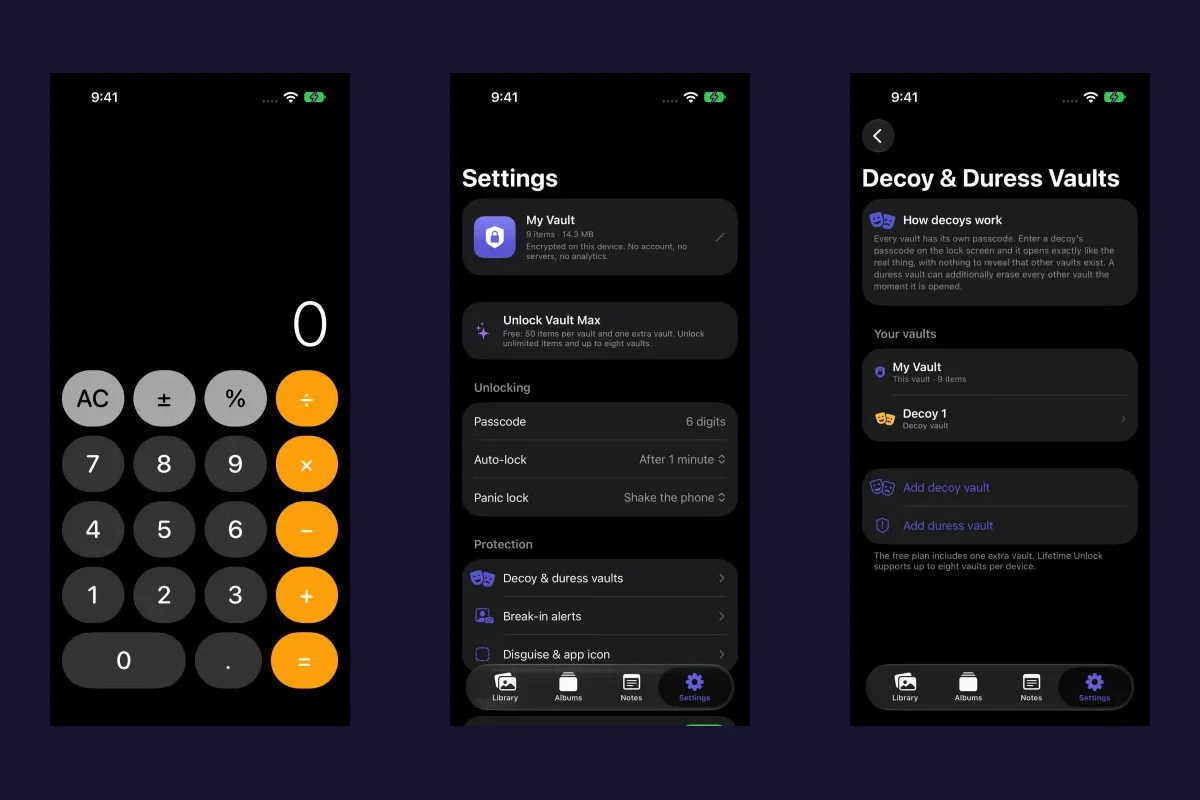
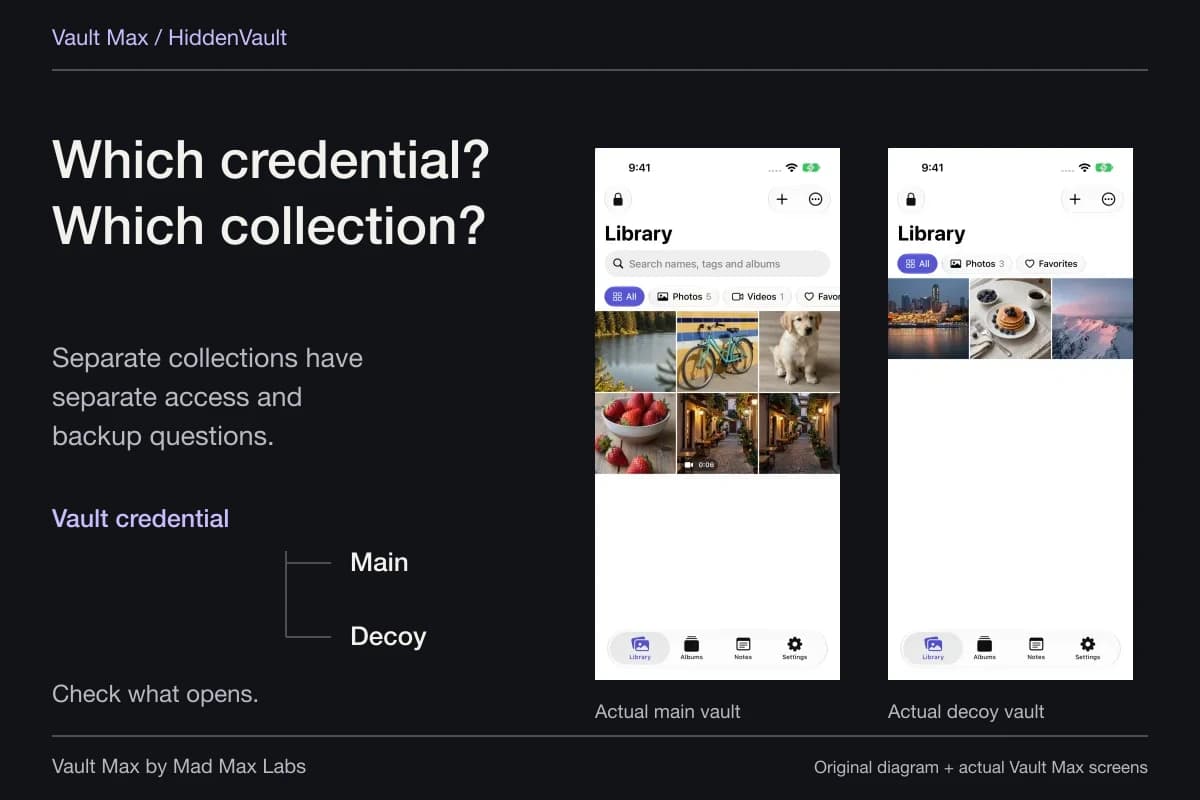
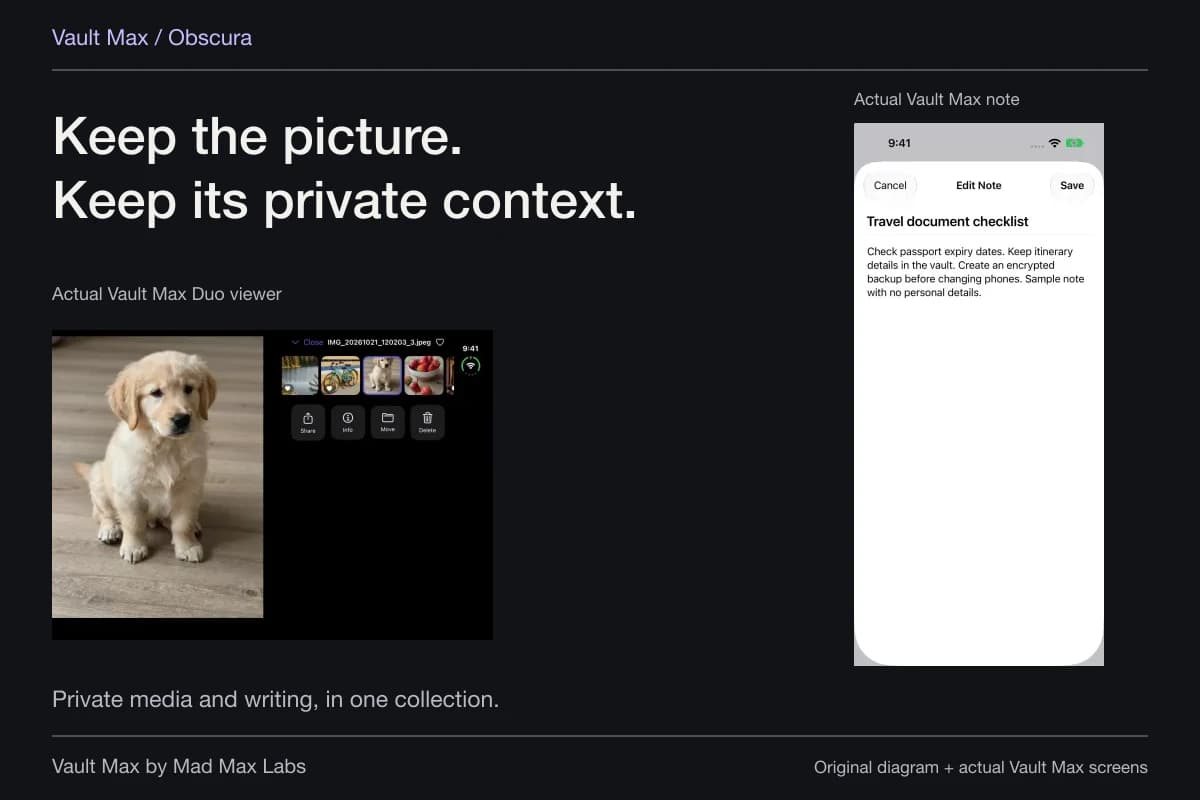
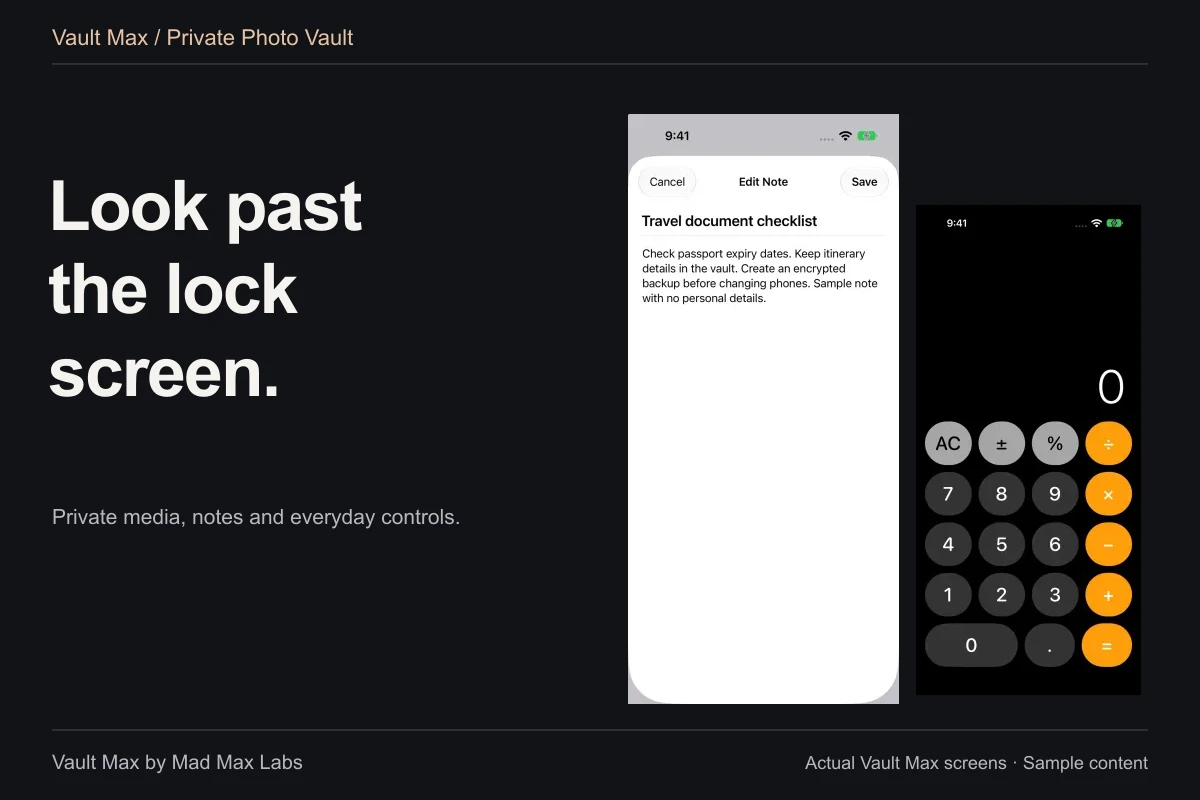
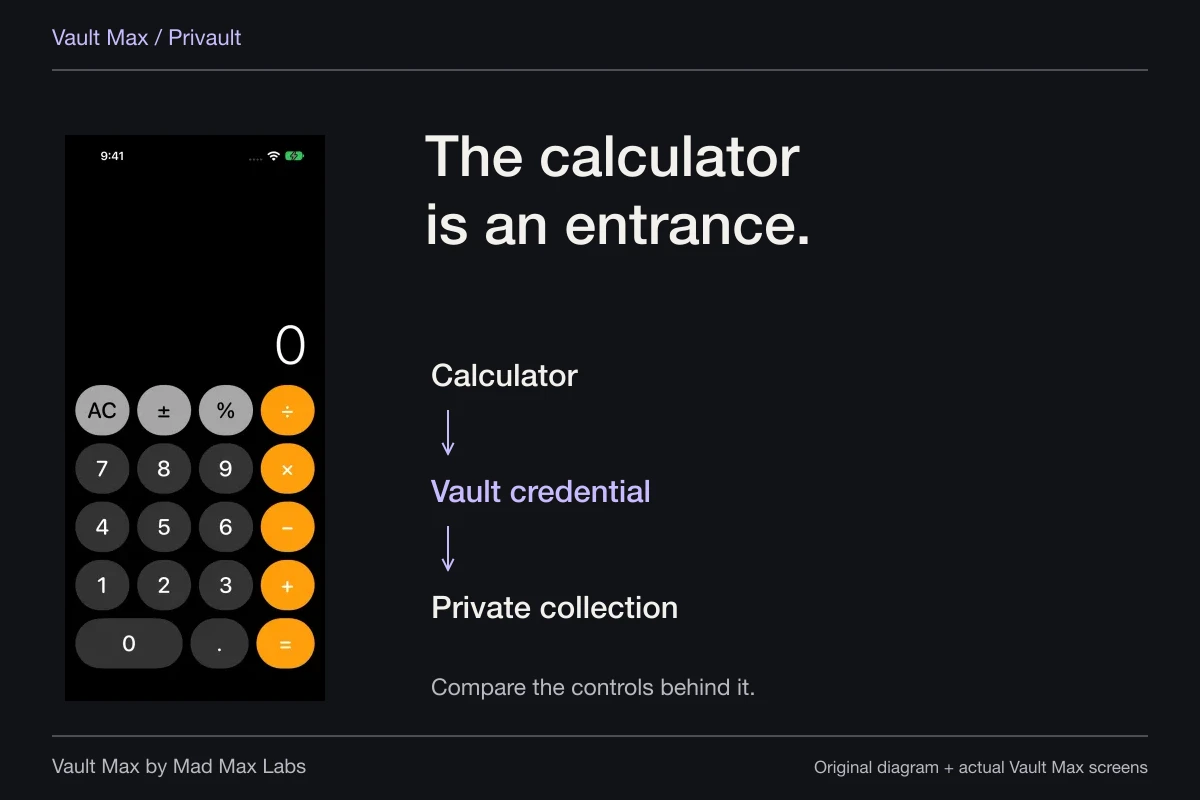
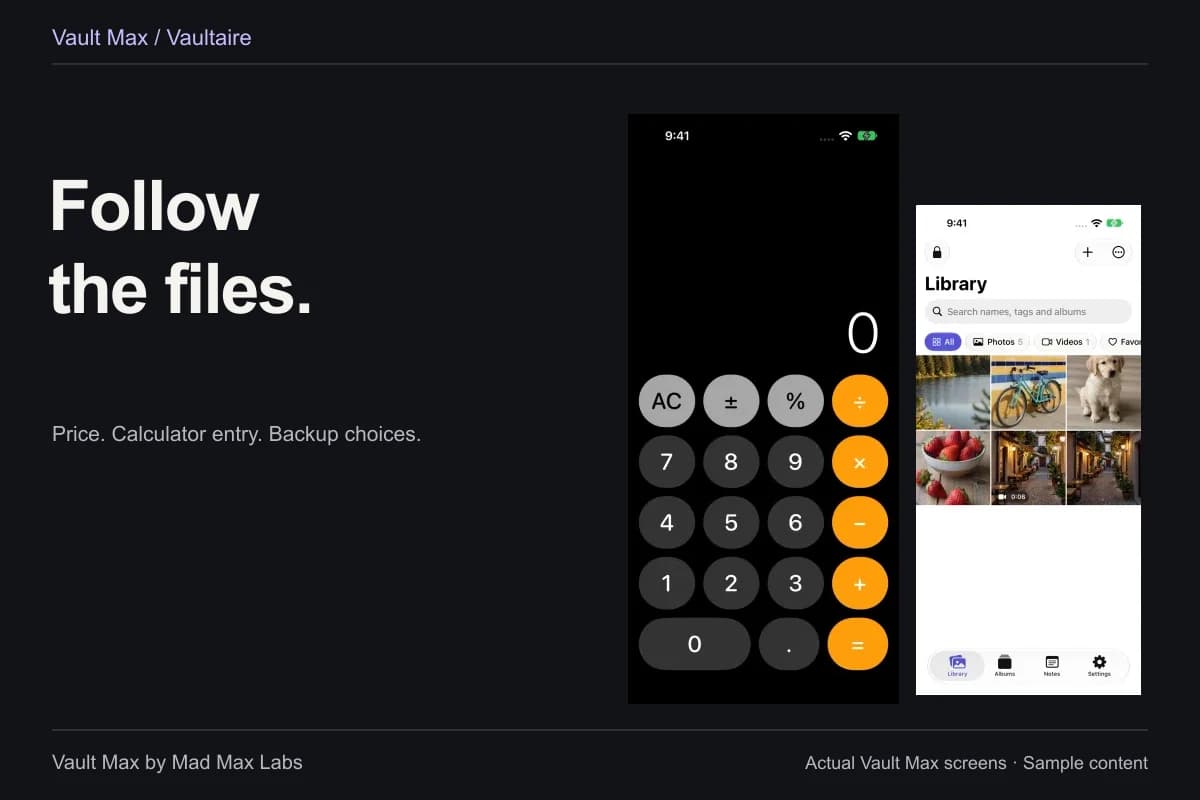
Vault Max's ordinary decoy can contain its own photos and files, reached through a separate credential. You can prepare a small everyday collection and practice opening that one. Its calculator is a working entrance, rather than a promise that the app cannot be discovered.
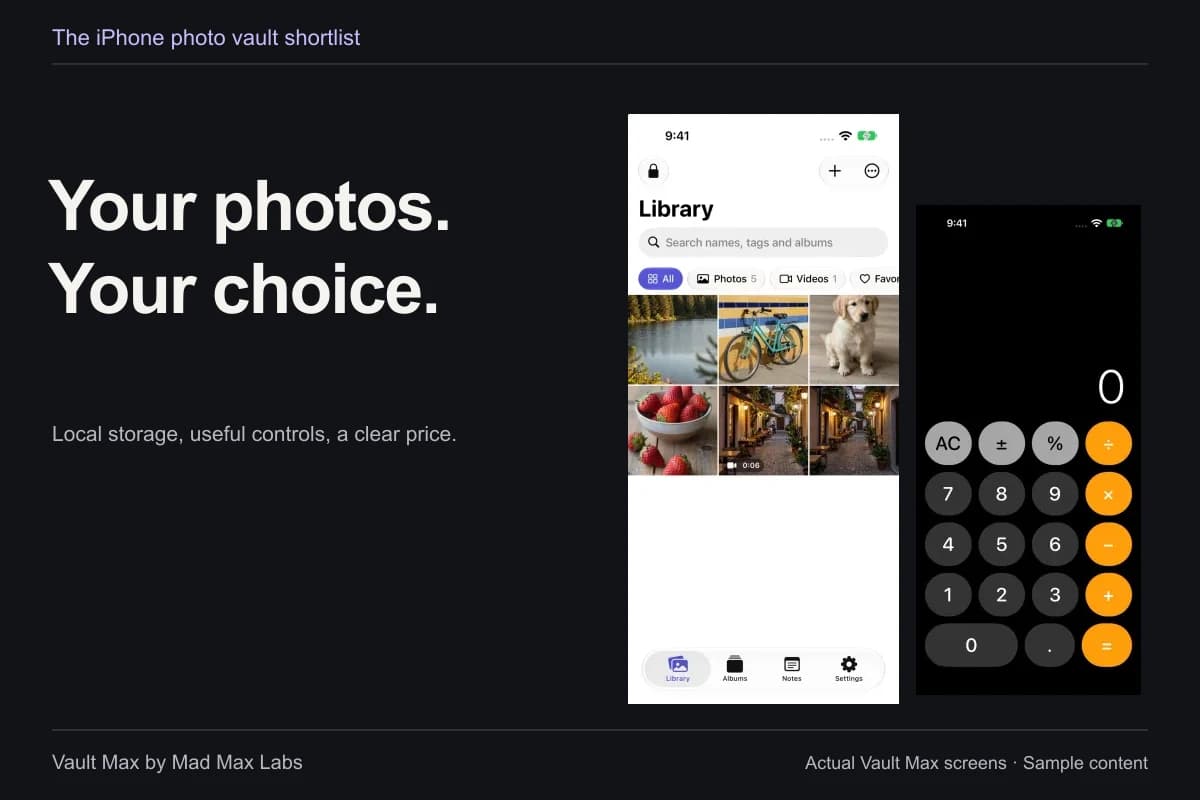
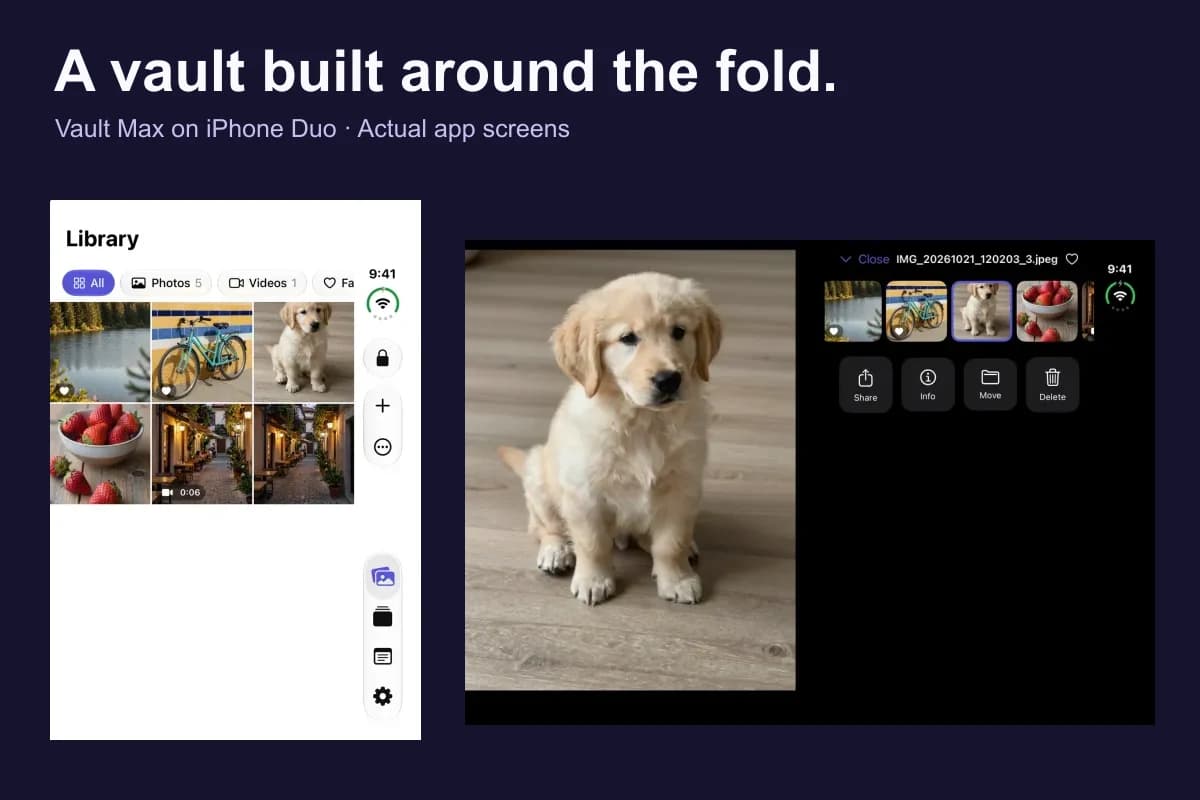
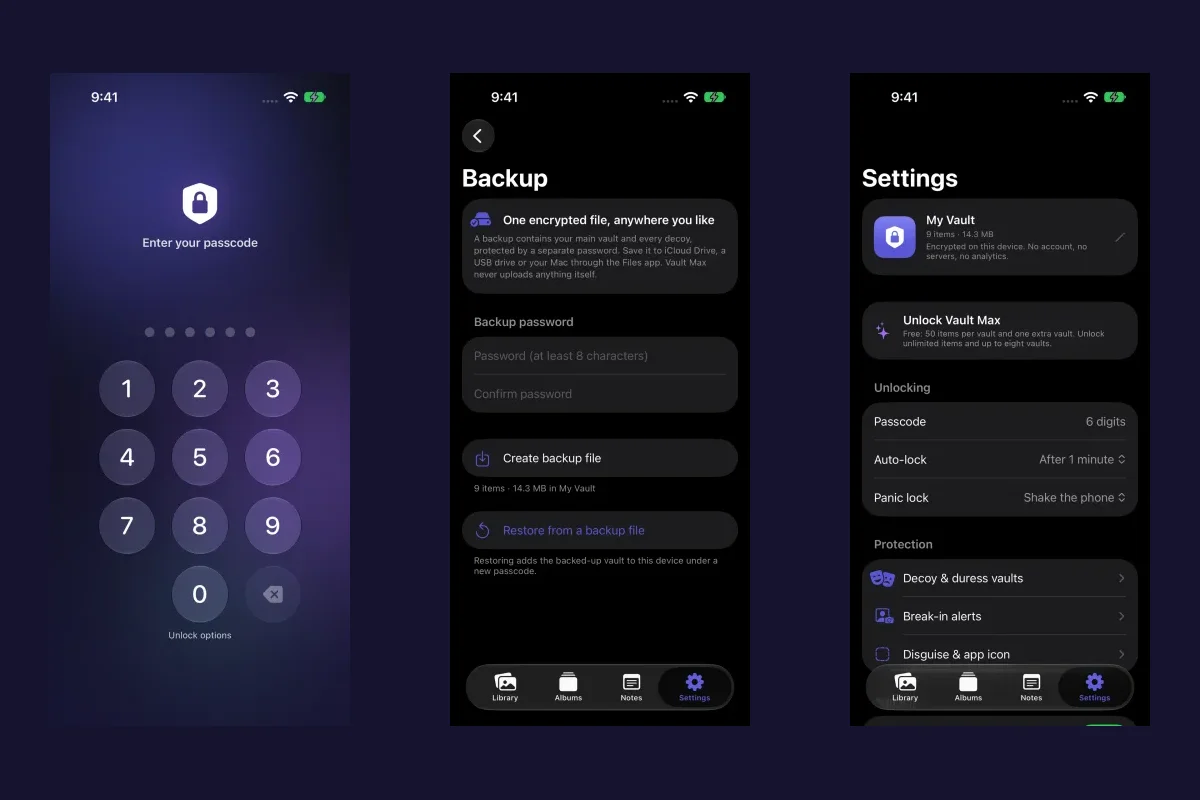
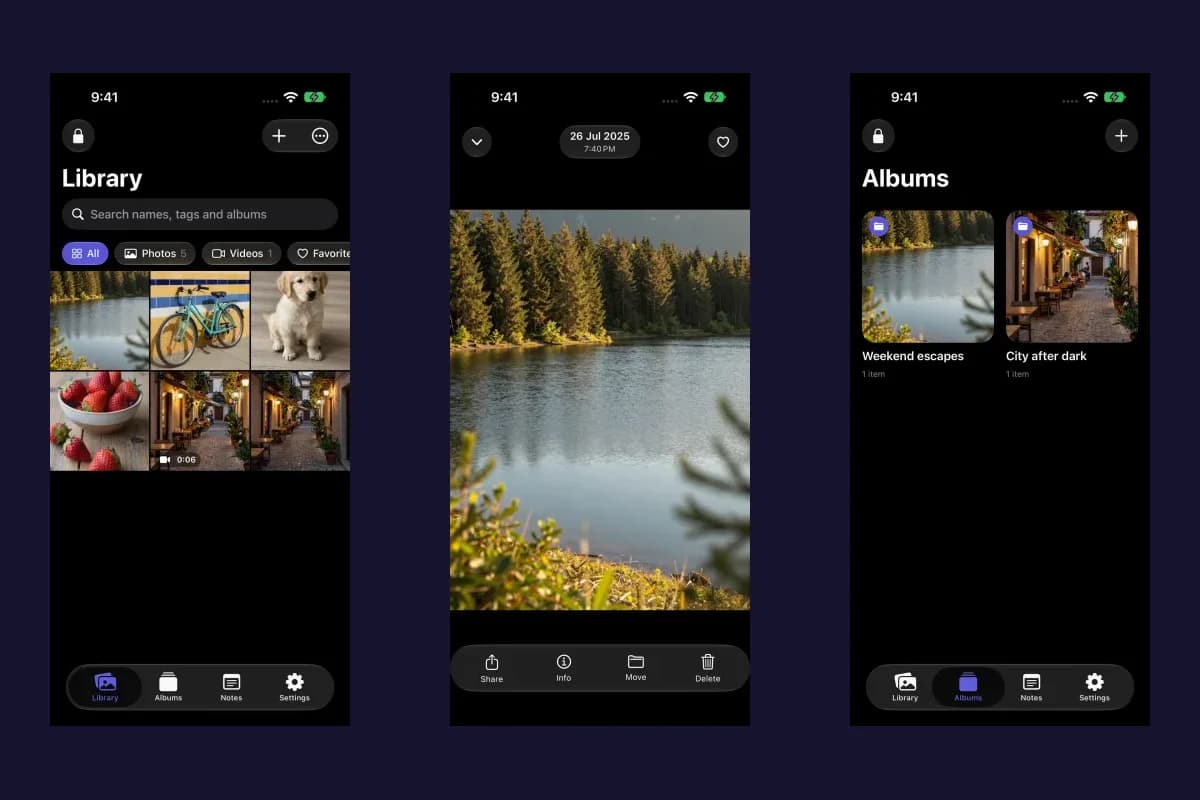
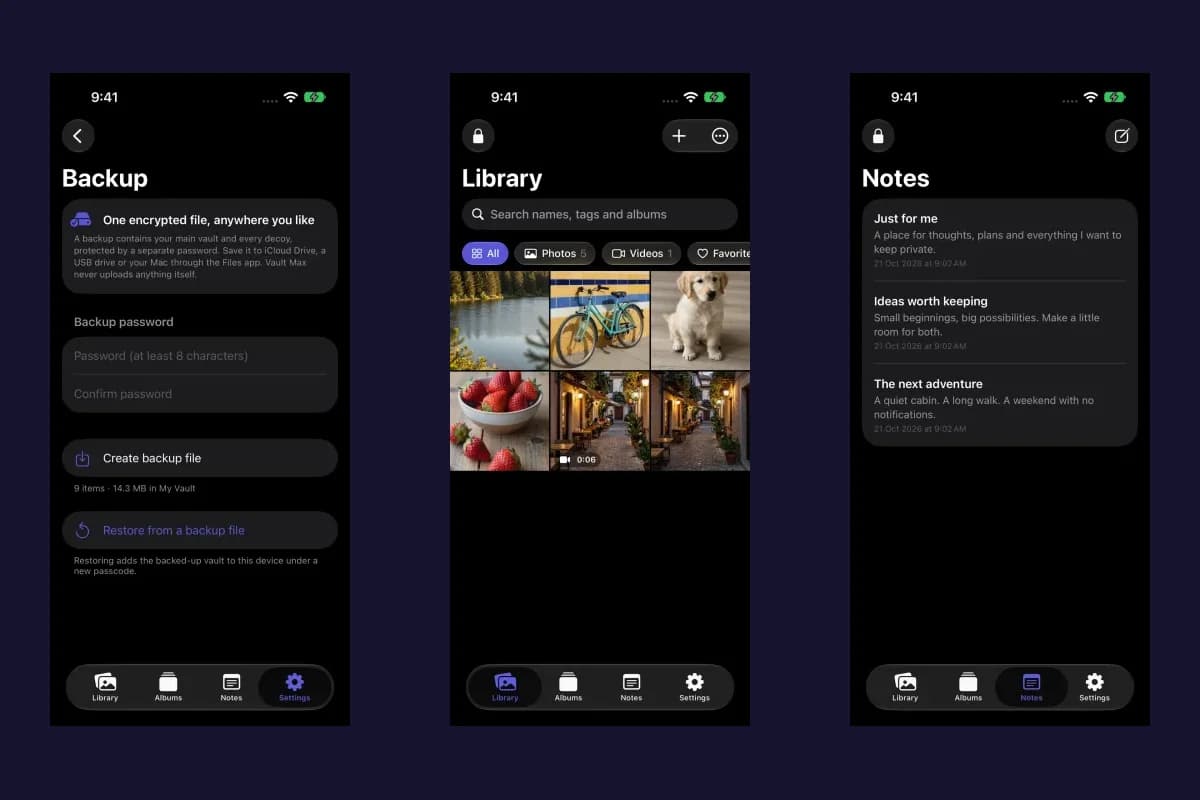
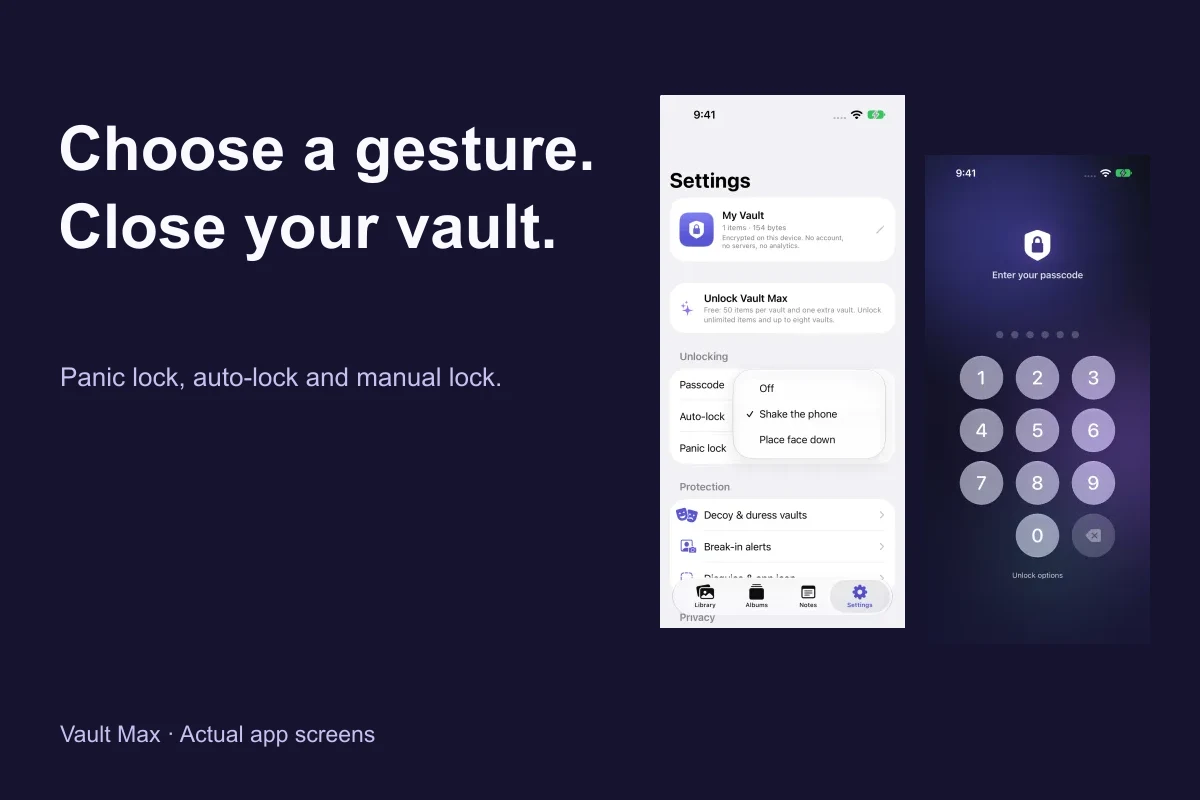
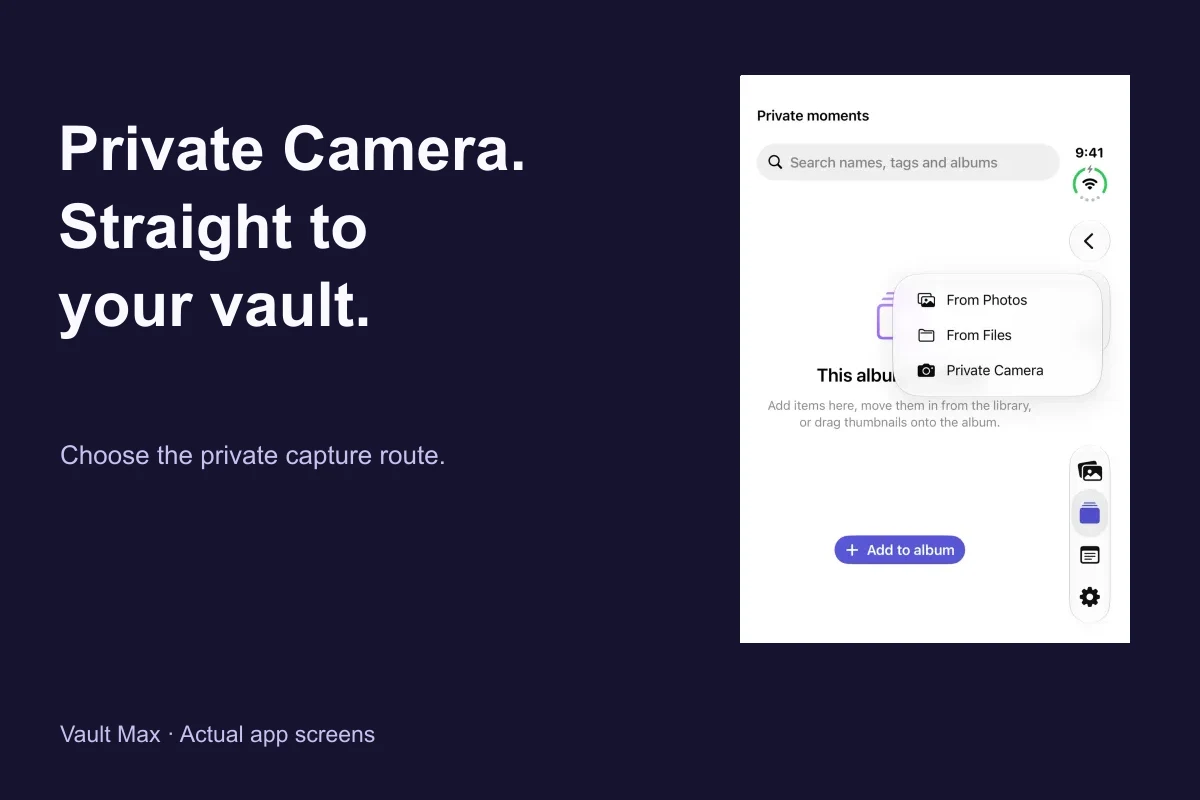
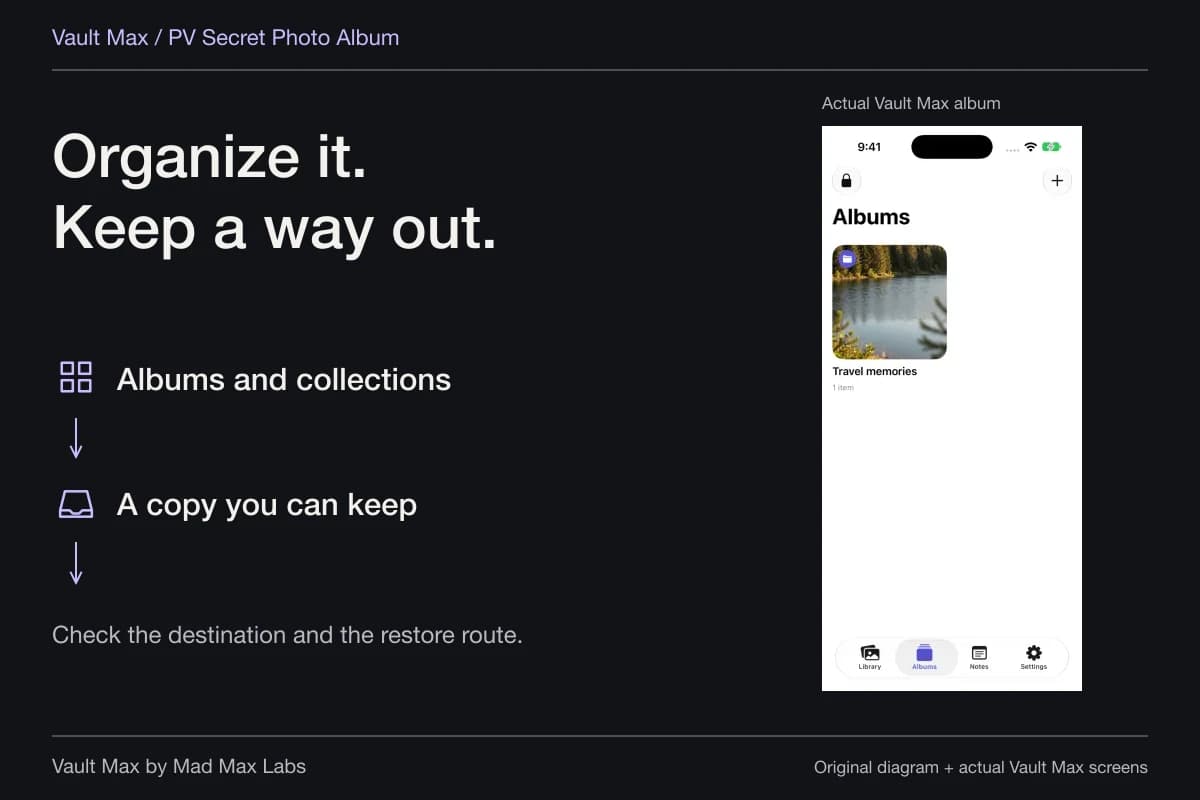
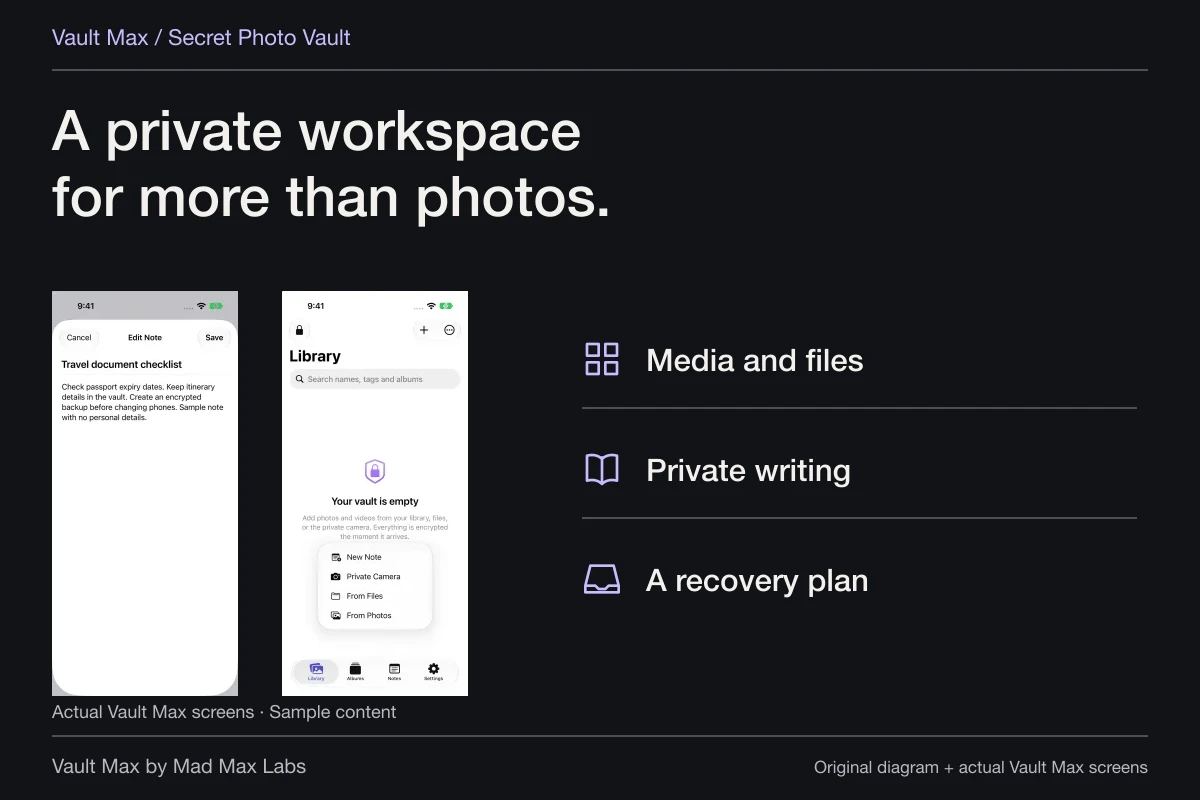
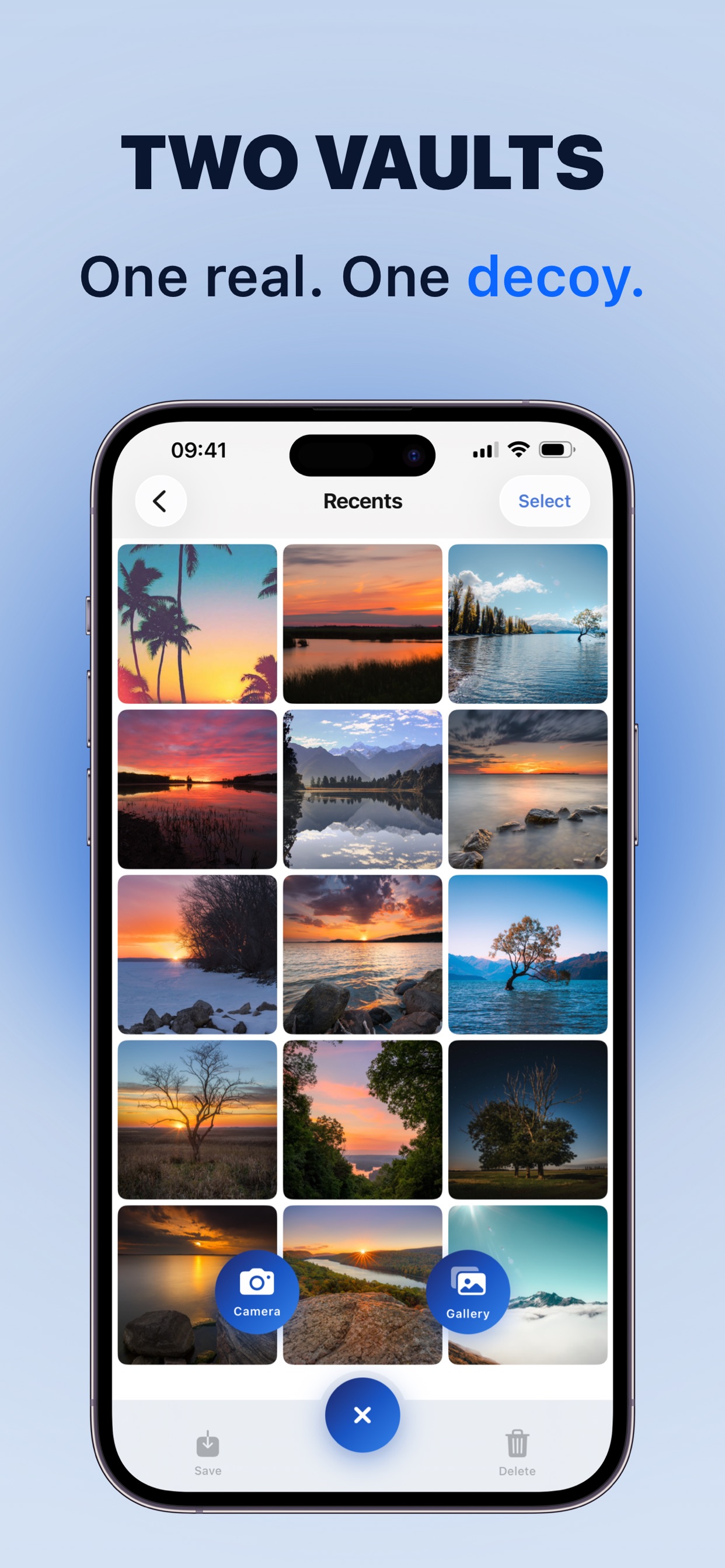
Sample Vault Max library. Select a screen for a closer look.
For a useful trial, write down the expected result for each code before entering it. Then test with disposable files. An ordinary alternate collection should not be confused with a destructive setting. Vault Max's optional duress vault can erase other local vaults, while exported archives and other outside copies may remain.
Label a sample test collection clearly while learning the behavior. Decide which credential opens it, which contents should appear and whether that collection belongs in your next recovery archive.
A service account and a vault credential have different jobs
Vaulty's Apple-linked privacy policy describes registration/authentication, cloud infrastructure, analytics and advertising services. Its developer declaration lists linked user content for functionality, alongside account, purchase and usage categories. Those are relevant data-handling disclosures, not evidence that private photographs are sold or that every optional feature is active for every user.
The inspected sources do not provide a full file-encryption and key-custody design. We cannot say from those pages that Vaulty's cloud content is unencrypted or readable to a particular employee. Ask whether the account password, an independent vault credential or another key protects the contents, and which recovery actions require each.
Vault Max has no app service account and no app analytics or telemetry. The vault credential opens its matching local collection. Apple handles purchases separately; a restored entitlement does not retrieve media. That arrangement removes the Vault Max account-management job, while making your own backup preparation essential.
Compare the current named offers carefully
The checked U.S. Vaulty listing includes several products at the same billing frequency. Their names do not establish that every user is eligible for the same offer or that different packages include identical services. Read the purchase sheet, including the renewal price, before accepting a trial.
| Billing choice | Vault Max published plan | Vaulty named entries |
|---|---|---|
| Weekly | $1.49/week | Weekly Premium $1.99; Weekly Membership $7.99; Weekly Plan entries $7.99 and $8.99 |
| Monthly | $3.99/month | Monthly Membership and Monthly Plan $14.99 |
| Quarterly | No quarterly plan | Quarterly Membership $34.99 |
| Annual | $14.99/year | Yearly Premium $29.99; Yearly Plan $39.99; Yearly Membership $99.99 |
| One-time capacity | $19.99 Lifetime Unlock | No matched lifetime entry established in the current checked U.S. list |
At those published Vault Max prices, our annual plan costs less than the named annual entries in that checked list. The packages are different: Vault Max does not include a hosted cloud gallery. Older international pages and older offers should not be mixed into a supposedly current U.S. price comparison.
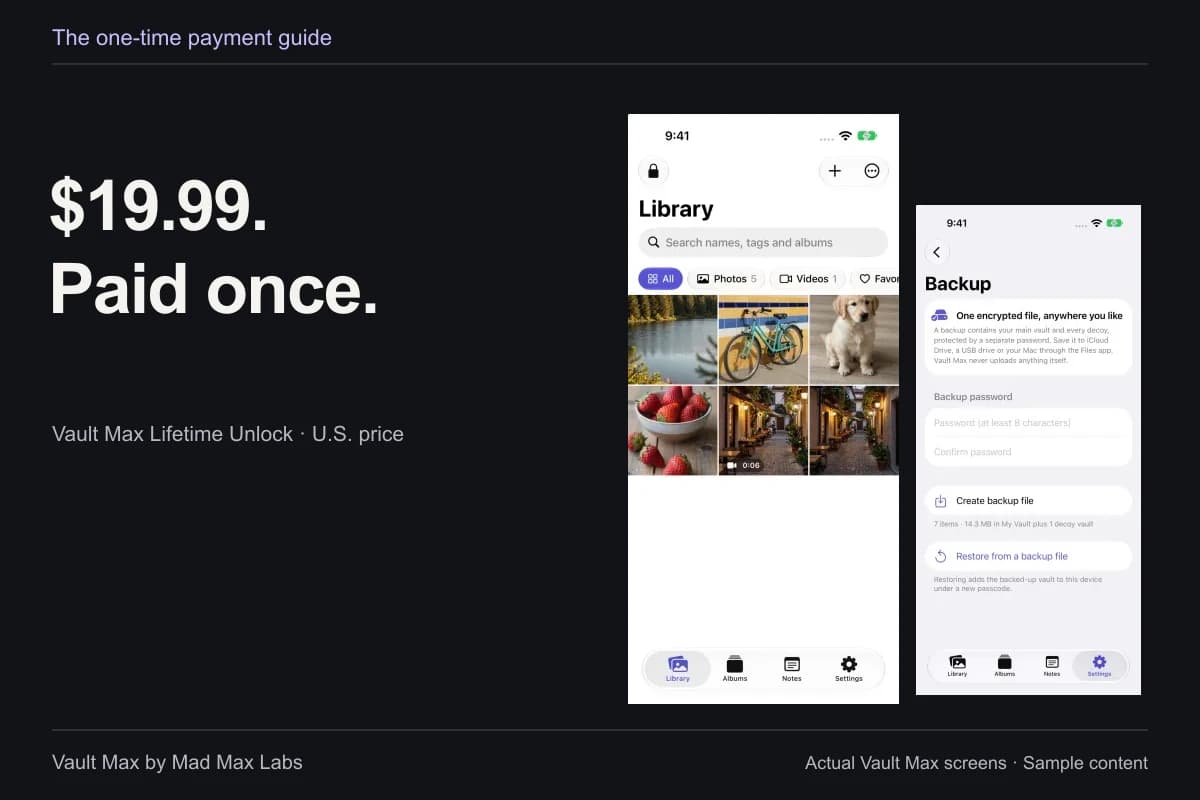
If you want to pay once for capacity, Vault Max's Lifetime Unlock is straightforward. It does not renew and enables unlimited counted items with eight total vaults per device. Physical storage remains finite. A one-time purchase also does not promise perpetual operating-system compatibility or eliminate the need to update your archive.
Ask what survives a deletion or a phone replacement
A cloud-backed gallery can reduce the burden of keeping another copy, but you still need to know what was actually uploaded, what account opens it and how deletion propagates. Do not test app deletion using the only remaining copy of an important photograph.
If account recovery is the attraction, examine it as a separate task. Check how you would regain the service login without the old device, whether another factor is needed and what the product says happens to media when an account or subscription changes. This guide has not performed those Vaulty operations, and a cloud label alone cannot supply the answers. Resolve them while the working installation and ordinary originals are still available.
For an initial trial, upload or import something harmless and check the completion state the product provides. Read the current recovery instructions before signing out, replacing a device or removing a service account. Account access, subscription status and a complete media collection are three distinct outcomes.
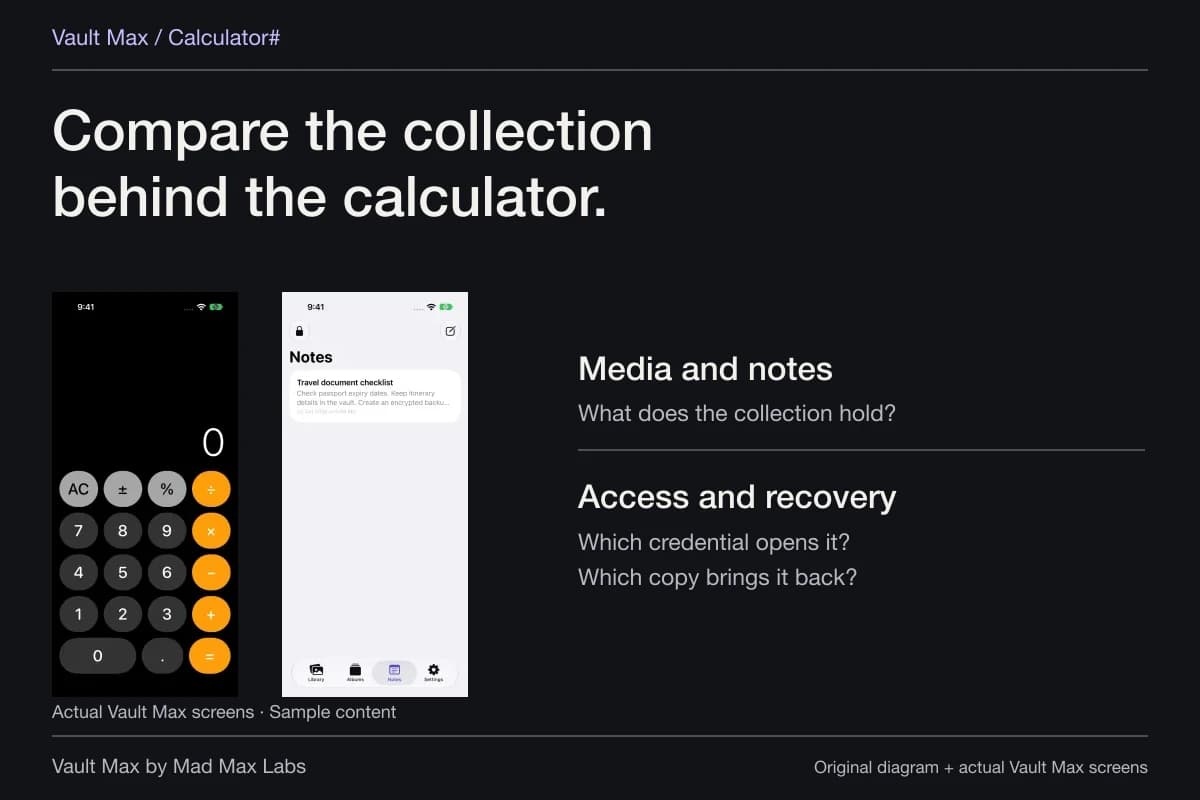
Vault Max's archive is a snapshot of the selected vault and included children. Keep the file accessible without the phone, with its separate password independently available. Inspect the archive's intended scope and make a newer copy after additions. If you can still open a vault after forgetting its typed credential, preserve that access and make a backup before changing anything.
Sample Vault Max library. Select a screen for a closer look.
The recovery checklist explains the distinctions without recommending that you erase the working copy to see what happens. A restore practice should use isolated sample material and leave valuable originals intact.
Check a practical route before moving your collection
Start with a small picture and video you do not need to keep private. Open the imported result, lock and reopen, then retrieve a usable copy through the expected export route. If several devices are the attraction, test that specific advertised setup with those samples before making it part of a real recovery plan.
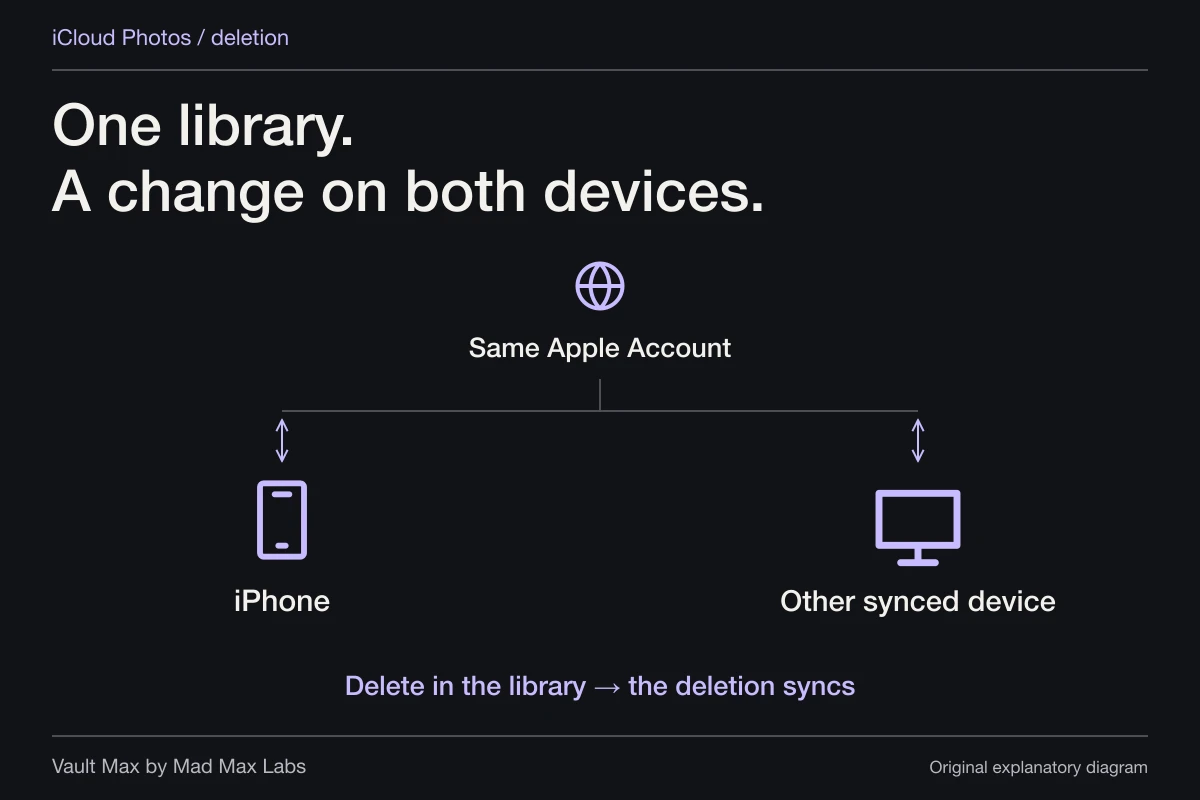
Also account for the originals. Importing into Vault Max creates a vault copy; it does not erase pictures retained in Photos, a shared album or a message thread. Deleting an original from a synced library can affect other devices, so learn the import workflow first.
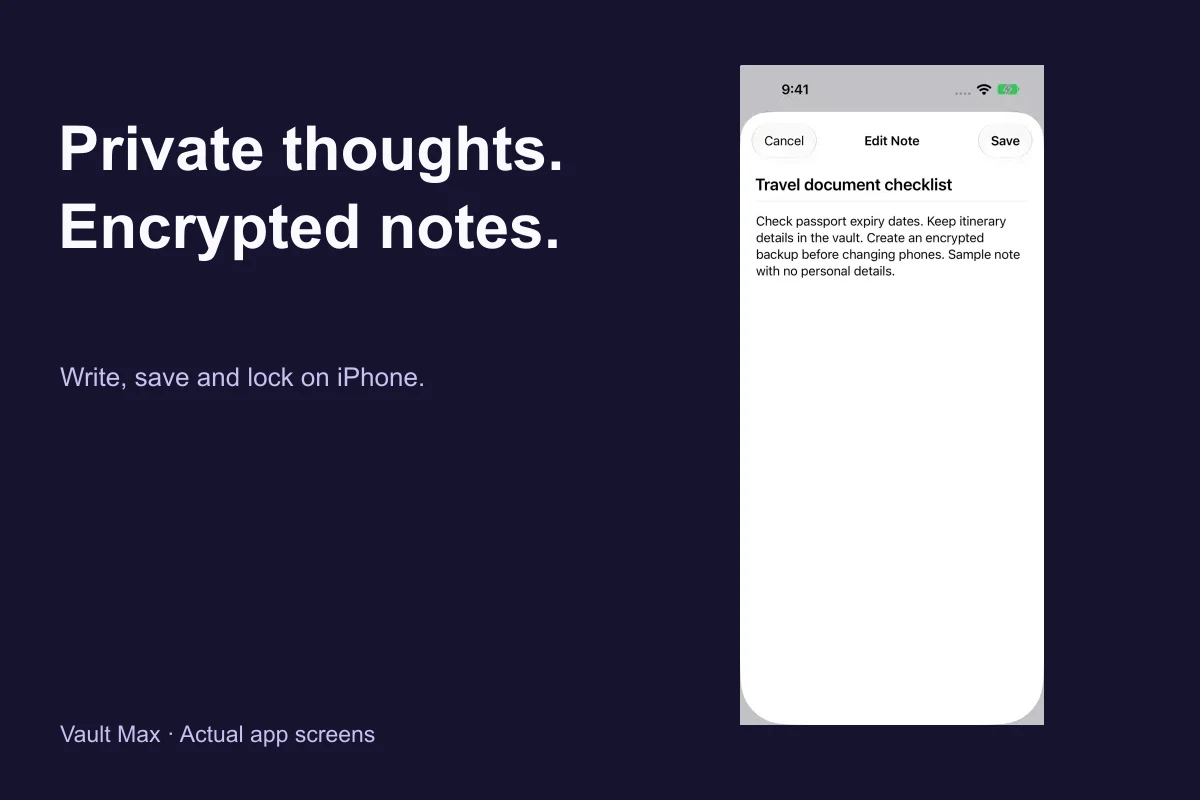
We choose Vault Max for a private local workspace, populated alternate collections, encrypted notes, a working calculator, no app telemetry and a modest one-time price. You can try that combination free before choosing capacity. Finish by explaining where the copies are and how you would open them without the current phone; those practical answers belong beside the price in a useful comparison.
Common questions
Which Vaulty app is compared here?
Vaulty: Hidden Photos Vault by MAPPVATE YAZILIM LIMITED SIRKETI, App Store ID 1616386868. A newer app called Lock Photos - Vaulty by another developer is a different product.
Does this comparison prove Vaulty's cloud is unencrypted?
No. Its publisher describes a cloud-backed collection, but the inspected sources do not provide a complete file-encryption and key-custody specification. Missing detail is not proof that encryption is absent.
How do the decoys differ?
Vaulty's listing describes a Decoy PIN that opens an empty gallery. Vault Max can open a separately populated ordinary decoy collection using its own credential. Verify the current behavior that fits your purpose.
Continue reading
More guides
Practical tips for your private library. Swipe or scroll to choose your next guide.
50 guides to explore